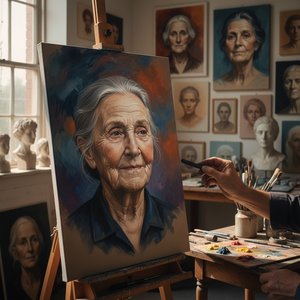
Andrew Festing: A Portraitist of Royal Dignity and Quiet Mastery
Born in 1941 amidst the echoes of a distinguished military lineage – his father, Field Marshal Sir Francis Festing, a figure steeped in wartime heroism and later service to the Crown – Andrew Thomas Festing’s artistic journey began not with formal training but with an innate appreciation for observation and a deep-seated connection to British heritage. Raised in Northumberland, a landscape of rolling hills and ancient woodlands, it's no surprise that his early influences were rooted in the natural world and the traditions of his family history. This formative environment instilled within him a meticulous eye for detail, a respect for craftsmanship, and an understanding of the subtle nuances of character – qualities that would ultimately define his remarkable career as a portrait painter.
Festing’s early life was punctuated by service in the Rifle Brigade, a Royal Green Jacket regiment. This military background provided him with discipline, strategic thinking, and a profound appreciation for order and precision—skills he later translated into his artistic practice. He spent time at Sotheby's, initially as an auction representative, honing his knowledge of art history and developing a keen understanding of the market’s discerning tastes. It was during this period that he began to seriously pursue painting, recognizing a compelling parallel between the careful observation required in military reconnaissance and the nuanced portrayal demanded by portraiture. His decision to transition from the regiment to full-time painting marked a pivotal moment, signaling his commitment to capturing the essence of individuals through brushstroke and light.
The Royal Society of Portrait Painters and Early Commissions
Festing’s formal entry into the world of portraiture occurred in 1989 when he was elected as a member of the prestigious Royal Society of Portrait Painters (RP). This affiliation provided him with access to a network of fellow artists, invaluable mentorship opportunities, and a platform for showcasing his work. The RP's emphasis on traditional techniques and rigorous standards aligned perfectly with Festing’s own artistic philosophy—a commitment to mastering the fundamentals and prioritizing accuracy and emotional resonance over fleeting trends. His early commissions began to establish him as a sought-after portraitist, attracting attention from prominent figures within British society.
Among his earliest notable works were portraits of Lord Carrington, a key figure in Margaret Thatcher’s government, and Queen Elizabeth II. These commissions demonstrated Festing's ability to capture the gravitas and dignity associated with these positions, while simultaneously revealing glimpses of their individual personalities. He quickly gained recognition for his ability to imbue his subjects with a sense of presence and immediacy—a testament to his meticulous observation skills and his understanding of human psychology. The National Portrait Gallery acquired one of these early portraits, cementing his place within the canon of British portraiture.
Technique and Style: A Blend of Precision and Sensitivity
Festing’s artistic style is characterized by a remarkable blend of technical precision and emotional sensitivity. He employs traditional oil painting techniques—layered glazes, subtle gradations of tone, and careful attention to detail—to create images that are both visually arresting and deeply evocative. His portraits rarely rely on dramatic lighting or exaggerated gestures; instead, he favors a more restrained approach, allowing the subject’s character and bearing to emerge organically from the interplay of light and shadow.
A key element of his technique is his ability to capture the texture of skin, clothing, and other materials with astonishing accuracy. He meticulously studies his subjects—observing their posture, expressions, and subtle details—to create portraits that are not merely likenesses but windows into their inner lives. His work reflects a deep respect for his subjects, conveying both admiration and empathy. The meticulousness of his brushwork is often described as almost forensic, revealing an extraordinary level of detail and control.
Royal Patronage and Legacy
Over the course of his career, Festing has been commissioned to paint numerous members of the British royal family, including Queen Elizabeth II on multiple occasions. These portraits have become iconic representations of the monarchy, capturing the dignity and solemnity associated with the institution. Beyond his work for the Royal Family, he has also created portraits of prominent figures in politics, business, and culture—including Lord Wolfson, a renowned art collector and philanthropist, and members of the Marylebone Cricket Club at Lord’s.
Festing's legacy extends beyond his individual works; he is considered a significant figure in contemporary British portraiture. His commitment to traditional techniques, combined with his exceptional skill and sensitivity, has established him as one of the most respected portraitists working today. His paintings are held in prestigious collections around the world—including the Royal Collection, the National Portrait Gallery, and the National Gallery of Ireland—testifying to the enduring value of his art. Andrew Festing’s work stands as a testament to the power of observation, discipline, and artistic mastery – a quiet but profound contribution to the rich tapestry of British art history.