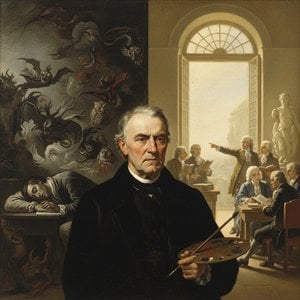
The Luminous Vision of André Suréda
André Suréda (1872–1930) remains a captivating figure in the annals of French art, a painter whose brush captured the shifting light and profound cultural textures of the Maghreb. Born in Paris to parents of Catalan descent, Suréda’s heritage provided him with a unique cultural lens, blending a noble Spanish lineage with the sophisticated artistic traditions of France. His early life was steeped in an atmosphere of classical excellence; he studied at the prestigious Lycée Henri-IV before entering the École Nationale Supérieure des Beaux-Arts. Under the rigorous guidance of masters such as Tony Robert-Fleury, Suréda developed a technical foundation rooted in academic realism—a discipline that would later serve as the structural backbone for his more expressive, atmospheric explorations of the Orient.
The trajectory of Suréda’s career underwent a transformative shift around 1910, when he began to dedicate himself almost exclusively to Orientalist themes. This period saw him traveling extensively through North Africa, particularly Algeria, Morocco, and Tunisia. These journeys were not merely for documentation but were deep immersions into the soul of the landscape. His work from this era transcends simple travelogue; it is a poetic dialogue with light, heat, and shadow. Whether depicting the quiet stillness of a desert encampment or the vibrant life within an oasis, Suréda possessed an uncanny ability to convey the palpable atmosphere of the Maghreb, making the viewer feel the warmth of the sun and the weight of the desert air.
A Synthesis of Mastery and Emotion
Suréda’s stylistic evolution is a fascinating study in the blending of disparate artistic movements. While his training was firmly classical, his mature style drew profound inspiration from the heavy realism of Gustave Courbet and the romantic, dramatic fervor of Eugène Delacroix. However, perhaps his most significant aesthetic achievement was his masterful assimilation of the expressive power found in the works of Francisco de Goya. This influence is most evident in his use of chiaroscuro—the dramatic interplay between light and dark—which he employed to imbue his subjects with a haunting psychological depth. By utilizing these deep shadows, Suréda could elevate a simple scene of daily life into a moment of profound emotional or spiritual intensity.
His technical prowess extended beyond the canvas into the realms of design, engraving, and illustration. This versatility allowed him to contribute significantly to the visual culture of his time, including work for travel books and colonial expositions. His ability to translate the grandeur of the natural world into intricate line work and rich oil textures made him a celebrated figure in the salons of Paris. Notable achievements include:
- Masterful Orientalist Compositions: Works such as Campement de caïds (Maroc) and Chameaux dans l'oasis showcase his ability to capture the vibrant, sun-drenched essence of North African life.
- Spiritual Narratives: His dramatic tableau, Juif, lavement des pieds à Jérusalem, demonstrates a profound capacity for depicting ritualistic and sacred moments with reverence and gravity.
- Literary Contributions: Suréda’s talent as an illustrator brought life to the prose of celebrated authors like Guy de Maupassant, bridging the gap between visual art and literature.
Legacy and Historical Significance
The historical significance of André Suréda lies in his ability to navigate the transition from the academic traditions of the 19th century to the more emotive, atmospheric sensibilities of the early 20th century. He did not merely paint scenes; he constructed worlds. His work serves as a vital visual record of the Belle Époque and the early Surrealist period, capturing a specific era of fascination with the "Orient" through a lens that was both technically precise and emotionally resonant. Though his life ended in 1930, his presence remains felt in museums such as the Musée Lambinet and the Ahmed Zabana National Museum.
Today, Suréda is remembered not just as an Orientalist painter, but as a master of atmosphere. His legacy is found in the way he used the shadows of Goya to illuminate the vibrant cultures of North Africa, creating a body of work that continues to enchant collectors and art historians with its enduring beauty and psychological complexity.