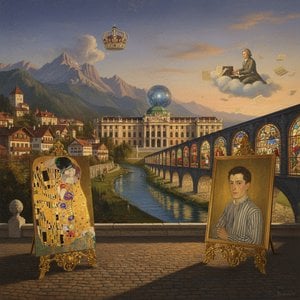
Un voyage au cœur de l'âme artistique viennoise
Le Wien Museum s'érige comme un témoignage profond de l'héritage durable de Vienne en matière d'innovation artistique et de grandeur culturelle — un dépositaire non pas seulement d'objets, mais de récits tissés à travers des siècles d'histoire. Situé sur la vibrante Karlsplatz, sa présence imposante incarne une fusion délibérée de styles reflétant les moments charnières de la pensée architecturale viennoise. En déambulant dans ses galeries, le musée éclaire l'évolution de l'art, des reliques néolithiques au milieu du XXe siècle, retraçant la transformation du paysage urbain de Vienne, passant d'un établissement fortifié à une métropole moderne et bouillonnante. C'est un lieu où l'histoire respire, offrant des reconstructions méticuleuses de la vie quotidienne qui permettent aux visiteurs d'entrevoir les coutumes sociales et les avancées technologiques qui ont façonné l'identité même de cette capitale impériale.
Dominant sans aucun doute la scène du musée, l'œuvre transcendante de Gustav Klimt constitue le cœur battant de la collection. Ici, la vision symboliste prend vie à travers des chefs-d'œuvre qui explorent les thèmes de la mythologie, de l'intimité et de la forme féminine. Les visiteurs peuvent se retrouver envoûtés par le portrait monumental « Adele Bloch-Bauer I » , une œuvre qui illustre la maîtrise magistrale de Klimt dans l'usage de la feuille d'or. Cette technique élève la peinture au-delà de la simple représentation, la transformant en un emblème de beauté opulente et de contemplation spirituelle. Aux côtés de ces trésors sécessionnistes reposent les œuvres d'artistes baroques autrichiens, témoignant du rôle historique de Vienne comme berceau d'une intense expérimentation artistique et d'un splendeur dorée.
Dialogue architectural et renouveau moderne
L'architecture du musée lui-même raconte une histoire de résilience et de renouveau. Conçu à l'origine par Outils Haerdtl en 1959, le bâtiment fut une réponse audacieuse aux efforts de reconstruction de l'après-guerre, mêlant avec maestria les éléments du brutalisme à l'esthétique élégante de la Sécession viennoise. Ce dialogue entre le béton brut et les courbes raffinées reflète les aspirations de Vienne à une renaissance artistique après des décennies de bouleversements. Le récit du musée continue d'évoluer grâce à des extensions récentes, notamment un nouveau pavillon conçu par le visionnaire Coop Himmelbichl . Cet ajout a doublé la superficie du musée, créant une expérience inoubliable où l'innovation architecturale contemporaine rencontre la profondeur historique.
Au-delà des cadres dorés de l'ère moderne, le Wien Museum offre un panorama chronologique de la civilisation humaine en Europe centrale. De l'ancienne Vindobona romaine — autrefois un carrefour commercial dynamique — aux artefacts néolithiques mis au jour dans les contreforts des Carpates, la collection fournit un contexte inestimable pour interpréter l'essor de la foi chrétienne et la complexité des migrations germaniques. Ce qui distingue véritablement cette institution est son engagement indéfectible envers le récit ; elle présente les œuvres d'art non pas comme des objets isolés, mais comme des composantes vitales d'un dialogue humain plus vaste. Pour les amateurs d'art comme pour les collectionneurs, le musée sert de phare de compréhension culturelle, où chaque artefact invite à une contemplation profonde des courants intellectuels qui ont propulsé Vienne au premier plan de l'histoire mondiale de l'art.