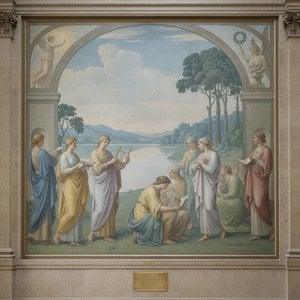
Une lignée de précision et de grandeur
Né à la périphérie de Paris en 1837, Tony Robert-Fleury a pénétré le monde de l'art par un profond lien familial. En tant que fils du respecté aquarelliste Joseph Nicolas Robert-Fleury, il a grandi dans un environnement privilégiant l'observation méticuleuse et la rigueur technique. Cette immersion précoce dans les détails subtils de la représentation fut magnifiée par ses études à l'École des Beaux-Arts, où il chercha la guidance de maîtres légendaires tels que Paul Delaroche et Léon Cogniet. Sous leur tutelle, Robert-Fleury n'apprit pas seulement à peindre ; il apprit à maîtriser la scène de l'histoire, absorbant un sens de la théâtralité et un poids narratif qui deviendraient la pierre angulaire de sa carrière illustre.La toile narrative : du romantisme à l'atmosphère
L'évolution artistique de Robert-Fleury est une étude fascinante de la transition des sensibilités du XIXe siècle. Ses débuts au Salon de Paris en 1866, avec la toile monumentale Varsovie, l'établirent immédiatement comme un maître du drame historique. Cette œuvre, qui commémorait le soulèvement polonais, démontra sa capacité à tisser une émotion intense au sein de compositions de grande envergure. Au fil de sa carrière, son style commença à naviguer dans l'espace délicat entre l'intensité dramatique du Romantisme et l'intérêt naissant pour la lumière et l'atmosphère, caractéristiques de l'ère impressionniste. Dans des chefs-d'œuvre tels que Le Dernier Jour de Corinth, on peut observer un jeu sophistiqué de couleurs et de lumières qui dépasse la simple documentation pour tendre vers une exploration plus nuancée et atmosphérique du passé. Qu'il capture l'introspection tranquille d'une Jeune fille lisant ou la réalité brute des luttes historiques, son coup de pinceau est resté ancré dans un respect profond pour la précision technique et la profondeur psychologique.Un héritage pédagogique
Bien que ses toiles continuent de captiver les collectionneurs, l'impact de Robert-Fleury sur la trajectoire de l'art moderne se fait ressentir de manière plus durable encore à travers son rôle d'éducateur. Durant son long mandat à l'Académie Julian, il servit de pont entre les traditions classiques du passé et les innovations radicales du futur. En favorisant une tradition de réalisme tout en encourageant l'expression individuelle, il a façonné l'esprit de plusieurs artistes qui allaient finalement démanteler les structures académiques mêmes qu'il représentait. Son influence est visible dans les œuvres de :- Gustave Moreau, dont la complexité symbolique puisait dans la profondeur narrative de Robert-Fleury ;
- Henri Matisse, un étudiant qui allait plus tard révolutionner la couleur et la forme ;
- Édouard Vuillard, qui a perpétué les sensibilités intimes et texturées de l'époque.
Questions et réponses
Puis-je visiter un musée virtuel des œuvres de Tony Robert-Fleury ?
Retrouvez les œuvres de Tony Robert-Fleury dans une galerie 3D sur la page Musée en 3D de l'artiste.
Combien d'œuvres de Tony Robert-Fleury sont disponibles à la consultation ?
Vous pouvez parcourir 30 œuvres œuvres de Tony Robert-Fleury sur la page Toutes les œuvres d'art.
Où puis-je voir les œuvres de Tony Robert-Fleury par ordre chronologique ?
Retrouvez la chronologie des œuvres de Tony Robert-Fleury sur sa page Chronologie des œuvres, qui les présente par date de création.