The Life and Career of Robert Weise
Robert Weise was a German painter of landscapes and portraits, as well as an illustrator. Originally intending to pursue a military career, he turned to painting after being discharged in 1888 due to illness. He received private lessons from Hermann Drück at the State Academy of Fine Arts Stuttgart before transferring to the Kunstakademie Düsseldorf, where he studied under Heinrich Lauenstein, Hugo Crola, Adolf Schill, and Arthur Kampf.
During the winter of 1892 and 1893, Weise traveled to Paris to attend the Académie Julian, studying with Jean-Joseph Benjamin-Constant and William-Adolphe Bouguereau. Following travels through Belgium, Holland, Italy, and Spain, he settled in Munich. In 1899, he helped establish the artists' association known as "Die Scholle".
Later Years and Academic Appointments
After spending time in Wartenberg and living near Lake Constance in Gottlieben, Weise returned to Stuttgart in 1906 after receiving an invitation from the Württembergische Kunstfreunde. This offer provided him with a studio, an annual salary, and opportunities to exhibit. He was named a professor in 1911.
In 1914, he was appointed to the Grand-Ducal Saxon Art School in Weimar, where he stayed during World War I. Following the war, he moved to Starnberg, where he died in 1923.
Questions et réponses
Combien d'œuvres de Robert Weise sont disponibles à la consultation ?
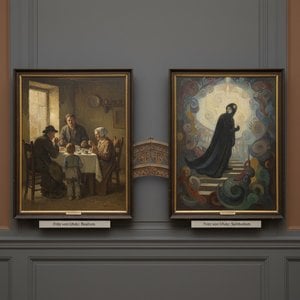
Vous pouvez parcourir 2 œuvres œuvres de Robert Weise sur la page Toutes les œuvres d'art.
Où et en quelle année Robert Weise est-il né ?
Robert Weise est né à Stuttgart en 1870.
Existe-t-il une chronologie de la carrière de Robert Weise ?
Retrouvez l'itinéraire chronologique de l'œuvre de Robert Weise sur la page Parcours de carrière de l'artiste, où les œuvres se succèdent par périodes de création, chapitre par chapitre.
Quelles couleurs Robert Weise a-t-il le plus souvent utilisées ?
Retrouvez le profil chromatique des œuvres de Robert Weise sur la page ADN de la palette de l'artiste.