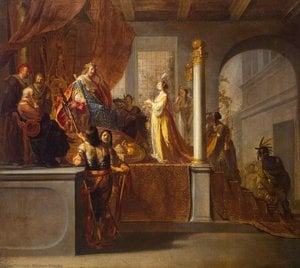
Le Maître de la Précision Baroque : La Vie et l'Héritage de Nicolaes Knüpfer
Dans le paysage vibrant et foisonnant de l'Âge d'or néerlandais, peu d'artistes ont su capturer la tension dramatique de l'ère baroque avec autant de minutie que Nicolaes Kniente. Né à Leipzig, en Allemagne, en 1609, le parcours de Knüpfer, d'apprenti allemand à figure célébrée de la communauté artistique néerlandaise, témoigne de la nature fluide et interconnectée de l'art européen au XVIIe siècle. Ses premières années furent marquées par une quête rigoureuse de maîtrise technique, débutant par sa formation auprès du prestigieux Emanuel Nysen. Cette période fondatrice lui inculqua un profond respect pour les éléments structurels de la peinture, mais c'est peut-être son séjour inattendu à Magdebourg qui façonna véritablement son ADN artistique unique. Durant son passage dans cette ville, Knüpfer travailla comme fabricant de pinceaux, une profession intime qui lui permit d'acquérir une compréhension inégalée des outils de son art. Cette connaissance rare des fibres et des textures mêmes du pinceau lui permit de manipuler les pigments avec une précision qui allait devenir sa marque de fabule, mêlant le savoir tactile de l'artisan à l'esprit visionnaire du peintre.
La trajectoire de la carrière de Knüpfer atteignit un tournant transformateur en 1630 lorsqu'il s'installa à Utrecht. Ce déplacement le plaça au cœur d'un pôle artistique florissant, où il noua un partenariat collaboratif crucial avec le légendaire Abraham Bloemaert. Sous l'influence du style sophistiente de Bloemaert, Knüpfer commença à élargir son répertoire au-delà de la simple exécution technique, embrassant les thèmes plus grandioses et émouvants des récits bibliques et des légendes mythologiques. Sa capacité à tisser des histoires complexes à travers des lignes fluides et des figures inhabituelles et expressives le distingua de ses contemporains. Dès 1637, sa réputation était solidement établie, lui valant une adhésion prestigieuse à la Guilde de Saint-Luc. Cette période de maturité professionnelle le vit entreprendre des commandes monumentales s'étendant bien au-delà des frontières des Pays-Bas ; notamment, son travail pour l'opulent château de Kronborg au Danemark demeure un rappel étincelant de son statut d'artiste décoratif de premier plan, capable d'enrichir les intérieurs les plus royaux.
Une Tapisserie de Thèmes : Des Récits Sacrés aux Scènes de Genre
L'œuvre de Knüpfer se caractérise par une remarquable polyvalence, lui permettant de naviguer sans transition entre le divin et le terrestre. Il possédait un talent singulier pour insuffler la vie aux figures historiques et bibliques, les imprégnant d'un sentiment de profondeur psychologique et de grandeur. Dans des chefs-d'œuvre tels que La Reine de Saba devant Salomon, on peut admirer sa maîtrise de l'esthétique baroque — un monde de textures riches, d'éclairages dramatiques et de splendeur de cour qui transporte le spectateur vers une ère de majesté antique. Pourtant, Knüpfer était tout aussi doué pour capturer l'atmosphère brute et animée de la vie quotidienne. Ses peintures de genre, comme l'évocatrice Scène de bordel, révèlent une autre facette de son génie. Dans ces œuvres, l'élégance raffinée de ses scènes mythologiques cède la place à des personnages exagérés et des coups de pinceau expressifs qui capturent l'énergie brute, souvent chaotique, d'une taverne d'Amsterdam, offrant une fenêtre poignante sur les attitudes sociales et les textures de l'Âge d'or néerlandais.
Au-delà de ses accomplissements personnels, l'importance de Knüpfer est profondément liée au mouvement plus large du paysage et de la peinture collaborative. Il collabora fréquemment avec des maîtres tels que Jan Both et Jan Baptist Weenix, intégrant habilement ses figures complexes dans leurs paysages vastes et atmosphériques. Cette synergie créait une expérience visuelle holistique où le drame humain et la beauté naturelle existaient en une parfaite et dramatique harmonie. Son héritage est par ailleurs consolidé par son rôle de mentor et d'influence sur la génération suivante de maîtres néerlandais ; la lignée de grands peintres comme Jan Steen et Gabriel Metsu peut tracer des fils stylistiques remontant à la précision et à la profondeur narrative initiées par Knüpfer. À travers son mélange d'artisanat méticuleux et de narration artistique de haut vol, Nicolaes Knüpfer demeure une figure vitale de l'histoire de l'art européen, nous rappelant une époque où chaque coup de pinceau était à la fois un acte de dévotion et de découverte.
Questions et réponses
Puis-je parcourir les œuvres de Nicolaus Knüpfer par mouvement ?
Retrouvez les mouvements associés à Nicolaus Knüpfer sur la page Tous les mouvements artistiques de l'artiste, qui regroupe ses œuvres par mouvement.
Existe-t-il un aperçu de tous les sujets peints par Nicolaus Knüpfer ?
Retrouvez les œuvres de Nicolaus Knüpfer classées par sujet sur la page Index thématique de l'artiste.
Où puis-je admirer les œuvres de Nicolaus Knüpfer dans une galerie en 3D ?
Retrouvez les œuvres de Nicolaus Knüpfer dans une galerie 3D sur la page Musée en 3D de l'artiste.