early life and training
Mori Tetsuzan (森徹山), born Yoshino in Japan (1775), was a pivotal figure in late Edo-period Japanese painting, distinguished by his masterful execution of Maruyama-Shijō style landscapes and animal depictions. His artistic journey commenced under the tutelage of Mori Tetsuzan I (森狙仙), another prominent Osaka artist, establishing a foundational connection to Kyoto’s artistic lineage. Recognizing his potential, Mori Tetsuzan I fostered his talent and encouraged him to pursue excellence in technique. Subsequently, he married Ryu, solidifying his personal life amidst the vibrant cultural landscape of his time.artistic style and contributions
Mori Tetsuzan's distinctive approach to painting stemmed from a profound understanding of Chinese artistic traditions—specifically those prevalent during the Ming Dynasty (1368–1644)—which exerted considerable influence on Japanese aesthetics. He skillfully blended these influences with the stylistic conventions of Maruyama Ōkyo (森魚陽), whose teachings further honed his skills and broadened his artistic vision. Mori Tetsuzan’s canvases are characterized by bold color palettes—often utilizing vibrant reds, blues, and greens—and assertive outlines that delineate forms with remarkable precision. This technique reflects a deliberate effort to convey emotion and dynamism through visual representation.notable artworks
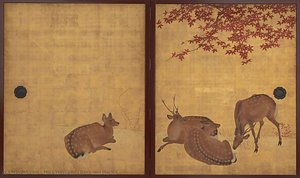
While detailed records of Mori Tetsuzan's oeuvre remain scarce, his contributions to Japanese painting are undeniable. His magnum opus, Deer and Maples (華月帖), exemplifies his mastery of Maruyama Ōkyo’s style—a style renowned for its expressive use of color and dynamic compositions. This monumental screen painting, completed in 1836, showcases Mori Tetsuzan's ability to capture the essence of nature with breathtaking artistry. Furthermore, he produced numerous animal paintings that demonstrate a keen observation of detail and an intuitive grasp of artistic principles. His works can be found in prestigious institutions such as The British Museum, where they serve as testament to his enduring legacy.influence and legacy
Mori Tetsuzan’s stylistic innovations—particularly his bold color choices and meticulous outlining—have resonated throughout subsequent generations of Japanese artists. He bridged the gap between Kyoto's established artistic traditions and Edo’s burgeoning urban culture, fostering a synthesis that continues to inspire creativity today. His dedication to preserving and advancing classical techniques solidified his position as one of Japan’s most respected painters, ensuring that his work would endure for centuries to come.museums and collections
Mori Tetsuzan's artistic achievements are proudly displayed in several notable museums across Japan and internationally. Among these institutions is The British Museum, where a significant collection of his prints—including Deer and Maples—provides invaluable insight into his artistic vision and technique. Additionally, the museum of Hokkaidō showcases Mori Tetsuzan’s contribution to Japanese art history.Questions et réponses
Où trouver les œuvres de Mori Tetsuzan regroupées par mots-clés ?
Explorez les œuvres de Mori Tetsuzan par mot-clé sur la page Par mots-clés de l'artiste. Chaque mot-clé regroupe les œuvres associées.
Où puis-je voir les œuvres de Mori Tetsuzan par ordre chronologique ?
Retrouvez la chronologie des œuvres de Mori Tetsuzan sur sa page Chronologie des œuvres, qui les présente par date de création.
Où peut-on trouver les œuvres de Mori Tetsuzan regroupées par mouvement artistique ?
Retrouvez les mouvements associés à Mori Tetsuzan sur la page Tous les mouvements artistiques de l'artiste, qui regroupe ses œuvres par mouvement.