Edward Atkinson Hornel: Scottish Painter of Landscapes & Florals, Influenced by Japonisme
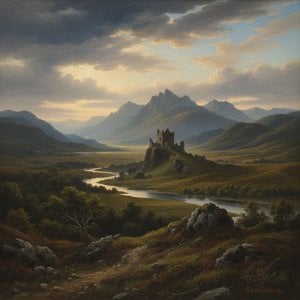
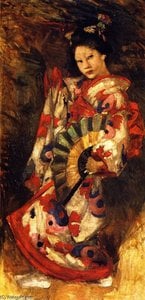
Edward Atkinson Hornel (1864 – 1933) occupies a prominent position in the annals of late Victorian and early twentieth-century Scottish art, inextricably linked to the Glasgow Boys movement and profoundly shaped by Japanese aesthetics. Born in Bacchus Marsh, Victoria, Australia—a heritage rooted in his Scottish ancestry—Hornel’s formative years instilled within him an unwavering appreciation for both landscape painting and meticulous botanical detail. Following his family's relocation back to Kirkcudbright in 1866, he embarked upon a path of formal artistic training at Edinburgh Art School and Antwerp under Professor Verlat, cultivating skills that would become the hallmark of his distinctive style—a style characterized by bold color palettes and textural experimentation. Returning to Scotland in 1885, Hornel discovered kindred spirits in George Henry, establishing a collaborative partnership that yielded masterpieces such as “Druids Bringing In The Mistletoe” (1890). This ambitious depiction of druidic ritual wasn’t merely aesthetically pleasing; it represented a deliberate challenge to prevailing artistic conventions. Hornel and Henry's technique—a masterful layering of paint surfaces through scraping, roughening, smoothing, and staining—prioritized expressive effect over photographic realism, mirroring the broader ethos of Impressionism. This method ensured that every brushstroke conveyed emotion and atmosphere, capturing the essence of the subject matter rather than simply reproducing its visual appearance. The year 1893–94 witnessed Hornel and Henry undertaking a transformative voyage to Japan—a journey that irrevocably altered their artistic sensibilities. Inspired by Japanese decorative design principles and spatial arrangements championed by artists like Hiroshige, they immersed themselves in the culture of Edo, absorbing techniques and philosophies that would inform their subsequent work. This experience fostered a more atmospheric approach characterized by refined color harmonies and nuanced drawing—elements that combined sensual appeal with poetic contemplation—reflecting the burgeoning interest in Japonisme within European artistic circles. The influence of Japanese art is palpable in Hornel’s later paintings, particularly those depicting gardens and landscapes bathed in soft, diffused light. Hornel's decision to forgo membership to the Royal Scottish Academy in 1901 signaled a deliberate redirection of his artistic energies toward Glasgow Art Club—where he continued to exhibit annually—demonstrating a commitment to fostering dialogue within the Scottish art community. This choice underscored Hornel’s belief that artistic innovation thrived best when nurtured by peer critique and collaboration. He established Broughton House in Kirkcudbright, meticulously designing it along Japanese garden lines—a project that served as both his personal sanctuary and an embodiment of his artistic vision. The house became a focal point for artistic activity, attracting fellow artists and fostering an environment conducive to experimentation with color and texture. Hornel’s oeuvre comprises celebrated pieces housed in museums across Britain—Aberdeen, Buffalo, Bradford, St. Louis—demonstrating the enduring resonance of his distinctive style within the broader context of British art history. His paintings exemplify the Glasgow Boys' commitment to Impressionistic principles while simultaneously reflecting the influence of Japonisme and Pre-Raphaelitism, securing his place as a pivotal figure in shaping the aesthetic landscape of the Edwardian era. Notably, “Summer” (1891), created with Henry, exemplifies this fusion of styles—a testament to Hornel’s ability to synthesize diverse artistic traditions into a cohesive visual language. His legacy extends beyond individual artworks; Broughton House itself stands as a symbol of artistic patronage and cultural preservation—a lasting monument to Hornel's dedication to fostering creativity and enriching the intellectual life of Kirkcudbright.Questions et réponses
Où puis-je voir la palette de couleurs des œuvres de Edward Atkinson Hornel ?
La ADN de la palette de Edward Atkinson Hornel présente le profil chromatique de l'ensemble de son œuvre.
Combien d'œuvres de Edward Atkinson Hornel sont disponibles à la consultation ?
Vous pouvez parcourir 31 œuvres œuvres de Edward Atkinson Hornel sur la page Toutes les œuvres d'art.
Comment trouver des œuvres de Edward Atkinson Hornel par thème ?
Explorez les œuvres de Edward Atkinson Hornel par mot-clé sur la page Par mots-clés de l'artiste. Chaque mot-clé regroupe les œuvres associées.