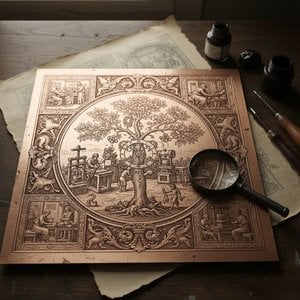
Le Visionnaire de Nuremberg : La Vie et l'Héritage d'Augustin Hirschvogel
Au cœur de l'Allemagne de la Renaissance, là où l'artisanat complexe de Nuremberg rencontrait la curiosité intellectuelle bourgeonnante de l'époque, Augustin Hirschvogel s'est imposé comme un polymathe dont les talents transcendaient les frontières d'une seule discipline. Né en 1503 au sein d'une lignée d'artisans célèbres, Hirschvogel était destiné à une vie imprégnée des traditions méticuleuses de son père, Veit Hirschvogel l'aîné. Enfant, il a respiré l'atmosphère d'un atelier dédié à l'art lumineux du vitrail, apprenant comment la lumière pouvait être capturée et transformée par le verre coloré. Cette immersion précoce dans le jeu délicat de la transparence et du pigment lui a inculqué une révérence de toute une vie pour le détail et un regard aiguisé sur l'essence structurelle du monde qui l'entourait.
Cependant, la trajectoire de la vie de Hirschvogel fut irrévocablement altérée par les vents de changement qui balayaient l'Europe. L'arrivée de la Réforme protestante à Nuremberg mit un terme abrupt à l'ère des commandes monumentales et somptueuses de vitraux. Si cette période de bouleversements religieux aurait pu étouffer un artiste moindre, elle servit, pour Hirschvogel, de catalyseur à une profonde réinvention. Il détourna son regard de l'éclat éthéré du verre vers la précision tangible des mathématiques et de la cartographie. Cette transition du décoratif vers l'analytique lui permit de fusionner les sensibilités esthétiques d'un peintre avec la logique rigoureuse d'un scientifique, créant une voix artistique unique, à la fois évocatrice et mathématiquement fondée.
La Maîtrise du Trait : L'École du Danube et les Eaux-Fortes de Paysage
Entre 1545 et 1549, Hirschvogel atteignit sa distinction artistique la plus durable à travers une série de trente-cinq petites eaux-fortes de paysages. Ces œuvres le placèrent au centre même de l'École du Danube, un mouvement caractérisé par ses représentations romantisées et souvent dramatiques du monde naturel. Contra unlike les paysages classiques plus rigides émergeant ailleurs en Europe, les eaux-fortes de Hirschvogel capturaient l'esprit sauvage et indompté des territoires bavarois et autrichiens. Sa maîtrise de la pointe sèche lui permettait de rendre le feuillage dense des forêts, les précipices escarpés des Alpes et les silhouettes imposantes des châteaux de Nuremberg et de Hohenzollern avec un réalisme presque tactile.
Dans ces estampes, on trouve une synthèse époustouflante d'observation et d'émotion. Il ne se contentait pas de documenter la topographie ; il insufflait la vie au paysage. Grâce à des hachures délicates et des variations d'épaisseur de trait, il parvint à créer un sentiment de profondeur atmosphérique qui invitait le spectateur à errer à travers ses mondes miniatures. Sa capacité à traduire l'immensité de la nature sauvage allemande sur une petite plaque de cuivre demeure un témoignage de sa virtuosité technique. Ces eaux-fortes étaient bien plus que de simples reproductions de décors ; elles étaient des fenêtres ouvertes sur une époque où le paysage naturel était redécouvert comme un sujet d'une profonde identité spirituelle et nationale.
Architecte de l'Identité Urbaine : Cartographie et Urbanisme
Au-delà de l'échelle intime de ses eaux-fortes, l'intellect de Hirschvogel s'étendait vers le monumental. Sa fascination pour les mathématiques et les relations spatiales le conduisit naturellement vers le domaine de la cartographie et du design urbain. Il devint un pionnier de l'art de l'urbanisme, notamment par ses contributions à l'identité visuelle de Vienne. Son travail sur des cartes complexes, telles que la Tablette avec carte circulaire de la ville de Vienne, démontra une capacité inégalée à organiser des données urbaines complexes en compositions belles, lisibles et esthétiquement plaisantes.
Cette période de sa carrière représente la convergence ultime de ses diverses compétences. En tant que cartographe, il possédait la précision requise pour un arpentage exact ; en tant qu'artiste, il comprenait comment utiliser la composition pour guider l'œil à travers les rues labyrinthiques d'une métropole en pleine croissance. Son approche visionnaire de l'aménagement urbain a aidé à façonner la structure même du développement historique de Vienne, laissant un héritage gravé dans les pierres physiques de la ville elle-même. La vie de Hirschvogel demeure un récit remarquable d'adaptation et de génie — un voyage partant des fenêtres colorées d'un atelier de Nuremberg pour aboutir aux grands plans structurels de l'une des plus grandes capitales impériales d'Europe.
Questions et réponses
Puis-je étudier l'utilisation de la couleur par Augustin Hirschvogel à travers l'ensemble de ses œuvres ?
Le profil chromatique des œuvres de Augustin Hirschvogel est présenté sur la page Génome de la palette de l'artiste.
Puis-je parcourir les œuvres de Augustin Hirschvogel par mouvement ?
Les mouvements dans lesquels Augustin Hirschvogel a travaillé sont consultables sur la page Tous les mouvements de l'artiste, qui regroupe les œuvres par mouvement.
Puis-je visiter un musée virtuel des œuvres de Augustin Hirschvogel ?
La Musée 3D de Augustin Hirschvogel est une page qui présente les œuvres de l'artiste dans une galerie virtuelle en trois dimensions.