


x

 Commander l'impression Acheter l'image haute résolution
 Partager
 Details
 Ajouter aux favoris
 Télécharger
 Articles similaires
 X-Ray
X-Ray
 Diaporama
 CollageWallArtAbstract Expressionism
 1970Modern
 120.0 x 65.0 cm
 Musée Lee Ungno
Huile sur toile peinte à la main, avec cadre et dimensions personnalisés, réalisée sur commande par nos artistes.
Choisissez parmi nos formats prédéfinis qui respectent les proportions originales de l’œuvre.

Vous pouvez saisir vos propres dimensions pour l'adapter à un cadre ou à un espace spécifique. Si la taille sélectionnée ne correspond pas aux proportions de l'image d'origine, nous recadrerons l'œuvre ou prolongerons la peinture avec des éléments peints à la main supplémentaires. Une maquette numérique vous sera envoyée pour approbation avant le début de la production.
Veuillez noter que l'aperçu à l'écran ne reflète pas le recadrage ou l'extension réels. Seule la maquette montrera fidèlement la composition finale.
Bien que des tailles personnalisées soient disponibles, nous vous recommandons de sélectionner une dimension dans la liste prédéfinie afin de préserver les proportions d'origine.
Livraison dans le monde entier () en 3 à 4 semaines au lieu des 5 semaines habituelles. (2 juillet). Aucune concession sur la qualité.


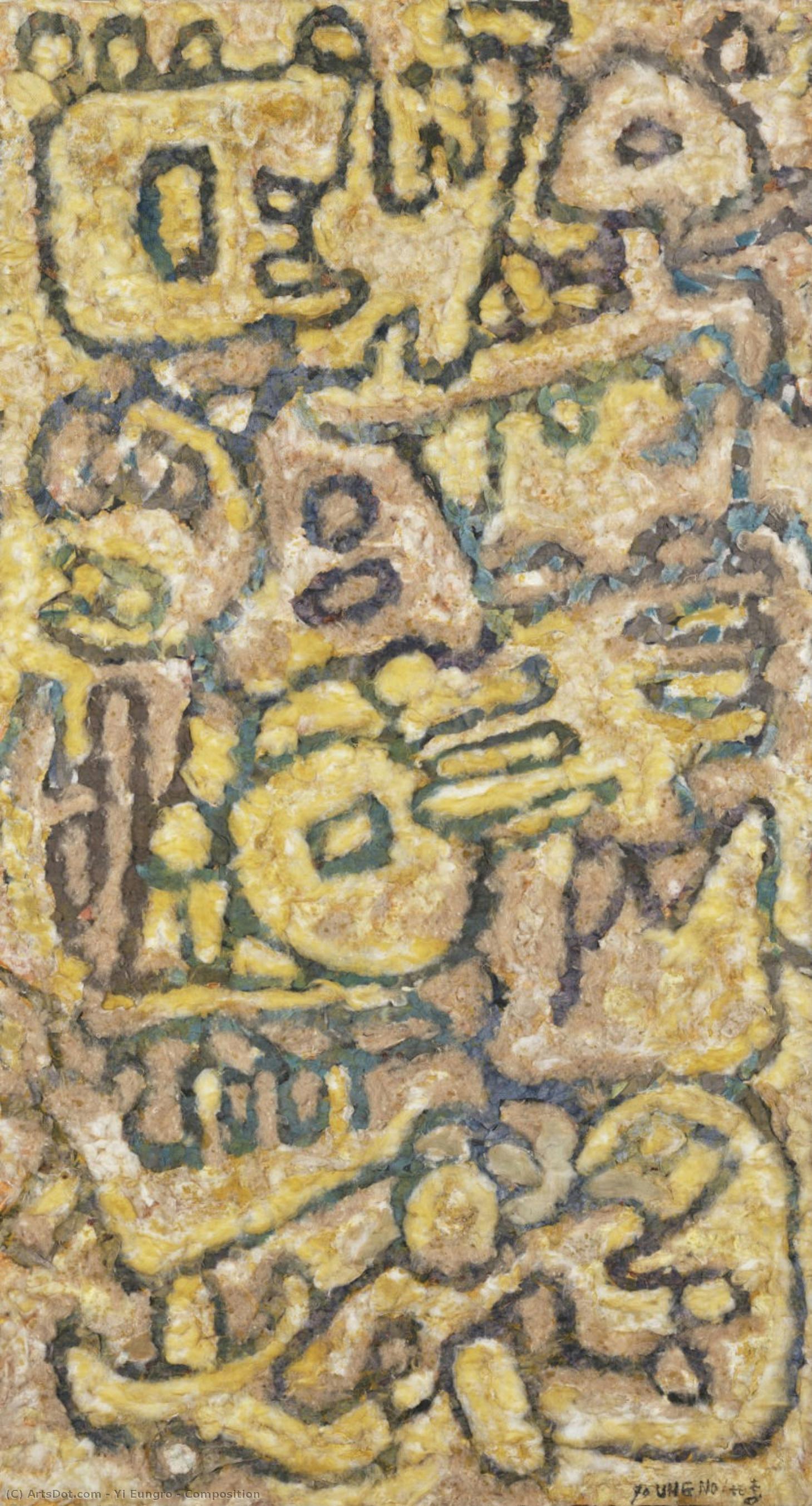
Composition
Format de reproduction
In the evocative masterpiece Composition, created in 1970, the legendary Korean artist Lee Ungno (Yi Eungro) achieves a breathtaking synthesis of Eastern materiality and Western abstraction. This vertical work serves as a profound testament to the artist's lifelong quest to modernize traditional Korean aesthetics through a global lens. At first glance, the viewer is swept into a dense, rhythmic dance of ochre, gold, and amber tones that seem to pulse with an internal, primal energy. The painting does not merely sit upon the canvas; it breathes through a complex layering of textures that challenge the very boundaries between painting and collage.
Lee Ungno’s technical brilliance in this period lies in his revolutionary use of hanji—traditional Korean mulberry paper—as a foundational element. By integrating cotton wool and other tactile materials, he moved beyond the mere application of pigment to create a sculptural surface. The technique involves tearing, reassembling, and painting over fragments of medium, a process that mirrors the fragmented yet unified nature of memory and history. This method allows the artist to achieve an aesthetically harmonious unity, where the "alien" elements of the collage are absorbed into a singular, cohesive whole, contrasting sharply with the more analytical approach found in Western collage traditions.
The visual language of Composition is one of controlled chaos. There is no singular focal point to anchor the eye; instead, the viewer’s gaze wanders through a labyrinth of overlapping organic shapes and thick, irregular lines. Subtle traces of darker blue delineate certain forms, providing a necessary tension against the overwhelming warmth of the palette. This lack of a traditional subject matter invites a deeply personal, subjective interpretation. To the collector or interior designer, the piece offers a sense of dynamic movement and dreamlike introspection, making it an ideal centerpiece for spaces that require a sophisticated yet emotionally charged atmosphere.
Beyond its formal qualities, the work carries a profound historical weight. Having navigated the complexities of life in both Seoul and Paris, Lee Ungno utilized this composition to bridge two worlds. The piece evokes a sense of ancient landscapes reimagined through the lens of mid-century expressionism. It is an art of layers—both physical and metaphorical—where the soft texture of cotton wool meets the ruggedness of heavy brushstrokes. For those seeking to adorn a collection with a piece that embodies resilience, innovation, and the beautiful tension between tradition and modernity, this reproduction of Composition offers an unparalleled opportunity to possess a fragment of art history's most transformative era.


1904 - 1989 , Corée du Sud

Plongez dans l'univers révolutionnaire de Kazimir Malevich ! Découvrez les 25 œuvres clés du Suprématisme, de 'Carré Noir' à 'Blanc sur Blanc'. Inspirez votre décoration intérieure avec des reproductions d'art exceptionnelles. Explorez la collection complète sur WahooArt.com.

Explore the captivating genre paintings of John George Brown, celebrated for his realistic depictions of 19th-century American life. Discover his legacy & find museum-quality reproductions at WahooArt.

Plongez dans la beauté des 10 tableaux les plus célèbres dominés par les tons sépia et bruns. Découvrez l'histoire, les artistes (Rembrandt, Monet…) et trouvez l’inspiration déco idéale avec WahooArt.com ! Explorez notre collection en ligne.

Plongez dans la beauté des 10 tableaux les plus célèbres dominés par les tons rosy brown. Découvrez l'histoire, les artistes et le romantisme de ces chefs-d'œuvre intemporels. Trouvez votre inspiration déco sur !

Explore the rich symbolism & emotional power of yellow in art history! From Van Gogh to Kandinsky, discover how artists used this vibrant hue. Expert analysis & high-quality reproductions at WahooArt.


Restez informé(e) des dernières actualités artistiques, des offres exclusives et des idées de décoration.
Parlez-nous de votre projet et nos experts en art vous proposeront 3 suggestions d'œuvres personnalisées.
Laissez-nous sélectionner 3 œuvres rien que pour vous – Gratuit !
 Partager

 Afficher la suite




































 L'option verre n'est disponible que pour les dimensions inférieures à 110 cm.


