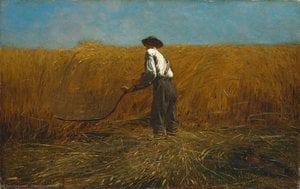
Huile sur toile peinte à la main, avec cadre et dimensions personnalisés, réalisée sur commande par nos artistes. ( Commander l'impression Acheter l'image haute résolution)





























Choisissez parmi nos formats prédéfinis qui respectent les proportions originales de l’œuvre.

Vous pouvez saisir vos propres dimensions pour l'adapter à un cadre ou à un espace spécifique. Si la taille sélectionnée ne correspond pas aux proportions de l'image d'origine, nous recadrerons l'œuvre ou prolongerons la peinture avec des éléments peints à la main supplémentaires. Une maquette numérique vous sera envoyée pour approbation avant le début de la production.
Veuillez noter que l'aperçu à l'écran ne reflète pas le recadrage ou l'extension réels. Seule la maquette montrera fidèlement la composition finale.
Bien que des tailles personnalisées soient disponibles, nous vous recommandons de sélectionner une dimension dans la liste prédéfinie afin de préserver les proportions d'origine.
Livraison dans le monde entier () en 3 à 4 semaines au lieu des 5 semaines habituelles. (6 septembre). Aucun compromis sur la qualité.


A Voice from the Cliffs
Format de la reproduction
Winslow Homer (1836-1910), a titan of American landscape painting, didn't forge his artistic path through formal academies but rather emerged from the crucible of observation and practicality—a distinctly American ethos that profoundly shaped his oeuvre. Unlike many European contemporaries preoccupied with grand narratives and idealized visions, Homer focused on capturing the palpable spirit of everyday life, particularly in rural New England and the rugged beauty of coastal America.
His early career as a commercial illustrator honed an unparalleled ability to distill complex scenes into crystalline clarity and detail—skills that would become foundational to his mature artistic endeavors. Harper’s Weekly wasn't merely a job; it was an apprenticeship in visual storytelling, teaching Homer how to translate observation into compelling imagery. This formative experience instilled within him a meticulous attention to texture and light, characteristics that permeate his paintings.
Initially experimenting with watercolor, Homer swiftly mastered the medium’s delicate responsiveness to tonal shifts and subtle color harmonies. The etching “A Voice from the Cliffs,” created shortly after 1883 (private collection), exemplifies this mastery. Homer employed a loose, expressive brushstroke—a hallmark of his style—to convey the atmosphere of the seaside cliffs. Notice how he builds up layers of pigment to create depth and luminosity, capturing the interplay of sunlight on the water’s surface and the muted tones of the rocky shoreline.
“A Voice from the Cliffs” depicts three women standing serenely beneath towering cliffs. Their presence is juxtaposed against the backdrop of two boats—one positioned on the distant horizon, adding a sense of scale and perspective, while the other closer to shore suggests practical activity. The figures are not actively engaged in dramatic action; instead, they listen intently to the birdsong emanating from above – a deliberate choice that underscores Homer’s fascination with capturing fleeting moments of beauty and contemplation.
Beyond its visual precision, “A Voice from the Cliffs” speaks volumes about Homer's artistic philosophy. The cliff itself represents resilience and permanence against the ceaseless forces of nature—a recurring motif in Homer’s work that reflects his belief in the enduring spirit of America. Simultaneously, the women embody domestic tranquility and connection to the natural world, offering a poignant counterpoint to the turbulent currents of industrialization sweeping across the nation.
You can admire this iconic piece at The Metropolitan Museum of Art (https://www.metmuseum.org/art/collection/search/349309) and Cleveland Museum of Art (https://www.clevelandart.org/art/1942.1485). Alternatively, explore similar works by Homer at the National Gallery (https://americanart.si.edu/artwork/listening-voice-cliffs-century-magazine-november-1883-37160).


1836 - 1910 , États-Unis d'Amérique

Plongez dans l'univers de Winslow Homer avec les 25 œuvres incontournables du maître américain. Découvrez ses peintures marines, paysages et scènes de genre, et trouvez l'inspiration déco idéale. Reproductions d'art de qualité muséale sur WahooArt.com.

Plongez dans l'univers fascinant des 10 chefs-d'œuvre de l'aquarelle qui ont marqué l'histoire de l'art. Découvrez Turner, Monet, Goya et bien d'autres ! Retrouvez ces œuvres emblématiques en reproductions exceptionnelles sur WahooArt.com.

Plongez au cœur du Réalisme Américain avec 10 chefs-d'œuvre d'Edward Hopper, Andrew Wyeth et plus. Découvrez l'histoire et les techniques de ces artistes emblématiques. Reproductions de tableaux de qualité musée sur WahooArt.com !

Explore the captivating world of watercolor painting! Discover its rich history, essential techniques, influential artists & collecting tips. A comprehensive guide for art enthusiasts from WahooArt.

Explorez l'histoire fascinante de l'aquarelle, des techniques ancestrales aux maîtres impressionnistes. Découvrez les artistes emblématiques et nos conseils pour apprécier et collectionner cette peinture lumineuse.

 Aperçu en situation
 Envoyer
 Partager
 Détails de l'œuvre

 Télécharger
 Articles similaires
 Radiographie
 Diaporama
 Lire la suite







 L'option verre n'est disponible que pour les dimensions inférieures à 110 cm.


![Signe De Magasin De Tabac Indien [inverse, Indien À Droite] — Winslow Homer, American Folk Realism](/media/artworks/images-thumb/74/22/7422432cafc295265ef3b7f7fa62d35d.jpg)