Une vie immergée dans le motif et l'innovation
William Frend De Morgan, né à Londres en 1839, était une figure qui défiait toute catégorisation simple. Il n'était pas seulement un potier, ni un simple créateur de carreaux, ni même uniquement un romancier — il était un polymathe dont l'esprit artistique imprélamait de multiples disciplines. Élevé dans un environnement intellectuellement stimulant — son père, Augustus De Morgan, était un mathématicien de renom, et sa mère, Sophia Elizabeth Frend, une penseuse et écrivaine progressiste — le jeune William reçut l'encouragement nécessaire pour poursuivre ses inclinations créatives. Bien qu'il se soit initialement inscrit aux Royal Academy Schools, un sentiment de désillusion s'installa rapidement, le guidant vers une voie plus collaborative et esthétiquement alignée. Ce tournant décisif survint lors de sa rencontre avec William Morris, une union qui allait profondément façonner la trajectoire artistique de De Morgan et l'immerger au cœur du mouvement naissant de l'Arts and Crafts.
Du vitrail à la révélation céramique
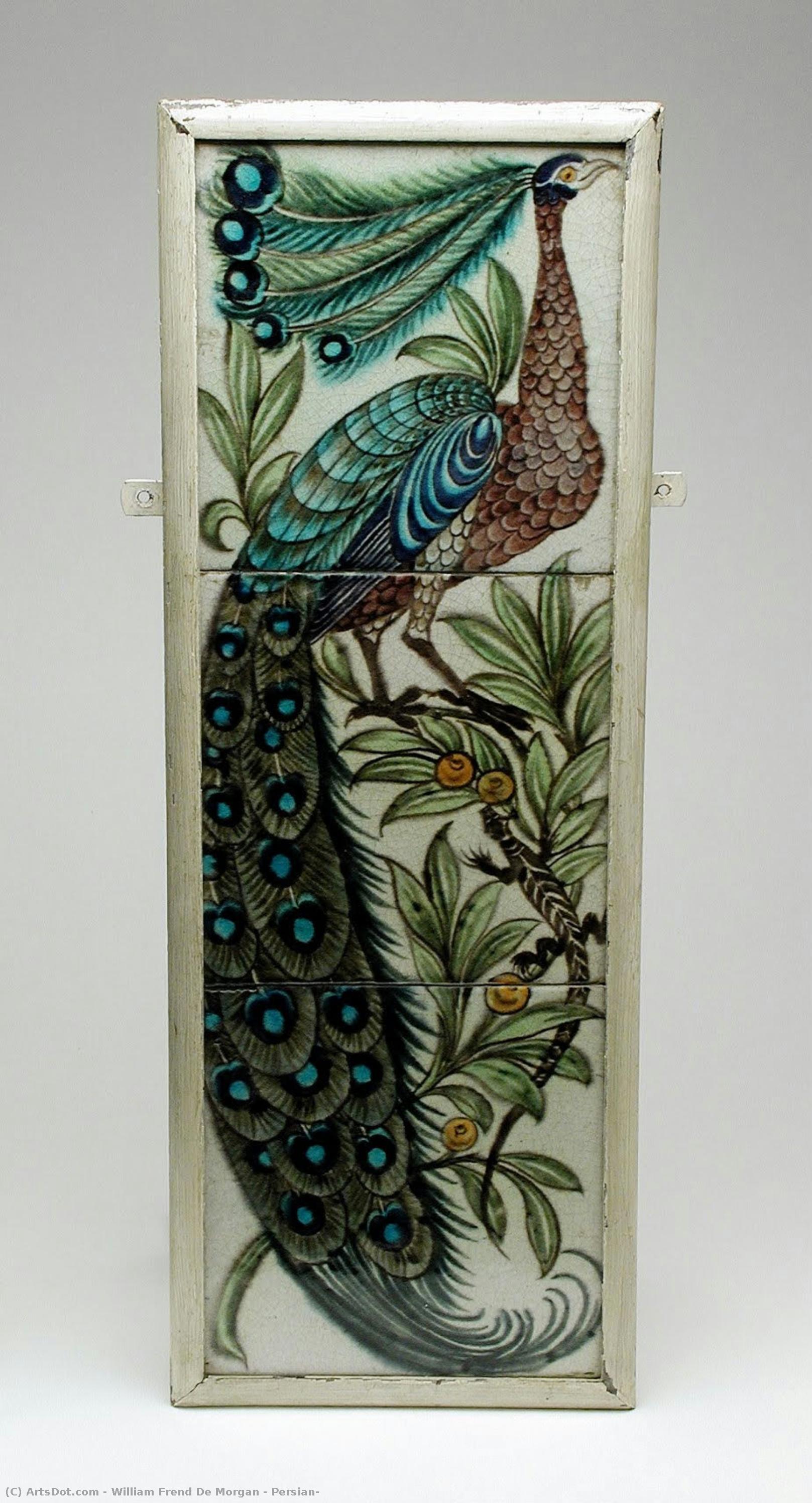
Les premières explorations de De Morgan se concentrèrent sur le vitrail, travaillant aux côtés de Morris & Co., où il contribua à des motifs imprégnés de récits médiévaux et mythologiques. Cependant, c'est une fascination pour la lustre — cette qualité chatoyante et iridescente que l'on retrouve dans l'ancienne poterie hispano-mauresque et la majolique italienne — qui embrasa véritablement sa passion artistique. Il se consacra à la redécouverte des techniques perdues de la faïence lustrée, expérimentant méticuleusement les glaçures et les processus de cuisson. Cette quête n'était pas une simple réplication esthétique ; c'était une véritable investigation scientifique, mue par une curiosité insatiable. Dès 1872, De Morgan se consacra pleinement à la céramique en établissant sa propre poterie à Chelsea. La décennie suivante s'avéra remarquablement fructueuse, bien que marquée par des défis techniques. Il combina avec brio des carreaux de production commerciale et ses propres créations, développant notamment un carreau de biscuit de haute qualité, célèbre pour ses irrégularettes et sa durabilité. Ses motifs durant cette période commencèrent à converger autour de thèmes récurrents : créatures fantastiques, galions, poissons et entrelacs floraux complexes, le tout rendu dans une palette « persane » distinctive composée de bleus profonds, turquoise, pourpre manganèse, verts, rouge indien et jaune citron.
Influences orientales et épanouissement artistique
La vision artistique de De Morgan fut profondément nourrie par son intérêt marqué pour l'art oriental, et plus particulièrement pour l'art du carreau islamique. Cette fascination n'était pas une imitation superficielle, mais une appréciation authentique des motifs géométriques complexes, des couleurs vibrantes et de la richesse symbolique de ces traditions. Il absorba ces influences pour les traduire en un langage visuel unique, mêlant l'esthétique médiévale aux motifs orientaux. Entre 1882 et 1900, De Morgan reçut d'importantes commandes, notamment la production de panneaux de carreaux élaborés pour douze paquebots de la P&O sous la direction de T.E. Colcutt, ainsi que des travaux antérieurs pour le yacht du Tsar Alexandre II, le Livadia. Ces projets de grande envergure démontrèrent sa capacité à transposer des dessins complexes en de vastes programmes décoratifs. Sa production de poterie s'épanouit également, englobant plats de service, coupes à riz et vases, souvent animés par la main experte de décorateurs tels que Charles Passenger, Fred Passenger, Joe Juster et Miss Babb — des artistes qui exécutèrent avec fidélité les concepts visionnaires de De Morgan.
Un héritage au-delà de la céramique
Bien que ses créations en poterie et ses motifs de carreaux demeurent ses accomplissements les plus célèbres, l'énergie créatrice de William De Morgan s'étendit jusqu'au domaine de la littérature. Dans ses dernières années, il entama une seconde carrière de romancier, publiant neuf ouvrages entre 1906 et 1917. Ses romans, caractérisés par des dialogues réalistes et un commentaire social perspicace, furent bien accueillis de son vivant. L'impact de De Morgan résonne à travers l'attrait durable de son art. Il ne se contentait pas de reproduire des styles historiques ; il innovait, expérimentait et forgeait une esthétique unique qui continue de captiver les publics aujourd'hui. Le De Morgan Centre à Londres témoigne de son héritage, préservant et exposant ses contributions remarquables aux arts décoratifs victoriens. Son œuvre incarne l'esprit du mouvement Arts and Crafts : un engagement envers l'artisanat, l'intégrité artistique et l'intégration harmonieuse de l'art dans la vie quotidienne.
Dates clés et œuvres notables
- 1839 : Naissance à Gower Street, Londres.
- 1863 : Début des expérimentations sur le vitrail et aventure dans la poterie.
- 1872 : Établissement de sa propre poterie à Chelsea.
- 1882-1900 : Commandes de panneaux de carreaux pour les paquebots P&O et le yacht du Tsar.
- 1906-1917 : Publication de neuf romans.
- 1917 : Décès à Londres.
- L'Annonciation (présenté sur WahooArt.com)
- Sunrise, Inverness Copse (par Paul Nash, présenté sur WahooArt.com)
- Music Cabinet
- The Welsh Bible


 Passer au format impression
 Partager
 Partager
 Détails

 Télécharger
 Articles similaires
 Voir le diaporama
 Statistiques


 Afficher la suite


![Vida De Miguel De Cervantes Saavedra (vie De Miguel De Cervantes Saavedra). Livre V De L'édition De Don Quichotte (biblioteca Nacional De España) [7] — Martín Fernández De Navarrete, Art Académique](/media/artworks/images-thumb/8c/b6/8cb67a4dd450447373a546c8dd039e57.jpg)


