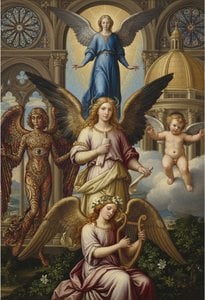
une vie marquée par un esprit créatif
william blake, artiste, poète et graveur visionnaire, a laissé une marque indélébile sur le monde de l'art. Né à Londres le 28 novembre 1757 et décédé le 12 août 1827, la vie de Blake témoigne de son profond esprit créatif.
Jeunesse et influences
La jeunesse de Blake a été marquée par un lien profond avec les arts. Son père,
william blake sr., marchand de laine, et sa mère,
catherine wright, ont influencé ses inclinations spirituelles et artistiques. Cela l'a conduit à une apprentissage auprès de
francisco bartolozzi, graveur.
Évolution artistique et œuvres notables
Le parcours artistique de Blake a traversé divers médiums, notamment la peinture, la poésie et la gravure. Certaines de ses œuvres les plus notables comprennent :
- The Tyger (1795) - chef-d'œuvre de la littérature romantique, présentant le mélange unique de Blake entre le mystique et le réel.
- The Sickle (1803) - exemple poignant de sa maîtrise de la gravure, reflétant son profond lien avec la nature.
- The Ghost of a Flea (c. 1819–1820) - témoignage de l'approche innovante de Blake envers l'art, brouillant les lignes entre la réalité et la fantaisie.
Musées présentant les œuvres de Blake
- Blake Museum, Royaume-Uni - destination incontournable pour tout amateur de Blake, abritant une collection étendue de ses œuvres d'art. [https://WahooArt.com/@/william-blake](https://WahooArt.com/@/william-blake)
- Fulham Public Library, Royaume-Uni - bien qu'elle ne soit pas exclusivement un musée de Blake, elle présente plusieurs de ses œuvres notables, offrant une perspective unique sur l'art britannique. [https://WahooArt.com/@@/a@d3bma9-discovering-the-artworks-of-fulham-public-library-united-kingdom](https://WahooArt.com/@@/a@d3bma9-discovering-the-artworks-of-fulham-public-library-united-kingdom)
Héritage et impact
L'influence de Blake sur l'art britannique est indéniable. Son mélange unique du mystique, du prophétique et de l'imaginatif a inspiré des générations d'artistes. En tant que précurseur du mouvement romantique, le travail de Blake continue de défier toute catégorisation facile, faisant de lui un pilier de la littérature et de l'art britanniques.
Pour aller plus loin
Pour en savoir plus sur William Blake et ses œuvres, explorez :



 Aperçu en situation
 Commander la reproduction peinte à la main
 Envoyer
 Partager
 Détails de l'œuvre

 Télécharger
 Articles similaires
 Radiographie
 Diaporama
 Stats
Stats
 Lire la suite






































 L'option verre n'est disponible que pour les dimensions inférieures à 110 cm.