Aperçu en situation Aperçu en RA Acheter la peinture faite à la main Passer au format image numérique Partager
Détails Ajouter aux favoris Télécharger Articles similaires Radiographie Voir le diaporama Statistiques

Untitled (10)

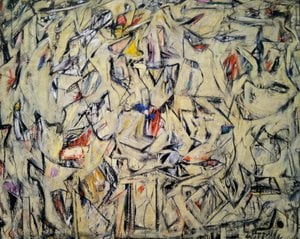
This monumental abstract expressionist painting by Willem de Kooning embodies the turbulent spirit of postwar America. Featuring fragmented figures and vibrant colors within a chaotic collage of furniture, it exemplifies De Kooning's signature "action painting" style.

Explorez le monde audacieux de Willem de Kooning (1904-1997), un pionnier de l'expressionnisme abstrait. Découvrez ses peintures emblématiques comme 'Woman I', connues pour leurs coups de pinceau dynamiques, leur figuration et leur intensité émotionnelle. Une figure clé de la Nouvelle École de New York.

Giclées et impressions d'art

Impressions giclées ou sur toile de qualité musée, avec une production rapide et des finitions au choix. ( Acheter la peinture faite à la main Passer au format image numérique)

P118B $10
P118H $10
P118W $10
P438Z $10
P508JH $12
P508YH $12
P805H $10
P805Z $10
P919BZ $10
P919G $10
P919XJ $10
P959ZH $10
P968JZ $12
W106C $8
W218G $10
W218JH $8
W218Y $10
W307PJ $10
W316G $10
W316PJ $8
W316Y $10
W398PJ $8
W4111J $10
W500HY $15
W500JH $15
W692G $12
W849H $8
W940BG $15
W953PJ $8

Format standard
personnalisé
CM
INCH

Choisissez parmi nos formats prédéfinis qui respectent les proportions originales de l’œuvre.

largeur
hauteur

Vous pouvez saisir vos propres dimensions pour vous adapter à un cadre ou à un espace spécifique. Si la taille sélectionnée ne correspond pas aux proportions de l'image originale, nous recadrerons l'œuvre ou étendrons l'image avec une bordure en miroir ou une couleur unie. Une maquette numérique vous sera envoyée pour approbation avant le début de la production.
Veuillez noter que l'aperçu à l'écran ne reflète pas le recadrage ou l'extension réelle. Seule la maquette montrera avec précision la composition finale.
Bien que des tailles personnalisées soient disponibles, nous vous recommandons de choisir une dimension dans la liste prédéfinie afin de préserver les proportions originales.

Livraison dans le monde entier () en 2 semaines au lieu des 4/5 semaines habituelles. (16 septembre)

why_choose_icon
Livraison express gratuite dans le monde entier
why_choose_icon
Toile de lin de haute qualité
why_choose_icon
Assurance transport complète
why_choose_icon
Garantie de remboursement des droits de douane
why_choose_icon
Garantie de fidélité des couleurs
why_choose_icon
Garantie de retour de 100 jours (uniquement en cas de défaut)
why_choose_icon
Garantie de remboursement à 100%
why_choose_icon
Tarifs dégressifs sur quantité

Prix total

$ 68

reproduction

Untitled (10)

Giclées et impressions d'art

Format de la reproduction

-

Prix total final

$ 68

L'essentiel de l'œuvre

  • Artistic style: Action Painting
  • Artist: Willem de Kooning
  • Notable elements or techniques: Collage, Fragmented Figures
  • Title: Untitled (10)
  • Subject or theme: Chaos, Emotion
  • Location: Private Collection

Quiz d'art

Chaque question ne comporte qu'une seule bonne réponse.

Question 1:
What artistic movement is Willem de Kooning primarily associated with?
Question 2:
The painting depicts a scene featuring several figures, but they appear to be...
Question 3:
What is a prominent technique employed by Willem de Kooning in this artwork?
Question 4:
Approximately when was this painting created?
Question 5:
The artwork’s overall mood can be described as...

A Symphony of Chaos: The Visceral World of Willem de Kooning

In the pantheon of mid-century modernism, few works command the room with such raw, unbridled energy as Willem de Kooning’s Untitled (10). Painted in 1950, this monumental canvas serves as a profound window into the heart of Abstract Expressionism, specifically the high-octane subgenre known as action painting. To stand before this piece is to witness an artist in the midst of a physical struggle with his medium. De Kooning did not merely paint; he famously described his process as attacking the canvas, and that sense of combat is palpable in every stroke. The work eschews the comfort of recognizable landscapes or serene portraits, opting instead to prioritize spontaneous gesture and impulsive marks as the primary conduits for human emotion.

The technique employed here is nothing short of sculptural. Through a heavy use of thick impasto, De Kooning creates palpable ridges and valleys of pigment that catch the light and cast miniature shadows across the surface. This layered approach gives the painting a three-dimensional vitality, where the texture itself mimics the feeling of psychological exertion and struggle. For the discerning collector or interior designer, this tactile quality offers an unparalleled depth, making the artwork feel less like a static image and more like a living, breathing entity that evolves as one moves around it.

Fragmented Identities and Domestic Tension

While the painting defies easy categorization, it is far from purely abstract. Within the swirling vortex of color and texture, one can discern the ghostly, distorted remnants of human figures and domestic objects. These fragmented forms—ostensibly human yet rendered with a grotesque, unsettling distortion—appear caught in an agitated confrontation. This deliberate fragmentation serves as a powerful symbol of psychological complexity and the fractured nature of identity in the post-war era. De Kooning uses these shapes to mirror the inner turmoil and anxieties that characterized the intellectual climate of the 1950s.

Adding a layer of profound unease to the composition is the inclusion of mundane objects, such as a chair and a dining table, scattered amidst the chaos. These elements ground the abstraction in a recognizable, albeit fractured, reality. The presence of furniture suggests a domestic setting fraught with tension, transforming a simple scene into an arena of existential dread. This juxtaposition of the familiar with the chaotic creates a captivating tension that draws the viewer deeper into the narrative, making it an ideal centerpiece for spaces that value intellectual depth and provocative conversation.

An Enduring Legacy for Modern Interiors

For those looking to curate a space of distinction, Untitled (10) offers more than just visual interest; it provides an emotional anchor. The vibrant and varied color palette, ranging from aggressive primaries to muted, earthy tones, allows the piece to integrate seamlessly into diverse high-end environments—from minimalist galleries to richly textured, eclectic studies. It is a work that demands attention and rewards prolonged contemplation.

Owning a high-quality reproduction of this masterpiece allows one to bring the revolutionary spirit of the New York School into the contemporary home. It serves as a tribute to an era when art broke free from its representational chains to explore the very essence of the human soul. Whether used to add a sense of movement to a quiet corner or to act as the bold protagonist of a large-scale room, this work remains a timeless testament to the power of spontaneous, uninhibited expression.


Biographie de l'artiste

jeunesse et carrière

Willem de Kooning, un artiste expressionniste abstrait néerlandais-américain renommé, est né le 24 avril 1904 à Rotterdam, aux Pays-Bas. Ses parents, Leendert de Kooning et Cornelia Nobel, ont divorcé en 1907, et de Kooning a vécu avec son père avant de passer sous la tutelle de sa mère. Il quitte l'école en 1916 et devient apprenti dans un cabinet d'arts commerciaux.

développement artistique

De Kooning a suivi des cours du soir à l’Académie des Beaux-Arts et des Sciences Techniques à Rotterdam de 1916 à 1924. En 1927, il s'installe à New York City, où il travaille comme peintre décorateur et commence à développer son style artistique unique.

expressionnisme abstrait

Le travail de De Kooning a évolué vers l’expressionnisme abstrait dans les années 1950, caractérisé par des coups de pinceau audacieux et des couleurs vibrantes. Sa peinture Woman I (1950-1952) est une œuvre fondamentale de ce mouvement, combinant la figuration à l'improvisation et à l'intensité émotionnelle.

œuvres notables et collections

* The Glazier (137 x 112 cm, huile sur toile) : une peinture sombre aux tons terreux inspirée des fresques de Boscoreale. * Door to the River (expressionnisme abstrait) : une peinture à large coup de pinceau rappelant son passé de peintre décorateur. * Standing Man (expressionnisme abstrait) : un exemple caractéristique du style expressionniste abstrait de De Kooning.

musées et collections

* Musée Boijmans Van Beuningen, Rotterdam, aux Pays-Bas : présente une impressionnante collection de plus de 151 000 œuvres d'art. * Bibliothèque universitaire de Leiden, aux Pays-Bas : abrite un centre culturel important avec plus de 5 200 000 volumes et 1 000 000 de livres électroniques. L'héritage de Willem de Kooning continue d'inspirer les artistes et les amateurs d'art, consolidant ainsi sa place en tant que pionnier de l'expressionnisme abstrait.
Willem de Kooning

Willem de Kooning

1904 - 1997 , Pays-Bas

En bref

  • Artistes Influents: ['Arshile Gorky']
  • Date De Décès: 19 mars 1997
  • Date De Naissance: 24 avril 1904
  • Lieu De Naissance: Rotterdam, Pays-Bas
  • Mouvement Artistique: Expressionnisme abstrait
  • Nationalité: Néerlandais-Américain
  • Nom Complet: Willem de Kooning
  • Oeuvres Notables:
    • Woman I
    • The Glazier
    • Excavation
Explorez des œuvres d'art classées par thèmes, styles et caractéristiques.