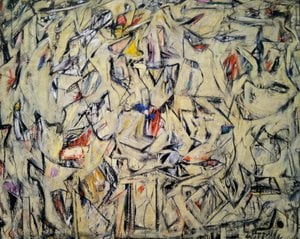
Willem de Kooning’s ‘Study for backdrop (labyrinth)’ – A Frenetic Dance of Form and Emotion
This vibrant, largely unknown work by Willem de Kooning, tentatively titled ‘Study for backdrop (labyrinth)’, offers a compelling glimpse into the artist's intensely personal and profoundly influential approach to Abstract Expressionism. Painted in 1946, during a period of intense experimentation and stylistic shifts within his oeuvre, the canvas pulsates with an almost primal energy – a testament to de Kooning’s relentless pursuit of raw emotion through purely formal means. The painting isn't simply a composition; it’s a visceral outpouring, a captured moment of restless contemplation rendered in bold, unapologetic color.
- Subject Matter: While ostensibly depicting animals – two dogs and three cats – the arrangement feels deliberately fragmented and unsettling. These creatures aren’t presented with any sense of narrative or traditional representation; instead, they become vehicles for de Kooning's exploration of form, color, and gesture.
- Technique: De Kooning employs a layered technique characteristic of his mature style. Thick impasto strokes dominate the surface, creating a tactile quality that invites close inspection. The paint is applied with a furious energy, building up areas of intense color and texture while leaving others relatively bare, revealing the underlying canvas beneath.
- Color Palette: The palette is dominated by jarring juxtapositions – fiery reds and oranges clash with cool blues and greens, creating a dynamic tension that mirrors the emotional intensity of the work. This deliberate use of contrasting colors was a key element in de Kooning’s strategy for disrupting traditional notions of harmony and balance.
The Context of Abstraction: De Kooning and the Second Generation
‘Study for backdrop (labyrinth)’ emerges from a pivotal moment in art history – the burgeoning Abstract Expressionist movement following World War II. De Kooning, along with artists like Jackson Pollock and Mark Rothko, was part of the “second generation” of American abstract painters who rejected European traditions and sought to forge a distinctly American artistic language. This period saw an increasing emphasis on individual expression and subjective experience, moving away from representational art towards purely formal concerns. De Kooning’s work reflects this shift, prioritizing the act of painting itself over any external subject or narrative.
The title, ‘Study for backdrop (labyrinth)’, hints at a process of exploration and experimentation. The term “study” suggests a preliminary sketch or working model, while "labyrinth" evokes a sense of complexity, disorientation, and perhaps even the artist's own internal struggles. It’s possible this piece was intended as a preparatory study for a larger mural or theatrical backdrop, further emphasizing its functional and dynamic nature.
Symbolism and Emotional Resonance
Despite its abstract qualities, ‘Study for backdrop (labyrinth)’ is rich in symbolic potential. The animals themselves can be interpreted as representing primal instincts, anxieties, or even the artist’s own fragmented psyche. The sports ball, a seemingly incongruous element, might symbolize competition, chaos, or the disruption of established order – themes frequently explored by de Kooning.
Ultimately, the painting's power lies in its ability to evoke a strong emotional response. The frenetic energy, jarring colors, and fragmented forms combine to create a sense of unease, tension, and perhaps even exhilaration. It’s a work that demands attention, inviting viewers to confront their own perceptions and emotions.
A Collector's Perspective
This exceptional piece offers a rare opportunity to acquire a significant work by one of the 20th century’s most important artists. A hand-painted reproduction captures not only the visual impact of ‘Study for backdrop (labyrinth)’ but also the textural richness and emotional depth of de Kooning's technique. Its dynamic composition and bold use of color make it an ideal addition to a wide range of interior design schemes, from modern minimalist spaces to more eclectic settings. This artwork is more than just decoration; it’s an investment in art history and a testament to the enduring power of Abstract Expressionism.



 Aperçu en situation
 Acheter la peinture faite à la main
 Partager
 Partager
 Détails
 Guide
Guide

 Télécharger
 Articles similaires
 Radiographie
 Voir le diaporama
 Statistiques

 Afficher la suite






































 L'option verre n'est disponible que pour les dimensions inférieures à 110 cm.