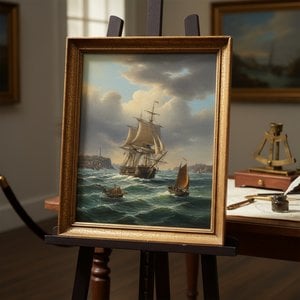
The Luminous Legacy of the Irish Robertson
In the delicate, intimate world of eighteenth-century portraiture, few names evoke as much charm and technical reverence as Walter Robertson. Known affectionately in the United States as "The Irish Robertson," he was a master of the miniature, an art form that required not only immense skill but a profound psychological sensitivity. Born in Dublin around 1750, Robertson emerged from a family of skilled miniaturists and jewelers, a lineage that likely provided him with his foundational understanding of fine detail and precious materials. His early years in Ireland were marked by a burgeoning talent that saw him excelling in the Dublin Society's School of Drawing, where his prowess in human studies earned him early accolades and set the stage for a career that would traverse the great artistic hubs of Europe and America.
The trajectory of Robertson’s life was as much about movement as it was about artistry. His journey took him from the cobblestone streets of Dublin to the sophisticated circles of London, and eventually to the burgeoning cultural landscape of New York. A pivotal moment in his professional development was his friendship with the legendary American easel painter Gilbert Stuart. This connection facilitated his move to New York in 1793, allowing his work to reach a new audience of American elites. Whether working in the bustling studios of London or the vibrant atmosphere of the young United States, Robertson maintained a stylistic consistency that made his hand instantly recognizable—a blend of Neoclassical elegance and an almost ethereal luminosity.
Mastery of Ivory and Light
To study a Robertson miniature is to witness a masterclass in the use of watercolor on ivory. This specific medium, favored by the era's most gifted miniaturists, offered a unique translucency that allowed light to pass through the pigment and reflect off the white surface of the ivory beneath. Robertson utilized this property to create skin tones that seemed to glow with life, capturing the subtle flush of a cheek or the soft contour of a jawline with unparalleled delicacy. His technique was characterized by fine, controlled brushstrokes that could convey the heavy texture of a velvet coat or the intricate lace of a cravat without ever overwhelming the small scale of the work.
His artistic development was deeply rooted in the Neoclassical tradition, an influence likely solidified during his apprenticeship under William Woolnoth. From Woolnoth, Robertson inherited a disciplined approach to form and a commitment to idealized yet accurate representation. This training allowed him to navigate the shifting aesthetic tides of the Napoleonic era, producing works that felt both timeless and contemporary. His portraits were not merely likenesses; they were carefully constructed windows into the social standing and character of his subjects. Through meticulous observation, he could imbue a tiny piece of ivory with the dignity of an aristocrat or the quiet intellect of a scholar.
A Catalogue of Elegance
The surviving body of Robertson's work serves as a precious historical record of the prominent figures of his age. His subjects were often individuals at the pinnacle of British and American society, captured in moments of poised sophistication. Some of his most notable achievements include:
- Lawrence Reid Yates: A rare 1794 miniature that exemplifies his ability to blend Neoclassical elegance with meticulous detail.
- Captain Joseph Anthony: A captivating portrait showcasing the artist's command over classical style and exquisite craftsmanship.
- John Jauncey Ketchum: A stunning watercolor on ivory from 1795, held in the Smithsonian American Art Museum, which demonstrates his exceptional skill in capturing texture and light.
- Mrs. Philip John Schuyler (Catherine van Rensselaer): A beautiful testament to his ability to render the delicate fashions of the eighteenth century.
Though historical records regarding his final years vary—with some accounts placing his death in London and others suggesting a more distant end in India—the impact of his artistry remains undiminished. Walter Robertson did more than just paint faces; he captured the very essence of an era defined by refinement, intellect, and a burgeoning global connection. His miniatures remain cherished treasures, offering a quiet, luminous glimpse into the hearts and histories of the past.



 Aperçu en situation
 Passer au format impression
 Partager
 Partager
 Détails
 Guide imprimable

 Télécharger
 Articles similaires
 Radiographie
 Voir le diaporama
 Statistiques


 Afficher la suite






































 L'option verre n'est disponible que pour les dimensions inférieures à 110 cm.