Aperçu en situation Aperçu en RA Passer au format impression Acheter la peinture faite à la main Partager
Détails Guide Ajouter aux favoris Télécharger Articles similaires Radiographie Voir le diaporama Statistiques

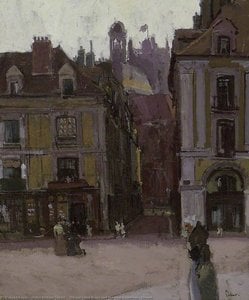
The Bar Parlour

Explore 'The Bar Parlour' by Walter Richard Sickert – an evocative Impressionist painting capturing London nightlife and featuring three figures in a dimly lit bar setting.

Découvrez Walter Richard Sickert (1860-1942), peintre britannique novateur ! Scènes de music-halls, portraits audacieux & influence sur l'art moderne.

Acquérez une image numérique haute résolution et optimisée, d'une qualité bien supérieure à l'aperçu en ligne.

Chaque fichier est méticuleusement préparé par nos spécialistes internes à l'aide d'outils avancés et d'une retouche manuelle experte. Nous garantissons que chaque image possède une clarté exceptionnelle, une précision des couleurs irréprochable et un niveau de détail fin.

Le fichier final est livré par e-mail sous 72 heures, optimisé pour une utilisation immédiate dans des contextes professionnels, éditoriaux et d'impression. Il offre la même qualité de confiance que celle utilisée par les plus grands studios de création, éditeurs et galeries.

Image numérique

Téléchargez un fichier haute résolution pour votre usage personnel, l'impression et vos projets créatifs. ( Passer au format impression Acheter la peinture faite à la main)

Prix total

$ 24,90

Inclus avec chaque commande d'image numérique

Livraison numérique experte, garantie.

En choisissant WahooArt.com, vous n'obtenez pas seulement une simple image : vous recevez une œuvre numérique sublimée avec professionnalisme, conçue avec précision et accompagnée d'une garantie de satisfaction. Voici tout ce qui accompagne automatiquement votre commande :

shipping_icon
Livraison rapide par e-mail

Votre fichier d'image numérique haute résolution vous sera envoyé par e-mail sous 72 heures après votre commande — prêt à un usage immédiat.

canvas_icon
Fichier numérique optimisé par l'IA

Votre œuvre d'art bénéficie d'une optimisation professionnelle grâce à des outils d'IA avancés et une retouche manuelle, garantissant un niveau maximal de détail, de clarté et de fidélité chromatique.

insurance_icon
Réexpédition gratuite à vie

Vous avez accidentellement supprimé ou perdu votre fichier ? Pas d'inquiétude — nous vous le renverrons gratuitement, quand vous le souhaitez.

tax_icon
Aucuns frais de douane — À jamais

Profitez de votre œuvre d'art instantanément sans frais de douane ni de livraison — les téléchargements numériques sont toujours exonérés de taxes.

color_icon
Garantie de fidélité des couleurs

Nous garantissons que votre image numérique reproduit les couleurs de l'original aussi fidèlement que possible grâce à des outils professionnels et une gestion rigoureuse des couleurs.

return_icon
Garantie de satisfaction de 100 jours

Si vous n'êtes pas satisfait de votre image numérique, nous la retoucherons ou vous rembourserons 100% sous 100 jours — sans poser de questions.

guarantee_icon
Garantie de remboursement à 100%

Pas satisfait ? Obtenez un remboursement intégral dans les 100 jours suivant la réception de votre fichier numérique — sans aucune question posée.

discount_icon
Remises sur les commandes groupées

Achetez 3 images, économisez 10% - Achetez 5, économisez 15% - Achetez 10+, économisez 20%. Idéal pour les projets créatifs, les galeries et les agences.

L'essentiel de l'œuvre

  • Dimensions: 104 x 158 cm
  • Location: Fitzwilliam Museum - University of Cambridge
  • Artistic style: Atmospheric Impressionism
  • Movement: Impressionism
  • Medium: Oil on canvas
  • Title: The Bar Parlour
  • Year: 1922

Quiz d'art

Chaque question ne comporte qu'une seule bonne réponse.

Question 1:
What artistic movement is Walter Richard Sickert’s ‘The Bar Parlour’ primarily associated with?
Question 2:
Describe the dominant color palette used in 'The Bar Parlour'. How does this contribute to the painting's atmosphere?
Question 3:
What is notable about Sickert’s depiction of the figures in ‘The Bar Parlour’? How does he convey psychological depth?
Question 4:
Where was ‘The Bar Parlour’ created?
Question 5:
What is a key characteristic of Sickert's style that distinguishes him from other artists of his time?

A Glimpse into London's Twilight: The Soul of Sickert's Bar Parlour

In the quiet, amber-hued corners of early twentieth-century London, Walter Richard Sickert found his most profound muses. The Bar Parlorp, painted in 1922, serves as a masterful window into a world that exists in the soft periphery of the bustling metropolis. This evocative piece captures a fleeting moment of repose within a dimly lit establishment, where the boundaries between public life and private intimacy begin to blur. Through his distinctive lens, Sickert does not merely document a scene; he invites the viewer to sit at the table, to feel the weight of the afternoon shadows, and to become a silent participant in this intimate tableau of everyday existence.

The composition is anchored by three figures who inhabit the space with a natural, unforced grace. Two women are seated at a table, their presence suggesting a shared confidence or perhaps a momentary respite from the world outside, while a man leans against the counter behind them, his posture embodying the weary yet watchful character of the urban dweller. There is a profound sense of theatricality in this arrangement—a nod to Sickert’s own early ambitions on the London stage. Every element, from the scattered bottles on the counter to the humble loaf of bread resting on the table, contributes to a narrative of domesticity found within the public sphere, creating a scene that feels both deeply personal and universally recognizable.

The Mastery of Impressionistic Light and Texture

Technically, The Bar Parlour is a triumph of late Impressionist sensibility. Sickert eschews the sharp, clinical lines of realism in favor of loose, expressive brushstrokes that prioritize atmosphere over anatomical precision. This technique allows the light to perform its own magic; rather than being a harsh, direct force, the illumination is soft and diffused, as if filtering through a haze of tobacco smoke and dust motes. The color palette is a sophisticated study in earth tones—deep ochres, warm umbers, and muted shadows—which coalesce to create an inviting, nostalgic warmth that wraps around the viewer like a heavy velvet curtain.

For the discerning collector or interior designer, this painting offers more than mere decoration; it provides a focal point of profound emotional depth. The texture of the paint itself adds a tactile dimension to the work, suggesting the weathered surfaces of the bar and the soft fabrics of the figures' attire. When rendered as a high-quality reproduction, the interplay of light and shadow retains its ability to transform a room, lending an air of sophisticated melancholy and timeless elegance to any curated space. It is a piece that does not demand attention through loudness, but rather commands it through a quiet, irresistible magnetism.

A Legacy of Shadows and Human Connection

To understand the emotional resonance of this work, one must consider Sickert’s unique position as an artist caught between German heritage and British urbanity. His fascination with the "marginalized" and the "unseen" is palpable here. There is no grand historical drama unfolding in The Bar Parlour; instead, the drama lies in the subtle psychological tension between the characters and the heavy, comforting stillness of their environment. It is a celebration of the mundane, elevated to the level of high art through sheer observational genius.

Owning or displaying a reproduction of this masterpiece allows one to bring a piece of London's historical soul into the modern home. It serves as a reminder of the beauty found in the quiet intervals of life—the moments of stillness amidst the chaos of progress. For those seeking to infuse their interiors with a sense of history, warmth, and intellectual depth, Sickert’s vision offers an unparalleled source of inspiration, bridging the gap between the fleeting present and the enduring past.


Biographie de l'artiste

Premières années et formation

Walter Richard Sickert, peintre britannico-allemand, est né le 31 mai 1860 à Munich, dans le royaume de Bavière. Sa famille s'est installée en Angleterre en 1868, après l'annexion du Schleswig-Holstein par l'Allemagne. La formation précoce de Sickert a débuté par un bref passage d’acteur, suivi de son inscription à la Slade School en 1881.

Développement artistique

Il est ensuite devenu l'élève de James Abbott McNeill Whistler, qui a considérablement influencé son œuvre. Les premières peintures de Sickert étaient de petites études tonales peintes "alla prima" directement d’après nature, suivant l’exemple de Whistler. Son approche évoluera vers un style plus personnel et distinctif.

Œuvres notables et controverses

Ses premières œuvres majeures, datant de la fin des années 1880, représentaient des scènes dans les music-halls londoniens. L'une de ses peintures les plus connues, Katie Lawrence at Gatti’s, a suscité la controverse en raison de sa représentation d'une chanteuse de music-hall bien connue, jugée « laide et vulgaire » par les critiques. Cette œuvre témoigne de son intérêt pour le réalisme social et l'observation directe de la vie quotidienne.

Association avec le Groupe de Camden Town

Sickert a été une influence importante sur les styles d’avant-garde britanniques au XXe siècle. Il a rejoint le New English Art Club en 1888, un groupe d'artistes réalistes influencés par l'art français, et est devenu plus tard membre du Groupe de Camden Town. Cette association marque une période clé dans son développement artistique, où il s’engage davantage dans les mouvements artistiques émergents.

Héritage et influence

L'œuvre de Sickert peut être admirée dans divers musées, dont le Museum Kunstsalon Franke Schenk, qui présente des œuvres du XVIe au XXe siècle. Son héritage dépasse sa propre œuvre, influençant les styles d’avant-garde britannique au milieu et à la fin du XXe siècle. Il est reconnu pour son approche unique de la peinture, combinant réalisme social, observation directe et une sensibilité particulière aux ambiances intimes et urbaines.
  • Découvrez 'Gaieté Montparnasse' de Sickert, peinture envoûtante de 1906 capturant la vie bohème parisienne. Intimité et influence impressionniste à WahooArt.com.
  • Portrait introspectif de George Moore par Walter Sickert (1890). Découvrez l'ambiance mélancolique et les coups de pinceau expressifs de cette œuvre post-impressionniste.
Dates clés : - 31 mai 1860 : né à Munich, royaume de Bavière - 1888 : rejoint le New English Art Club - 1903-04 : a développé une approche distinctive des tableaux à plusieurs figures lors de son dernier voyage de peinture à Venise.

Conclusion

Le travail pionnier de Walter Richard Sickert dans l’art d’avant-garde britannique a laissé une marque indélébile sur le monde de l'art. Son héritage continue d'inspirer et d'influencer les artistes, faisant de lui une figure cruciale dans l'histoire de l'art moderne.
Walter Richard Sickert

Walter Richard Sickert

1860 - 1942 , Allemagne

En bref

  • Artistes Influents: ['James Abbott McNeill Whistler']
  • Date De Décès: 22 janvier 1942
  • Date De Naissance: 31 mai 1860
  • Influence Sur Les Artistes: ['Camden Town Group']
  • Lieu De Naissance: Munich, Allemagne
  • Mouvement Artistique: Post-Impressionnisme
  • Nationalité: Britannique (d'origine allemande)
  • Nom Complet: Walter Richard Sickert
  • Œuvres Notables:
    • Katie Lawrence at Gatti’s
    • Gaieté Montparnasse