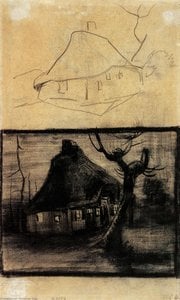
Tabernacle in the Heath
“Tabernacle in the Heath” by Vincent van Gogh stands as a poignant testament to the artist’s ability to distill profound emotion into deceptively simple visual elements. Created in 1886 during his formative years in Paris, this pencil drawing embodies Realism—a movement prioritizing truthful representation of everyday life—and reflects Van Gogh's unwavering fascination with capturing the essence of rural landscapes.
Artistic Style and Influences
Van Gogh’s stylistic approach is deeply rooted in Post-Impressionism. Like Impressionists before him, he sought to convey subjective experience rather than objective observation; however, unlike his predecessors, he rejected optical realism in favor of expressive brushwork and bold color palettes. The influence of Japanese woodblock prints – Ukiyo-e – is palpable in the flattened perspective and deliberate use of decorative lines, mirroring techniques found in traditional Japanese art.
- Realism: Van Gogh’s commitment to depicting reality with accuracy is evident in meticulous attention to detail—particularly in rendering the textures of grass and thatch.
- Post-Impressionism: Bold lines and expressive brushstrokes convey emotion, prioritizing feeling over precise visual representation.
- Japanese Influence: Flattened perspective and decorative linework echo stylistic conventions from Ukiyo-e prints.
The Scene Depicted
The drawing portrays a humble house nestled amidst a tranquil heathland. The thatched roof dominates the composition, symbolizing stability and domesticity against the backdrop of expansive greenery. Two figures stand outside the dwelling—one positioned to the left and another slightly further back—suggesting human presence within this serene environment. A smaller building is visible in the center, adding depth and complexity to the scene.
Symbolism and Emotional Impact
The muted color palette—primarily browns and greens—contributes to a contemplative mood, reflecting Van Gogh’s preoccupation with themes of solitude and contemplation. The twisted tree in the foreground serves as a visual metaphor for resilience and endurance, mirroring the artist's own struggles with mental health. Overall, “Tabernacle in the Heath” communicates a sense of peace and harmony, inviting viewers to appreciate the beauty of the natural world and contemplate its profound spiritual significance.
- Color Palette: Muted browns and greens evoke tranquility and contemplation.
- Symbolism: The twisted tree represents resilience and endurance.
- Mood: The artwork conveys a feeling of peace and harmony.
### Similar Artists and Collections
Artists exploring similar themes and styles include Niels Strøbek, whose realistic landscapes capture the spirit of Danish rural life. Notably, the Contini Bonacossi Collection at the Uffizi Gallery in Florence houses an impressive array of artworks spanning various periods and movements—including pieces by Gauguin and Cézanne—offering invaluable insight into artistic trends of the late 19th century.
- Niels Strøbek: Danish painter known for realistic depictions of rural landscapes.
- Contini Bonacossi Collection: Uffizi Gallery collection showcasing diverse artworks from various eras and styles.
### Further Exploration
For a deeper understanding of Vincent van Gogh’s artistic vision, consider visiting the Rijksmuseum Vincent Van Gogh in Amsterdam—home to the largest collection of his paintings—or exploring online resources like WikiArt (WikiArt) and Wikipedia (Wikipedia).



 Aperçu en situation
 Passer au format impression
 Partager
 Partager
 Détails
 Guide
Guide

 Télécharger
 Articles similaires
 Radiographie
 Voir le diaporama
 Statistiques

 Afficher la suite