


Impressions giclées ou sur toile de qualité musée, avec une production rapide et des finitions au choix. ( Commander la reproduction peinte à la main Acheter l'image haute résolution)





























Choisissez parmi nos formats prédéfinis qui respectent les proportions originales de l’œuvre.

Vous pouvez saisir vos propres dimensions pour vous adapter à un cadre ou à un espace spécifique. Si la taille sélectionnée ne correspond pas aux proportions de l'image originale, nous recadrerons l'œuvre ou étendrons l'image avec une bordure en miroir ou une couleur unie. Une maquette numérique vous sera envoyée pour approbation avant le début de la production.
Veuillez noter que l'aperçu à l'écran ne reflète pas le recadrage ou l'extension réelle. Seule la maquette montrera avec précision la composition finale.
Bien que des tailles personnalisées soient disponibles, nous vous recommandons de choisir une dimension dans la liste prédéfinie afin de préserver les proportions originales.
Livraison dans le monde entier () en 2 semaines au lieu des 4/5 semaines habituelles. (7 septembre)


Swift
Format de la reproduction
“Swift,” created in 1887 during Vincent van Gogh’s Parisian sojourn, stands as a testament to his unwavering dedication to capturing the essence of nature and movement. This unassuming pencil sketch on paper transcends mere representation; it embodies the spirit of Post-Impressionism—a stylistic rebellion against academic conventions that championed bold colors and expressive brushstrokes.
The painting’s composition is remarkably simple yet profoundly effective. Van Gogh utilizes horizontal lines to establish a grounding presence, mirroring the stillness of the landscape beneath which the bird takes flight. However, these lines are punctuated by dynamic diagonals—primarily emanating from the bird's wings—creating an illusion of motion that draws the viewer’s eye upwards and outwards. This deliberate juxtaposition underscores the artist’s fascination with conveying dynamism within a static framework.
Van Gogh’s technique is characterized by loose, impasto brushstrokes – thick layers of pigment applied directly to the paper surface—which imbue the sketch with palpable texture and vibrancy. The pencil lines themselves are not meticulously rendered but rather convey an immediacy and spontaneity that reflects Van Gogh's intuitive approach to artistic creation.
Painted against the backdrop of Impressionism’s waning influence, “Swift” represents a conscious departure from prevailing trends. While Impressionists sought to capture fleeting moments of light and color, Van Gogh prioritized emotional expression—a hallmark of Post-Impressionism—allowing his feelings about the natural world to permeate the artwork.
The bird itself serves as a potent symbol of freedom and aspiration. Its outstretched wings symbolize overcoming obstacles and reaching for higher ideals – themes that resonate deeply within Van Gogh’s personal struggles and artistic vision. The sketch's muted palette—primarily browns, ochres, and grays—contrasts sharply with the vibrancy of Impressionist landscapes, highlighting Van Gogh’s preference for conveying mood and atmosphere rather than photographic accuracy.
“Swift” aligns closely with Van Gogh’s broader artistic explorations during his Parisian period. Like Gauguin, he sought inspiration in Japanese woodblock prints—Ukiyo-e—which influenced his compositional choices and flattened perspectives. Consider also “The Potato Eaters,” where Van Gogh similarly depicts the hardships of rural life with unflinching honesty.
Notable reproductions from WahooArt.com offer exceptional detail and expert craftsmanship, allowing collectors to appreciate the nuances of Van Gogh’s technique and artistic sensibility. For a deeper understanding of his life and oeuvre, visit the Museum Boijmans Van Beuningen in Rotterdam – a treasure trove for admirers of Post-Impressionist art.
Ultimately, “Swift” remains a captivating glimpse into Vincent van Gogh's artistic soul—a timeless masterpiece that continues to inspire awe and admiration.


1853 - 1890 , Pays-Bas

Master the nuances of Impressionism vs. Post-Impressionism with our expert guide. Explore the revolutionary shift from Monet’s fleeting light to Van Gogh’s emotional depth. Discover how these iconic movements continue to inspire fine art collectors and modern interiors today.

Explore the profound emotional depth of Van Gogh's impasto technique. Discover how his sculptural brushstrokes and textured oil layers define Post-Impressionism through an expert art-historical lens, perfect for discerning collectors and fine art enthusiasts.
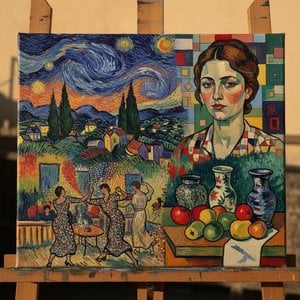
Unveil the profound revolution of Post-Impressionism. Explore how masters like Van Gogh and Cézanne utilized bold colors and emotional depth to transcend mere representation, laying the foundation for modern art. A sophisticated journey through history's most emotive brushstrokes.

 Aperçu en situation
 Envoyer
 Partager
 Détails de l'œuvre

 Télécharger
 Articles similaires
 Radiographie
 Diaporama

 Lire la suite







 L'option verre n'est disponible que pour les dimensions inférieures à 110 cm.


