The Illusion of Form: Exploring Vasarely's Geometric Universe
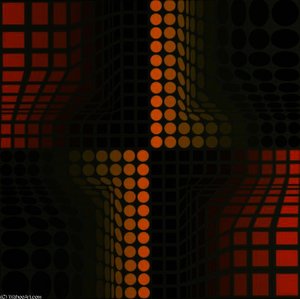
To stand before a work by Victor Vasarely is not merely to observe paint on canvas; it is to engage in a sophisticated dialogue with perception itself. This piece, characterized by its vibrant, almost pulsating geometric network, draws the viewer into a mesmerizing optical labyrinth. It speaks directly to the intellectual curiosity of the modern collector and the design sensibility of those who appreciate art as an architectural element. The composition, reminiscent of a honeycomb or a perfectly tessellated celestial map, uses color and line not just for decoration, but as active agents in creating visual vibration.
Mastery of Op Art and Optical Play
Vasarely stands as one of the undisputed pioneers of Op Art. His genius lay in taking the rigorous logic of mathematics and geometry—disciplines often considered cold or purely academic—and infusing them with breathtaking, almost psychedelic color. The technique employed here is a masterful manipulation of contrast and pattern repetition. These repeating shapes do not simply sit on the surface; they seem to shift, to breathe, and to vibrate against one another. This optical effect forces the eye into an active role, making the viewing experience inherently participatory. It challenges the viewer's assumption that art must represent something recognizable from the natural world.
A Historical Echo: From Bauhaus to Modern Abstraction
Understanding this work requires a glimpse into Vasarely’s rich artistic journey. Having absorbed the foundational principles of functional design and geometric abstraction during his time studying in environments influenced by the Bauhaus movement, Vasarely built a visual language rooted in pure structure. This piece is a perfect crystallization of that lineage—a bridge between the rigid order of early 20th-century modernism and the vibrant, almost kinetic energy of later abstract expressionism. It represents an intellectual triumph rendered with dazzling chromatic flair.
Symbolism and Emotional Resonance for the Modern Space
Beyond its technical brilliance, the symbolism within such a pattern is one of underlying order amidst apparent complexity. The honeycomb structure itself evokes themes of community, efficiency, and natural perfection—a visual metaphor for interconnected systems. For an interior designer, this piece offers unparalleled dynamism; it acts as a focal point that energizes a room without resorting to literal depiction. It suggests intelligence, modernity, and a sophisticated appreciation for pure form. Owning a reproduction allows one to bring this controlled explosion of color and pattern into a contemporary living space, transforming a mere wall into an active visual experience.



 Aperçu en situation
 Commander la reproduction peinte à la main
 Envoyer
 Partager
 Détails de l'œuvre

 Télécharger
 Articles similaires
 Radiographie
 Diaporama
 Statistiques

 Lire la suite






































 L'option verre n'est disponible que pour les dimensions inférieures à 110 cm.