Impressions giclées ou sur toile de qualité musée, avec une production rapide et des finitions au choix. ( Commander la reproduction peinte à la main Acheter l'image haute résolution)





























Choisissez parmi nos formats prédéfinis qui respectent les proportions originales de l’œuvre.

Vous pouvez saisir vos propres dimensions pour vous adapter à un cadre ou à un espace spécifique. Si la taille sélectionnée ne correspond pas aux proportions de l'image originale, nous recadrerons l'œuvre ou étendrons l'image avec une bordure en miroir ou une couleur unie. Une maquette numérique vous sera envoyée pour approbation avant le début de la production.
Veuillez noter que l'aperçu à l'écran ne reflète pas le recadrage ou l'extension réelle. Seule la maquette montrera avec précision la composition finale.
Bien que des tailles personnalisées soient disponibles, nous vous recommandons de choisir une dimension dans la liste prédéfinie afin de préserver les proportions originales.
Livraison dans le monde entier () en 2 semaines au lieu des 4/5 semaines habituelles. (6 septembre)


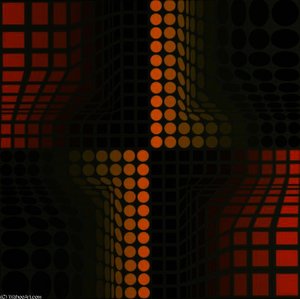
Untitled 20
Format de la reproduction
Victor Vasarely's "Untitled 20" is not merely a painting; it’s an invitation to reconsider the very nature of perception. This striking black and yellow composition, dominated by meticulously arranged squares and geometric forms, embodies the core tenets of Op Art – Optical Art – a movement that emerged in the mid-20th century with the audacious goal of stimulating visual responses through purely abstract designs. Born Károly Vaszary in 1906 in Pécs, Croatia, Vasarely’s artistic trajectory began unexpectedly, initially driven by an interest in medicine before he was captivated by the possibilities of visual expression. His formative years within the Bauhaus-influenced Műhely workshop instilled a profound understanding of functional design and geometric abstraction, principles that would become the bedrock of his revolutionary style.
The power of “Untitled 20” lies in its masterful manipulation of optical illusion. Vasarely employed a precise technique – layering squares of varying sizes and orientations – to create an effect that transcends the flat surface of the canvas. The interplay between yellow and black, combined with the nested square patterns, generates a dynamic sense of depth and movement. It’s as if the painting is actively shifting and morphing before your eyes, a testament to Vasarely's deliberate exploitation of human visual perception. This technique, central to Op Art, aimed to trick the eye into perceiving three-dimensional space within a two-dimensional format, a feat achieved through careful control of color, scale, and repetition.
Created in the late 1960s, “Untitled 20” reflects the broader artistic currents of its time. Following the devastation of World War II and the rise of consumer culture, artists sought new ways to engage with the modern world. Op Art, spearheaded by Vasarely alongside artists like Bridget Riley and Josef Albers, offered a radical response – a celebration of industrial design, technology, and the increasingly complex visual environment surrounding individuals. Vasarely’s work was deeply influenced by developments in kinetic art and his fascination with the principles of optics and color theory. He sought to create artwork that wasn't just observed but *experienced*, actively stimulating the viewer’s senses.
While ostensibly abstract, “Untitled 20” resonates with a deeper symbolic significance. The geometric forms – squares, in particular – represent order, structure, and rationality – concepts central to Vasarely's philosophical approach. The painting evokes a sense of controlled chaos, mirroring the complexities of modern life. It’s a visually stimulating experience that can be both calming and unsettling, prompting contemplation on perception, reality, and the relationship between art and the viewer. The bold use of color adds to this emotional impact, creating a vibrant and engaging visual field.
WahooArt offers meticulously crafted hand-painted reproductions of “Untitled 20,” ensuring that you experience the full power of Vasarely’s vision. Our skilled artisans employ traditional painting techniques to faithfully recreate this iconic artwork, capturing every nuance of color and detail. Whether adorning a contemporary interior or serving as a striking statement piece in a classic setting, this reproduction offers an unparalleled opportunity to own a piece of art history.

Victor Vasarely (né Károly Vaszary) a été une figure essentielle dans le développement de l'Op Art et de l'art cinétique. Son œuvre cherchait à transcender la peinture traditionnelle en explorant les illusions d’optique et en créant des expériences visuelles dynamiques. Né à Pécs, alors faisant partie de la Hongrie-Autriche (aujourd'hui en Croatie), sa vie précoce a impliqué l'étude de la médecine à l'Université Eötvös Loránd à Budapest avant de se consacrer pleinement à l'art.
La contribution de Vasarely à l’histoire de l’art est multiple. Il a dépassé les techniques picturales traditionnelles pour créer des œuvres qui engagent activement la perception du spectateur. Son approche systématique a remis en question les notions conventionnelles de créativité artistique et a ouvert la voie à l'art généré par ordinateur et à la conception numérique. En embrassant la reproductibilité et les applications commerciales, Vasarely a brouillé les frontières entre les beaux-arts et la culture populaire, laissant une marque durable sur les deux.

1906 - 1997 , Croatie

Explore the profound spiritual depth of geometric abstraction. From Malevich's Suprematism to modern masters, our expert guide reveals how pure form and color command presence in fine art collections.

Discover the profound beauty of abstract art. Our expert guide explores geometric abstraction, Op Art, and Expressionism, offering connoisseurs deep insights into collecting and curating powerful, non-representational masterpieces for sophisticated interiors.

 Aperçu en situation
 Envoyer
 Partager
 Détails de l'œuvre

 Télécharger
 Articles similaires
 Radiographie
 Diaporama

 Lire la suite







 L'option verre n'est disponible que pour les dimensions inférieures à 110 cm.