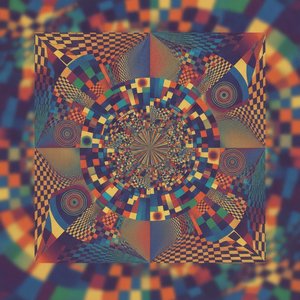
A Symphony of Geometry and Light
To encounter Victor Vasarely’s Tridim is to step into a realm where the boundaries of the two-dimensional canvas dissolve, replaced by a pulsating, architectural depth that defies the stillness of the frame. This mid-20th-century masterpiece serves as a profound exploration of how the human eye interprets space, acting as a cornerstone of the Op Art movement. At first glance, the viewer is met with a complex tapestry of overlapping cubes and planes, meticulously arranged in a hexagonal grid that seems to shift and breathe as one moves before it. There are no recognizable figures or landscapes here; instead, Vasarely rejects representational imagery to focus entirely on the transformative power of geometric abstraction. The artwork does not merely sit upon a wall; it interacts with the viewer’s perception, creating a kinetic experience that feels both mathematically precise and emotionally stirring.
The technical brilliance of Tridim lies in its masterful manipulation of color and light to engineer an optical illusion of three-dimensionality. Against a stark, void-like black background, a vibrant palette of reds, greens, blues, purples, and earthy browns is strategically deployed. Each hue is not merely a color but a tool used to define the edges of individual planes, creating subtle variations in luminosity that suggest highlights and deep shadows. This meticulous use of color gradation allows the viewer to perceive multiple cubes stacked upon one another, generating a sense of structural integrity and weight. The precision of the straight, geometric lines reinforces this sense of order, guiding the eye through a labyrinthine pattern that feels as much like a feat of engineering as it does a work of fine art.
The Legacy of Rationalism and Vision
The historical soul of Tridim is deeply rooted in the post-World War II era, a period defined by a cultural shift toward rationalism, clarity, and functional design. The influence of the Bauhaus movement is palpable within its disciplined structure, reflecting an era that sought beauty in simplified forms and mathematical harmony. Vasarely, drawing inspiration from the structural complexities of M.C. Escher and the color theories of Josef Albers, utilized these principles to push the boundaries of visual experience. His work embodies the spirit of a new age—one where art could be both intellectually stimulating and universally accessible, moving away from the subjective chaos of earlier movements toward a structured, rhythmic beauty.
For the discerning collector or interior designer, Tridim offers more than just a striking visual element; it provides a focal point of intellectual intrigue. Its ability to command attention through movement and depth makes it an extraordinary addition to modern spaces, where its vibrant energy can contrast beautifully with minimalist decor or complement the clean lines of contemporary architecture. Owning a high-quality reproduction of this work means bringing a piece of art history into the home—a piece that continues to challenge our understanding of space, light, and the very mechanics of sight. It is an invitation to linger, to observe, and to rediscover the magic hidden within the precision of geometry.
Questions et réponses
Où puis-je acheter une reproduction numérique de «Tridim» de Victor Vasarely ?
Pour obtenir une version numérique de «Tridim» de Victor Vasarely, commandez téléchargement d'une image numérique haute résolution sur sa page Image numérique haute résolution.
Quelle est la teinte dominante de «Tridim» de Victor Vasarely ?
«Tridim» tend vers une nuance Amber to Saffron.
Quelle atmosphère et quelle émotion se dégagent de « Tridim » ?
L'atmosphère qui se dégage de «Tridim» de Victor Vasarely est Modern, et sa tonalité émotionnelle est Calm.



 Commander la reproduction peinte à la main
 Envoyer
 Partager
 Détails de l'œuvre
 Guide
Guide

 Télécharger l'image
 Articles similaires
 Diaporama
 Q&A
Q&A Statistiques

 Lire la suite






































 L'option verre n'est disponible que pour les dimensions inférieures à 110 cm.