


Huile sur toile peinte à la main, avec cadre et dimensions personnalisés, réalisée sur commande par nos artistes. ( Commander l'impression Acheter l'image haute résolution)





























Choisissez parmi nos formats prédéfinis qui respectent les proportions originales de l’œuvre.

Vous pouvez saisir vos propres dimensions pour l'adapter à un cadre ou à un espace spécifique. Si la taille sélectionnée ne correspond pas aux proportions de l'image d'origine, nous recadrerons l'œuvre ou prolongerons la peinture avec des éléments peints à la main supplémentaires. Une maquette numérique vous sera envoyée pour approbation avant le début de la production.
Veuillez noter que l'aperçu à l'écran ne reflète pas le recadrage ou l'extension réels. Seule la maquette montrera fidèlement la composition finale.
Bien que des tailles personnalisées soient disponibles, nous vous recommandons de sélectionner une dimension dans la liste prédéfinie afin de préserver les proportions d'origine.
Livraison dans le monde entier () en 3 à 4 semaines au lieu des 5 semaines habituelles. (7 septembre). Aucun compromis sur la qualité.


Sikra
Format de la reproduction
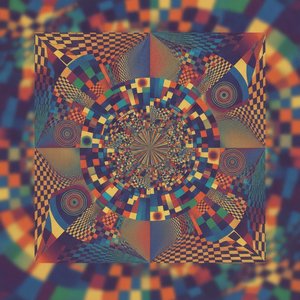
To encounter Victor Vasarely’s “Sikra” is to step away from the stillness of traditional viewing and enter a realm where the canvas breathes, pulses, and vibrates with an engineered energy. This masterpiece stands as a cornerstone of the Op Art movement—a revolution in visual perception that challenged the mid-20th century to reconsider the very mechanics of sight. The painting is not merely a static arrangement of pigment; it is an intellectual exploration into how our eyes interpret color and form, reflecting Vasarely's profound fascination with the intersection of mathematics and artistic expression. As the viewer engages with the work, the surface seems to undergo a rhythmic dance, creating a kinetic experience that transforms a flat plane into a dynamic, living entity.
The visual language of “Sikra” is built upon a foundation of meticulous geometric precision. The composition is dominated by a mesmerizing interplay of vibrant hues—bold blues juxtaposed against fiery reds, and sunny yellows dancing alongside verdant greens. Within this chromatic landscape, Vasarely employs a complex framework of circles, squares, and triangles. These shapes are not merely decorative elements; they embody mathematical concepts such as tessellations and fractals, where repeating geometric patterns create an illusion of depth and movement without the need for overlapping layers. Through the careful manipulation of color gradients and spatial relationships, Vasarely achieves a sense of structural tension, making the eye wander through a labyrinth of light and perceived motion.
The genesis of such groundbreaking work lies in the unique life journey of the artist himself. Born Károly Vaszary in 1906 in Pécs, Vasarely’s path toward becoming the "grandfather" of Op Art was anything but linear. Originally pursuing medical studies at Eötvös Loránd University, his transition to the fine arts in 1927 marked a pivot from studying human anatomy to mastering a different kind of anatomy: the mechanics of perception. His formative years in Budapest, particularly his enrollment in Sándor Bortnyik’s Műhely workshop, deeply embedded him in the principles of the Bauhaus movement. This exposure to functional design and geometric abstraction became the DNA of his later works, instilling a lifelong dedication to the idea that art could be both mathematically rigorous and universally accessible.
For the modern collector or interior designer, “Sikra” offers more than just aesthetic beauty; it provides a focal point of profound intellectual depth. The painting’s ability to interact with its environment—changing its perceived character depending on light and angle—makes it an extraordinary choice for sophisticated spaces. Whether placed in a contemporary gallery setting or as a bold statement piece in a curated residential interior, the work invites conversation and contemplation. It serves as a reminder of a time when art broke free from the window-like perspective of the past to become a direct, visceral experience, offering a timeless sense of wonder that continues to captivate the human spirit.
Victor Vasarely (né Károly Vaszary) a été une figure essentielle dans le développement de l'Op Art et de l'art cinétique. Son œuvre cherchait à transcender la peinture traditionnelle en explorant les illusions d’optique et en créant des expériences visuelles dynamiques. Né à Pécs, alors faisant partie de la Hongrie-Autriche (aujourd'hui en Croatie), sa vie précoce a impliqué l'étude de la médecine à l'Université Eötvös Loránd à Budapest avant de se consacrer pleinement à l'art.
La contribution de Vasarely à l’histoire de l’art est multiple. Il a dépassé les techniques picturales traditionnelles pour créer des œuvres qui engagent activement la perception du spectateur. Son approche systématique a remis en question les notions conventionnelles de créativité artistique et a ouvert la voie à l'art généré par ordinateur et à la conception numérique. En embrassant la reproductibilité et les applications commerciales, Vasarely a brouillé les frontières entre les beaux-arts et la culture populaire, laissant une marque durable sur les deux.

1906 - 1997 , Croatie
Explore the mesmerizing world of Victor Vasarely. Discover how his Bauhaus-inspired Op Art masters the science of perception through geometric abstraction and vibrant color. A sophisticated guide for discerning art collectors seeking to understand the legacy of optical illusion.

Embark on a visual journey through the mesmerizing world of Op Art. Discover the masters of optical illusion, explore geometric abstraction, and learn how to curate high-impact kinetic works for your private collection with expert guidance from art professionals.

Explore the profound spiritual depth of geometric abstraction. From Malevich's Suprematism to modern masters, our expert guide reveals how pure form and color command presence in fine art collections.

 Aperçu en situation
 Envoyer
 Partager
 Détails de l'œuvre

 Télécharger
 Articles similaires
 Radiographie
 Diaporama

 Lire la suite







 L'option verre n'est disponible que pour les dimensions inférieures à 110 cm.





