Victor Vasarely’s *Quadrature*: A Dance of Perception
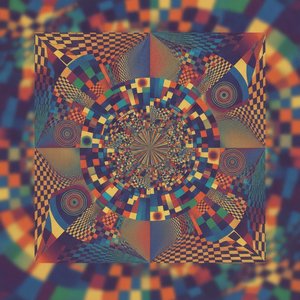
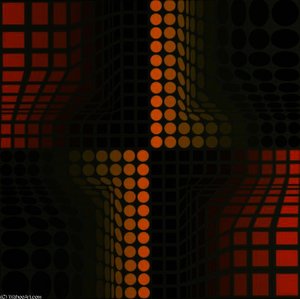
Victor Vasarely's *Quadrature* isn't merely a painting; it’s an invitation – an invitation to question the very nature of visual reality. Created by a visionary who anticipated the digital age, this work embodies the core tenets of Op Art, a movement that sought to manipulate perception through carefully constructed geometric forms and vibrant color fields. Painted in 1960s, *Quadrature* showcases Vasarely’s mastery of optical illusion, transforming two dynamic spheres into an experience that seems to vibrate with energy before your eyes. The bold use of yellow and orange, punctuated by strategic blue accents, isn't simply decorative; it’s a calculated orchestration designed to disrupt our ingrained assumptions about depth and space.
Geometric Abstraction and the Bauhaus Legacy
Vasarely’s artistic journey began far from the canvas. Initially trained as a medical student, his fascination with visual form led him to abandon conventional pursuits in favor of exploring abstraction. This path was profoundly shaped by his time at Sándor Bortnyik’s Műhely workshop, directly influenced by the revolutionary principles of the Bauhaus school. The Bauhaus emphasized functional design and geometric reduction – stripping away extraneous detail to reveal the essential structure of objects. Vasarely absorbed these ideas, translating them into a uniquely personal style characterized by precisely rendered circles, squares, and spheres arranged in dynamic compositions. *Quadrature* stands as a testament to this rigorous training, demonstrating a deep understanding of how our eyes perceive and interpret visual information.
The Illusion of Movement: Op Art’s Core Principles
At the heart of *Quadrature* lies the captivating technique that defines Op Art – the creation of an illusion of movement or depth through static imagery. Vasarely meticulously controlled color, scale, and repetition to achieve this effect. The overlapping spheres create a sense of infinite space, drawing the viewer’s eye across the canvas in a perpetual dance. This isn't about depicting a realistic scene; it’s about manipulating our visual system, triggering a neurological response that generates an impression of motion. The painting is a powerful demonstration of how art can actively engage with the viewer’s perception, challenging the boundaries between what is seen and what is felt.
Symbolism and Emotional Impact
While seemingly abstract, *Quadrature* resonates with profound symbolic weight. The geometric forms themselves represent fundamental building blocks of reality – circles symbolizing wholeness and unity, squares representing stability and order. The dynamic arrangement suggests a constant state of flux, mirroring the ever-changing nature of perception itself. More than just an aesthetic experience, *Quadrature* evokes a sense of wonder and intrigue, prompting contemplation about our relationship with space, time, and visual information. It’s a piece that rewards repeated viewing, revealing new layers of complexity with each encounter.
A Legacy of Innovation
*Quadrature* represents a pivotal moment in the history of art, solidifying Vasarely's place as a pioneer of Op Art and kinetic art. His influence extends far beyond the 1960s, inspiring generations of artists and designers. Today, reproductions like this one offer an accessible way to experience the brilliance of Vasarely’s vision – a timeless exploration of perception that continues to captivate and challenge viewers worldwide.



 Aperçu en situation
 Commander la reproduction peinte à la main
 Envoyer
 Partager
 Détails de l'œuvre

 Télécharger
 Articles similaires
 Radiographie
 Diaporama
 Statistiques

 Lire la suite






































 L'option verre n'est disponible que pour les dimensions inférieures à 110 cm.