Impressions giclées ou sur toile de qualité musée, avec une production rapide et des finitions au choix. ( Commander la reproduction peinte à la main Acheter l'image haute résolution)





























Choisissez parmi nos formats prédéfinis qui respectent les proportions originales de l’œuvre.

Vous pouvez saisir vos propres dimensions pour vous adapter à un cadre ou à un espace spécifique. Si la taille sélectionnée ne correspond pas aux proportions de l'image originale, nous recadrerons l'œuvre ou étendrons l'image avec une bordure en miroir ou une couleur unie. Une maquette numérique vous sera envoyée pour approbation avant le début de la production.
Veuillez noter que l'aperçu à l'écran ne reflète pas le recadrage ou l'extension réelle. Seule la maquette montrera avec précision la composition finale.
Bien que des tailles personnalisées soient disponibles, nous vous recommandons de choisir une dimension dans la liste prédéfinie afin de préserver les proportions originales.
Livraison dans le monde entier () en 2 semaines au lieu des 4/5 semaines habituelles. (7 septembre)


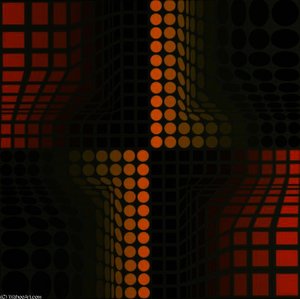
Axo-11
Format de la reproduction
Victor Vasarely's Axo-11 is not merely a painting; it’s an invitation to contemplate the very nature of perception. Created by one of the foremost figures in Op Art, this striking black and white composition immediately commands attention with its deceptively simple arrangement: a meticulously checkered square punctuated by a startlingly vibrant blue void. The image, a photographic representation of Vasarely's original work, captures the essence of his groundbreaking approach – a systematic exploration of optical illusions and the dynamic effects created through geometric abstraction.
Born in 1906 in Pécs, Croatia (then part of Austria-Hungary), Károly Vaszary, as he was initially known, embarked on a remarkable artistic journey. Initially drawn to medicine, his passion shifted dramatically upon enrolling at the Podolini-Volkmann Academy and later Sándor Bortnyik’s influential “Műhely” workshop – a direct descendant of the Bauhaus movement. This immersion in functional design and geometric abstraction proved transformative. Vasarely wasn't simply painting; he was meticulously constructing visual experiences, anticipating the rise of Op Art with his focus on manipulating perception through controlled patterns and color variations. His work reflects a deep engagement with the theories of Gestalt psychology, particularly the principles of figure-ground relationships – the inherent human tendency to organize visual elements into meaningful wholes.
The creation of Axo-11 exemplifies Vasarely’s precise technique. The black and white checkered pattern, achieved through meticulous layering and control of pigment density, generates a subtle but powerful sense of movement. This is not accidental; it's the deliberate orchestration of visual elements designed to trick the eye. The blue void, strategically placed at the center, acts as a focal point, intensifying the illusion of depth and creating an unsettling yet captivating dynamic. Vasarely’s process involved painstaking hand-painting, ensuring each element contributed to the overall effect – a testament to his dedication to precision and control. The seemingly static image is, in fact, a carefully constructed illusion, demanding active engagement from the viewer.
Beyond its purely optical properties, Axo-11 carries symbolic weight. The square, a fundamental geometric form, represents stability and order – yet this is immediately disrupted by the void, suggesting emptiness, uncertainty, or perhaps even the subconscious. The blue color itself, often associated with tranquility and spirituality, introduces an element of contrast and intrigue. Vasarely’s work isn't about depicting reality; it’s about exploring the subjective experience of seeing. The piece evokes a sense of both fascination and unease, prompting viewers to question their own perceptions and the way they interpret visual information. It’s a powerful reminder that our understanding of the world is inherently constructed.
Victor Vasarely (né Károly Vaszary) a été une figure essentielle dans le développement de l'Op Art et de l'art cinétique. Son œuvre cherchait à transcender la peinture traditionnelle en explorant les illusions d’optique et en créant des expériences visuelles dynamiques. Né à Pécs, alors faisant partie de la Hongrie-Autriche (aujourd'hui en Croatie), sa vie précoce a impliqué l'étude de la médecine à l'Université Eötvös Loránd à Budapest avant de se consacrer pleinement à l'art.
La contribution de Vasarely à l’histoire de l’art est multiple. Il a dépassé les techniques picturales traditionnelles pour créer des œuvres qui engagent activement la perception du spectateur. Son approche systématique a remis en question les notions conventionnelles de créativité artistique et a ouvert la voie à l'art généré par ordinateur et à la conception numérique. En embrassant la reproductibilité et les applications commerciales, Vasarely a brouillé les frontières entre les beaux-arts et la culture populaire, laissant une marque durable sur les deux.

1906 - 1997 , Croatie

Explore the profound spiritual depth of geometric abstraction. From Malevich's Suprematism to modern masters, our expert guide reveals how pure form and color command presence in fine art collections.

 Aperçu en situation
 Envoyer
 Partager
 Détails de l'œuvre

 Télécharger
 Articles similaires
 Radiographie
 Diaporama

 Lire la suite







 L'option verre n'est disponible que pour les dimensions inférieures à 110 cm.