Impressions giclées ou sur toile de qualité musée, avec une production rapide et des finitions au choix. ( Commander la reproduction peinte à la main Acheter l'image haute résolution)





























Choisissez parmi nos formats prédéfinis qui respectent les proportions originales de l’œuvre.

Vous pouvez saisir vos propres dimensions pour vous adapter à un cadre ou à un espace spécifique. Si la taille sélectionnée ne correspond pas aux proportions de l'image originale, nous recadrerons l'œuvre ou étendrons l'image avec une bordure en miroir ou une couleur unie. Une maquette numérique vous sera envoyée pour approbation avant le début de la production.
Veuillez noter que l'aperçu à l'écran ne reflète pas le recadrage ou l'extension réelle. Seule la maquette montrera avec précision la composition finale.
Bien que des tailles personnalisées soient disponibles, nous vous recommandons de choisir une dimension dans la liste prédéfinie afin de préserver les proportions originales.
Livraison dans le monde entier () en 2 semaines au lieu des 4/5 semaines habituelles. (6 septembre)


Akos Iv
Format de la reproduction
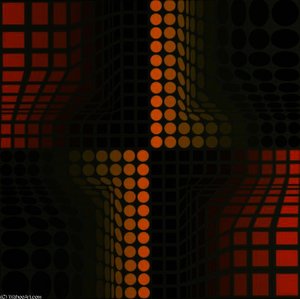
Victor Vasarely's "Akos Iv" is not merely a painting; it’s an invitation to question the very nature of perception. This striking close-up reveals a deceptively simple composition – a vibrant red square punctuated by a pristine white center, overlaid with a meticulously rendered checkered pattern reminiscent of honeycomb or a complex lattice. It's a quintessential example of Op Art, a movement that exploded onto the art scene in the mid-20th century and continues to captivate viewers with its mastery of optical illusion. The work’s power lies not just in its visual impact but also in its intellectual engagement – forcing us to confront how our eyes interpret shape, color, and space.
The deliberate juxtaposition of red and white is fundamental to “Akos Iv’s” effect. Red, traditionally associated with energy, passion, and movement, commands immediate attention. The stark contrast against the white creates a sense of depth and dynamism, drawing the eye across the surface. Vasarely wasn't simply applying color; he was manipulating it strategically to trigger specific visual responses. The checkered pattern further amplifies this effect, creating an illusion of movement and vibration that seems to shift with every subtle change in viewing position. This is a testament to Vasarely’s deep understanding of how the human eye processes information – a key principle behind Op Art.
"Akos Iv" was created during a period of significant artistic and intellectual upheaval. Following the devastation of World War II, artists were increasingly rejecting traditional representational art in favor of abstraction. Vasarely’s work aligned with this broader trend, but he took it further by actively exploring the scientific basis of perception. His approach anticipated developments in fields like psychology and optics, demonstrating a remarkable intersection between art and science. Born in Pécs, Croatia (then part of Austria-Hungary) in 1906, Vasarely’s early medical studies ultimately led him to a profound appreciation for visual form, shaping his lifelong dedication to geometric abstraction.
A hand-painted reproduction of “Akos Iv” offers a unique opportunity to own a piece of art history. These reproductions capture not only the visual impact of Vasarely’s original but also the meticulous craftsmanship that went into its creation. Beyond its aesthetic appeal, "Akos Iv" represents a pivotal moment in the development of modern art – a bold experiment with perception and illusion that continues to resonate today. Its vibrant colors and dynamic composition make it an ideal addition to contemporary interiors, adding a touch of intellectual stimulation and visual intrigue.
Victor Vasarely (né Károly Vaszary) a été une figure essentielle dans le développement de l'Op Art et de l'art cinétique. Son œuvre cherchait à transcender la peinture traditionnelle en explorant les illusions d’optique et en créant des expériences visuelles dynamiques. Né à Pécs, alors faisant partie de la Hongrie-Autriche (aujourd'hui en Croatie), sa vie précoce a impliqué l'étude de la médecine à l'Université Eötvös Loránd à Budapest avant de se consacrer pleinement à l'art.
La contribution de Vasarely à l’histoire de l’art est multiple. Il a dépassé les techniques picturales traditionnelles pour créer des œuvres qui engagent activement la perception du spectateur. Son approche systématique a remis en question les notions conventionnelles de créativité artistique et a ouvert la voie à l'art généré par ordinateur et à la conception numérique. En embrassant la reproductibilité et les applications commerciales, Vasarely a brouillé les frontières entre les beaux-arts et la culture populaire, laissant une marque durable sur les deux.

1906 - 1997 , Croatie

Explore the mesmerizing world of Victor Vasarely. Discover how his Bauhaus-inspired Op Art masters the science of perception through geometric abstraction and vibrant color. A sophisticated guide for discerning art collectors seeking to understand the legacy of optical illusion.

Embark on a visual journey through the mesmerizing world of Op Art. Discover the masters of optical illusion, explore geometric abstraction, and learn how to curate high-impact kinetic works for your private collection with expert guidance from art professionals.

Explore the profound impact of geometric form in art history. From Cubism to Op Art, discover how shape creates movement and emotion in masterpieces, and learn how to curate these powerful compositions for your private collection.

 Aperçu en situation
 Envoyer
 Partager
 Détails de l'œuvre

 Télécharger
 Articles similaires
 Radiographie
 Diaporama

 Lire la suite







 L'option verre n'est disponible que pour les dimensions inférieures à 110 cm.