Aperçu en situation Visualiser en RA Commander la reproduction peinte à la main Passer au format numérique Envoyer
Détails de l'œuvre Guide Ajouter aux favoris Télécharger l'image Articles similaires Radiographie Diaporama Statistiques

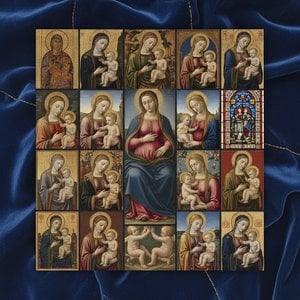
Virgin and Child

Experience the brilliance of Titian's 'Virgin and Child'! This masterpiece showcases Renaissance artistry with vibrant colors, emotional depth, and a captivating composition – a timeless treasure.

Tiziano Vecellio : Le titan vénitien ! Maître de la couleur et révolutionnaire de la peinture italienne avec ses œuvres emblématiques comme Venise et les Éléphants.

Giclées et impressions d'art

Impressions giclées ou sur toile de qualité musée, avec une production rapide et des finitions au choix. ( Commander la reproduction peinte à la main Passer au format numérique)

Corner sample of the P118B picture frame: polystyrène moulé, 5 cm wide and 3 cm thick
P118B €10
Corner sample of the P118H picture frame: polystyrène moulé, 5 cm wide and 3 cm thick
P118H €10
Corner sample of the P118W picture frame: polystyrène moulé, 5 cm wide and 3 cm thick
P118W €10
Corner sample of the P438Z picture frame: polystyrène moulé, 5.5 cm wide and 3.5 cm thick
P438Z €10
Corner sample of the P508JH picture frame: polystyrène moulé, 7 cm wide and 3.5 cm thick
P508JH €12
Corner sample of the P508YH picture frame: polystyrène moulé, 7 cm wide and 3.5 cm thick
P508YH €12
Corner sample of the P805H picture frame: polystyrène moulé, 5 cm wide and 3.5 cm thick
P805H €10
Corner sample of the P805Z picture frame: polystyrène moulé, 5 cm wide and 3.5 cm thick
P805Z €10
Corner sample of the P919BZ picture frame: polystyrène moulé, 7 cm wide and 3.5 cm thick
P919BZ €10
Corner sample of the P919G picture frame: polystyrène moulé, 7 cm wide and 3.5 cm thick
P919G €10
Corner sample of the P919XJ picture frame: polystyrène moulé, 7 cm wide and 3.5 cm thick
P919XJ €10
Corner sample of the P959ZH picture frame: polystyrène moulé, 5 cm wide and 3 cm thick
P959ZH €10
Corner sample of the P968JZ picture frame: polystyrène moulé, 6 cm wide and 4 cm thick
P968JZ €12
Corner sample of the W106C picture frame: bois massif, 5 cm wide and 3 cm thick
W106C €8
Corner sample of the W218G picture frame: bois massif, 5 cm wide and 3 cm thick
W218G €10
Corner sample of the W218JH picture frame: bois massif, 5 cm wide and 3 cm thick
W218JH €8
Corner sample of the W218Y picture frame: bois massif, 5 cm wide and 3 cm thick
W218Y €10
Corner sample of the W307PJ picture frame: bois massif, 6 cm wide and 3 cm thick
W307PJ €10
Corner sample of the W316G picture frame: bois massif, 6 cm wide and 3 cm thick
W316G €10
Corner sample of the W316PJ picture frame: bois massif, 6 cm wide and 3 cm thick
W316PJ €8
Corner sample of the W316Y picture frame: bois massif, 6 cm wide and 3 cm thick
W316Y €10
Corner sample of the W398PJ picture frame: bois massif, 5 cm wide and 3 cm thick
W398PJ €8
Corner sample of the W4111J picture frame: bois massif, 6.5 cm wide and 3.5 cm thick
W4111J €10
Corner sample of the W500HY picture frame: bois massif, 7 cm wide and 5 cm thick
W500HY €15
Corner sample of the W500JH picture frame: bois massif, 7 cm wide and 5 cm thick
W500JH €15
Corner sample of the W692G picture frame: bois massif, 8 cm wide and 4 cm thick
W692G €12
Corner sample of the W849H picture frame: bois massif, 5 cm wide and 3 cm thick
W849H €8
Corner sample of the W940BG picture frame: bois massif, 7.5 cm wide and 4.5 cm thick
W940BG €15
Corner sample of the W953PJ picture frame: bois massif, 6 cm wide and 3.5 cm thick
W953PJ €8

Format standard
sur mesure
CM
INCH

Choisissez parmi nos formats prédéfinis qui respectent les proportions originales de l’œuvre.

largeur
hauteur

Saisissez la largeur et la hauteur souhaitées pour qu'elles s'adaptent à votre cadre ou à votre mur. Une impression peut être recadrée, mais jamais agrandie au-delà de l'image originale ; ainsi, un format de forme différente entraînera la perte d'une partie de l'image. Nous vous envoyons une maquette numérique pour approbation avant toute impression. L'image présentée sur cette page ne montre pas le recadrage réel — seule la maquette le permet.

Livraison dans le monde entier () en 2 semaines au lieu des 4/5 semaines habituelles. (26 octobre)

Livraison express gratuite dans le monde entier
Toile de lin de qualité supérieure
Assurance transport complète
Garantie de remboursement des droits de douane
Garantie de fidélité des couleurs
Politique de retour de 100 jours (uniquement en cas de défaut)
Garantie de remboursement à 100%
Offre de tarifs dégressifs

Prix total

€ 60

Virgin and Child

Giclées et impressions d'art

Format de la reproduction

-

Prix total

€ 60

The Genesis of a Divine Portrait

Tiziano Vecellio, universally known as Titian, stands not merely as an artist of the Venetian Renaissance but as its very soul. Born around 1488 in the rugged foothills of the Dolomites – a landscape that would forever inform his vibrant palette – he was a revolutionary who redefined painting through sheer mastery of color and a profound understanding of human emotion. His ‘Virgin and Child,’ painted circa 1545, is more than just a devotional image; it’s a distillation of Titian's artistic philosophy, a testament to the power of light, texture, and the deeply felt connection between mother and child. The painting resides within the hallowed halls of the Fundación Colección Thyssen-Bornemisza in Pedralbes, Barcelona, a location that allows viewers to appreciate its scale and detail amidst a collection of equally magnificent works.

Titian’s Virgin and Child

A Mannerist Embrace: Style and Technique

‘Virgin and Child’ firmly establishes Titian within the burgeoning realm of Mannerism, a style that emerged in Italy during the late 15th and early 16th centuries. Unlike the idealized perfection of High Renaissance art, Mannerism embraced dynamism, asymmetry, and an almost unsettling intensity of emotion. Titian doesn't shy away from this; his brushstrokes are loose and expressive, creating a sense of movement and immediacy that draws the viewer into the scene. The composition itself is deliberately unbalanced – the Virgin’s figure dominates slightly to the right, while Christ leans towards her, fostering a palpable intimacy. This isn’t a static depiction but a moment captured in time, brimming with tenderness and quiet contemplation. The painting's foundation is built upon oil on panel, a medium that allowed Titian to layer colors with remarkable subtlety and achieve an astonishing level of luminosity. He employed a technique known as ‘impasto,’ applying thick layers of paint to create textural richness, particularly evident in the folds of Mary’s robe and the delicate details of Christ's garments.

Echoes of Faith and Family

The subject matter itself is deeply rooted in Christian iconography. The Virgin Mary, cradling her infant son Jesus, embodies both divine grace and maternal love. The blue of her dress – a color traditionally associated with purity and the heavens – immediately establishes her sacred status. Adding to this symbolism is the presence of Saint Anne, Mary’s mother, depicted behind them, offering a visual representation of lineage and familial devotion. The inclusion of two figures flanking the central scene adds depth and context, suggesting a broader narrative of faith and heritage. The curtain in the background, a recurring motif in Titian's work, serves as more than just a decorative element; it acts as a veil, separating the earthly realm from the divine, hinting at the mysteries of faith.

A Legacy of Color: Historical Context

Titian’s influence extended far beyond Venice. He was a sought-after portraitist for European royalty and nobility, capturing the power and prestige of figures like Charles V and Philip II of Spain. His work reflects the changing tastes of his patrons, moving from the more restrained style of the High Renaissance to a richer, more opulent aesthetic. The ‘Virgin and Child’ exemplifies this evolution, showcasing Titian's ability to synthesize classical ideals with Venetian sensuality. It’s important to note that the painting was created during a period of intense religious and political upheaval in Europe, marked by the Reformation and the rise of powerful centralized states. Titian’s art served as both a reflection of these turbulent times and a means of asserting Venetian identity and artistic dominance. The painting's journey through various collections—from the Sciarra-Colonna family in Rome to the Thyssen-Bornemisza collection—testifies to its enduring appeal and historical significance.

Questions et réponses

Qui est l'artiste derrière « Virgin and Child » ?

« Virgin and Child » a été créé par Titian. Les informations présentes sur cette page décrivent l'œuvre originale de Titian.

De quel type d'œuvre s'agit-il pour «Virgin and Child» de Titian ?

«Virgin and Child» de Titian est classé comme wall art. Cette catégorie définit la nature de l'œuvre originale.

Quelles sont les dimensions de l'original «Virgin and Child» de Titian ?

L'œuvre originale «Virgin and Child» de Titian mesure 38 x 31 cm.


Biographie de l'artiste

Tiziano Vecellio: The Venetian Titan

Tiziano Vecellio, universally known as Titian, stands as a monumental figure of the Italian Renaissance—perhaps its most celebrated colorist and a master who redefined the possibilities of oil painting. Born around 1490 in Pieve di Cadore, nestled amidst the dramatic landscapes of the Venetian Alps, his journey from humble beginnings to international acclaim is a testament to prodigious talent and an unwavering dedication to artistic innovation. The exact date of Titian’s birth remains elusive, debated among scholars, but contemporary sources and his early stylistic development converge on estimates between 1488 and 1490.

His father, Gregorio Vecellio, was a military man—a profession that instilled in young Tiziano a disciplined spirit and an appreciation for observation. Lucia, his mother, nurtured him with affection and fostered his artistic inclinations. Recognizing their sons’ potential, the family orchestrated Tiziano’s apprenticeship with Sebastiano Zuccato, a renowned mosaicist—a decision that would irrevocably steer him toward mastering one of Venice’s most prestigious crafts.

Giovanni Bellini, Titian’s elder brother and mentor, further honed his artistic skills. Under Bellini’s guidance, Tiziano absorbed the principles of Venetian painting—characterized by a harmonious blend of realism and spirituality—and developed a distinctive style marked by luminous colors and subtle tonal gradations. This formative period cemented Bellini's influence on Titian's aesthetic sensibilities.

Early Artistic Development & Giorgione’s Influence

The encounter with Giorgione proved pivotal in shaping Tiziano’s artistic trajectory. Like Bellini, Giorgione had trained under Giovanni Bellini—establishing a lineage of Venetian artists committed to exploring innovative visual languages. Together, they embarked on ambitious projects, notably the decoration of the Fondaco dei Tedeschi—a bustling trading post frequented by German merchants—where their collaboration yielded masterpieces that epitomized the Venetian Renaissance.

Giorgione’s distinctive style—characterized by hazy atmospheric effects and muted palettes—challenged conventional artistic conventions. Tiziano embraced Giorgione’s aesthetic principles, incorporating similar techniques into his own paintings. *A Man with a Quilted Sleeve*, completed around 1509, exemplifies this stylistic fusion—demonstrating Tiziano’s burgeoning talent for portraiture while simultaneously reflecting Giorgione’s ethereal vision.

Venetian Mastery & Expanding Horizons

Titian swiftly ascended to prominence within Venice’s artistic milieu. He secured commissions from influential patrons—including Alfonso I d’Este and Cardinal Giovanni Grimani—and established himself as one of the foremost painters of his era. His reputation for capturing psychological depth and rendering textures with remarkable accuracy quickly garnered acclaim.

Among his most celebrated achievements were the frescoes adorning Santa Maria Gloriosa dei Frari—a monumental undertaking that showcased Tiziano’s mastery of color and composition. The ambitious project cemented his position as a leading figure in Venetian painting and solidified his legacy as an innovator who pushed the boundaries of artistic expression.

Beyond Venice, Titian cultivated relationships with artists across Europe—including Peter Paul Rubens and Rembrandt—who recognized him as a beacon of artistic excellence. His influence extended far beyond his lifetime, shaping the stylistic sensibilities of subsequent generations of painters and cementing his place among the titans of Western art history.

A Legacy Illuminated

Titian died in Venice in 1576—leaving behind an unparalleled oeuvre that continues to captivate audiences worldwide. His paintings reside in museums spanning continents—from the Galleria Palatina in Florence to the Prado Museum in Madrid and the National Gallery in London—serving as enduring reminders of his artistic genius.

To gaze upon a Titian is to immerse oneself in a realm of luminous color, masterful brushwork, and profound psychological insight. He remains an unsurpassed exemplar of Renaissance artistry—a painter who transformed the visual language of his time and bequeathed to posterity a legacy of beauty and innovation that continues to inspire awe and admiration.

Titian

Titian

1490 - 1576 , Italie

L'essentiel de l'artiste

  • Artistic Movement Or Style: Renaissance, Venise
  • Artists Or Movements Influenced By This Artist:
    • Rubens
    • Delacroix
  • Artists Who Influenced This Artist:
    • Giovanni Bellini
    • Giorgione
  • Date Of Birth: c. 1490
  • Date Of Death: 1576
  • Full Name: Tiziano Vecellio
  • Nationality: Italien
  • Notable Artworks:
    • La Schiavona
    • Venus Urbino
  • Place Of Birth: Pieve di Cadore, Italie
Explorez des œuvres d'art classées par thèmes, styles et caractéristiques.