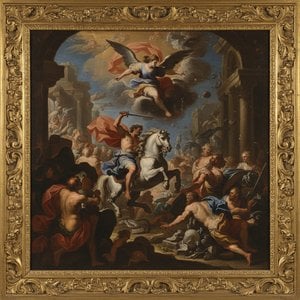
Tiziano Vecellio: The Venetian Titan
Tiziano Vecellio, universally known as Titian, stands as a monumental figure of the Italian Renaissance—perhaps its most celebrated colorist and a master who redefined the possibilities of oil painting. Born around 1490 in Pieve di Cadore, nestled amidst the dramatic landscapes of the Venetian Alps, his journey from humble beginnings to international acclaim is a testament to prodigious talent and an unwavering dedication to artistic innovation. The exact date of Titian’s birth remains elusive, debated among scholars, but contemporary sources and his early stylistic development converge on estimates between 1488 and 1490.
His father, Gregorio Vecellio, was a military man—a profession that instilled in young Tiziano a disciplined spirit and an appreciation for observation. Lucia, his mother, nurtured him with affection and fostered his artistic inclinations. Recognizing their sons’ potential, the family orchestrated Tiziano’s apprenticeship with Sebastiano Zuccato, a renowned mosaicist—a decision that would irrevocably steer him toward mastering one of Venice’s most prestigious crafts.
Giovanni Bellini, Titian’s elder brother and mentor, further honed his artistic skills. Under Bellini’s guidance, Tiziano absorbed the principles of Venetian painting—characterized by a harmonious blend of realism and spirituality—and developed a distinctive style marked by luminous colors and subtle tonal gradations. This formative period cemented Bellini's influence on Titian's aesthetic sensibilities.
Early Artistic Development & Giorgione’s Influence
The encounter with Giorgione proved pivotal in shaping Tiziano’s artistic trajectory. Like Bellini, Giorgione had trained under Giovanni Bellini—establishing a lineage of Venetian artists committed to exploring innovative visual languages. Together, they embarked on ambitious projects, notably the decoration of the Fondaco dei Tedeschi—a bustling trading post frequented by German merchants—where their collaboration yielded masterpieces that epitomized the Venetian Renaissance.
Giorgione’s distinctive style—characterized by hazy atmospheric effects and muted palettes—challenged conventional artistic conventions. Tiziano embraced Giorgione’s aesthetic principles, incorporating similar techniques into his own paintings. *A Man with a Quilted Sleeve*, completed around 1509, exemplifies this stylistic fusion—demonstrating Tiziano’s burgeoning talent for portraiture while simultaneously reflecting Giorgione’s ethereal vision.
Venetian Mastery & Expanding Horizons
Titian swiftly ascended to prominence within Venice’s artistic milieu. He secured commissions from influential patrons—including Alfonso I d’Este and Cardinal Giovanni Grimani—and established himself as one of the foremost painters of his era. His reputation for capturing psychological depth and rendering textures with remarkable accuracy quickly garnered acclaim.
Among his most celebrated achievements were the frescoes adorning Santa Maria Gloriosa dei Frari—a monumental undertaking that showcased Tiziano’s mastery of color and composition. The ambitious project cemented his position as a leading figure in Venetian painting and solidified his legacy as an innovator who pushed the boundaries of artistic expression.
Beyond Venice, Titian cultivated relationships with artists across Europe—including Peter Paul Rubens and Rembrandt—who recognized him as a beacon of artistic excellence. His influence extended far beyond his lifetime, shaping the stylistic sensibilities of subsequent generations of painters and cementing his place among the titans of Western art history.
A Legacy Illuminated
Titian died in Venice in 1576—leaving behind an unparalleled oeuvre that continues to captivate audiences worldwide. His paintings reside in museums spanning continents—from the Galleria Palatina in Florence to the Prado Museum in Madrid and the National Gallery in London—serving as enduring reminders of his artistic genius.
To gaze upon a Titian is to immerse oneself in a realm of luminous color, masterful brushwork, and profound psychological insight. He remains an unsurpassed exemplar of Renaissance artistry—a painter who transformed the visual language of his time and bequeathed to posterity a legacy of beauty and innovation that continues to inspire awe and admiration.



 Aperçu en situation
 Passer au format impression
 Partager
 Partager
 Détails

 Télécharger
 Articles similaires
 Radiographie
 Voir le diaporama
 Statistiques

 Afficher la suite






































 L'option verre n'est disponible que pour les dimensions inférieures à 110 cm.