A Vision of Intellectual Might
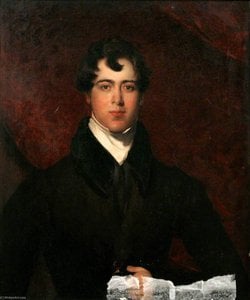
In the grand tradition of British portraiture, few works capture the intersection of political gravity and intellectual fervor as profoundly as Thomas Phillips’s Henry Peter Brougham, Baron Brougham and Vaux. Created around 1807, this masterpiece serves as more than a mere likeness; it is a psychological study of a man destined to shape the course of Victorian history. As the viewer encounters the subject, they are immediately struck by a commanding presence that transcends the canvas. Phillips does not simply paint a statesman; he sculpts an icon of the Romantic era, presenting Brougham with a gaze that seems to pierce through the veil of time, reflecting the unwavering conviction of a man dedicated to parliamentary reform and the abolition of slavery.
The portrait functions as a window into the soul of an era defined by debate and moral evolution. Through the dignified posture and the intense, luminous eyes, Phillips communicates the weight of responsibility carried by the nineteenth-century intellectual elite. For the discerning collector or interior designer, this piece offers a profound sense of gravitas, making it an ideal centerpiece for spaces that demand an atmosphere of sophistication, wisdom, and historical depth.
The Mastery of Light and Shadow
Technically, the portrait is a triumph of the academic style, showcasing Phillips’s extraordinary ability to manipulate chiaroscuro. The artist employs dramatic contrasts between deep, receding shadows and brilliant highlights to give Brougham’s features a three-dimensional vitality. This interplay of light does not merely illuminate the subject; it defines his very character. The meticulous application of thin oil glazes creates a velvety texture on the skin, while the subtle reflections in the eyes suggest a sharp, analytical mind at work.
Every brushstroke reveals the artist's rigorous training, from the precise rendering of the subject's facial hair to the heavy, dignified folds of his attire. The background, a rich and dramatic crimson, serves a dual purpose: it provides a striking color contrast that pushes the figure forward toward the viewer, and it symbolizes the passion and political turbulence of Brougham’s life. This masterful use of color and light ensures that the painting possesses a rhythmic energy, drawing the eye across the composition in a continuous loop of discovery.
An Enduring Legacy for the Modern Collector
To possess a reproduction of this work is to invite a piece of British heritage into one's environment. The portrait of Baron Brougham and Vaux resonates with anyone who appreciates the power of storytelling through art. It embodies the spirit of an age where ideas were forged in the fires of rhetoric and reform. For those seeking to curate a collection that speaks of erudition and strength, this painting provides an unparalleled emotional impact.
Whether placed in a private library, a formal study, or a contemporary living space, the artwork acts as a silent interlocutor, sparking conversation and inspiring reflection. It is a testament to the enduring allure of the human spirit and the timeless beauty of classical portraiture—a perfect acquisition for those who value art that possesses both historical significance and aesthetic splendor.



 Aperçu en situation
 Acheter la peinture faite à la main
 Partager
 Partager
 Détails
 Guide
Guide

 Télécharger
 Articles similaires
 Radiographie
 Voir le diaporama
 Statistiques


 Afficher la suite






































 L'option verre n'est disponible que pour les dimensions inférieures à 110 cm.