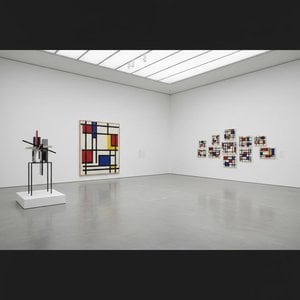
Aperçu en situation Aperçu en RA Acheter la peinture faite à la main Passer au format image numérique Partager
Détails Guide imprimable Ajouter aux favoris Télécharger Articles similaires Radiographie Voir le diaporama Statistiques

Counter composition X

Experience Theo van Doesburg's bold 1924 abstract composition featuring primary colors; own a piece of geometric modern art history today.

Découvrez Theo van Doesburg (1883-1931), fondateur du De Stijl & Néoplasticisme ! Explorez ses abstractions géométriques, son influence Bauhaus et son impact sur l'art moderne.

Giclées et impressions d'art

Impressions giclées ou sur toile de qualité musée, avec une production rapide et des finitions au choix. ( Acheter la peinture faite à la main Passer au format image numérique)

Corner sample of the P118B picture frame: moulded polystyrene, 5 cm wide and 3 cm thick
P118B €10
Corner sample of the P118H picture frame: moulded polystyrene, 5 cm wide and 3 cm thick
P118H €10
Corner sample of the P118W picture frame: moulded polystyrene, 5 cm wide and 3 cm thick
P118W €10
Corner sample of the P438Z picture frame: moulded polystyrene, 5.5 cm wide and 3.5 cm thick
P438Z €10
Corner sample of the P508JH picture frame: moulded polystyrene, 7 cm wide and 3.5 cm thick
P508JH €12
Corner sample of the P508YH picture frame: moulded polystyrene, 7 cm wide and 3.5 cm thick
P508YH €12
Corner sample of the P805H picture frame: moulded polystyrene, 5 cm wide and 3.5 cm thick
P805H €10
Corner sample of the P805Z picture frame: moulded polystyrene, 5 cm wide and 3.5 cm thick
P805Z €10
Corner sample of the P919BZ picture frame: moulded polystyrene, 7 cm wide and 3.5 cm thick
P919BZ €10
Corner sample of the P919G picture frame: moulded polystyrene, 7 cm wide and 3.5 cm thick
P919G €10
Corner sample of the P919XJ picture frame: moulded polystyrene, 7 cm wide and 3.5 cm thick
P919XJ €10
Corner sample of the P959ZH picture frame: moulded polystyrene, 5 cm wide and 3 cm thick
P959ZH €10
Corner sample of the P968JZ picture frame: moulded polystyrene, 6 cm wide and 4 cm thick
P968JZ €12
Corner sample of the W106C picture frame: solid wood, 5 cm wide and 3 cm thick
W106C €8
Corner sample of the W218G picture frame: solid wood, 5 cm wide and 3 cm thick
W218G €10
Corner sample of the W218JH picture frame: solid wood, 5 cm wide and 3 cm thick
W218JH €8
Corner sample of the W218Y picture frame: solid wood, 5 cm wide and 3 cm thick
W218Y €10
Corner sample of the W307PJ picture frame: solid wood, 6 cm wide and 3 cm thick
W307PJ €10
Corner sample of the W316G picture frame: solid wood, 6 cm wide and 3 cm thick
W316G €10
Corner sample of the W316PJ picture frame: solid wood, 6 cm wide and 3 cm thick
W316PJ €8
Corner sample of the W316Y picture frame: solid wood, 6 cm wide and 3 cm thick
W316Y €10
Corner sample of the W398PJ picture frame: solid wood, 5 cm wide and 3 cm thick
W398PJ €8
Corner sample of the W4111J picture frame: solid wood, 6.5 cm wide and 3.5 cm thick
W4111J €10
Corner sample of the W500HY picture frame: solid wood, 7 cm wide and 5 cm thick
W500HY €15
Corner sample of the W500JH picture frame: solid wood, 7 cm wide and 5 cm thick
W500JH €15
Corner sample of the W692G picture frame: solid wood, 8 cm wide and 4 cm thick
W692G €12
Corner sample of the W849H picture frame: solid wood, 5 cm wide and 3 cm thick
W849H €8
Corner sample of the W940BG picture frame: solid wood, 7.5 cm wide and 4.5 cm thick
W940BG €15
Corner sample of the W953PJ picture frame: solid wood, 6 cm wide and 3.5 cm thick
W953PJ €8

Format standard
personnalisé
CM
INCH

Choisissez parmi nos formats prédéfinis qui respectent les proportions originales de l’œuvre.

largeur
hauteur

Vous pouvez saisir vos propres dimensions pour vous adapter à un cadre ou à un espace spécifique. Si la taille sélectionnée ne correspond pas aux proportions de l'image originale, nous recadrerons l'œuvre ou étendrons l'image avec une bordure en miroir ou une couleur unie. Une maquette numérique vous sera envoyée pour approbation avant le début de la production.
Veuillez noter que l'aperçu à l'écran ne reflète pas le recadrage ou l'extension réelle. Seule la maquette montrera avec précision la composition finale.
Bien que des tailles personnalisées soient disponibles, nous vous recommandons de choisir une dimension dans la liste prédéfinie afin de préserver les proportions originales.

Livraison dans le monde entier () en 2 semaines au lieu des 4/5 semaines habituelles. (10 octobre)

Livraison express gratuite dans le monde entier
Toile de lin de haute qualité
Assurance transport complète
Garantie de remboursement des droits de douane
Garantie de fidélité des couleurs
Garantie de retour de 100 jours (uniquement en cas de défaut)
Garantie de remboursement à 100%
Tarifs dégressifs sur quantité

Prix total

€ 59

Counter composition X

Giclées et impressions d'art

Format de la reproduction

-

Prix total final

€ 59

L'essentiel de l'œuvre

  • Subject or theme: Geometric squares
  • Dimensions: 50 x 50 cm
  • Artist: Theo van Doesburg
  • Title: Counter composition X
  • Artistic style: Abstraction

Quiz d'art

Chaque question ne comporte qu'une seule bonne réponse.

Question 1:
What artistic movement is Theo van Doesburg most associated with?
Question 2:
The artwork 'Counter composition X' is characterized by:
Question 3:
In what year was 'Counter composition X' created?
Question 4:
The painting described features four distinct colored squares. Which color is located in the upper left corner?
Question 5:
Theo van Doesburg's artistic philosophy emphasized channeling an inner reality through:

The Geometry of Pure Being: Exploring Counter composition X

To stand before Theo van Doesburg's Counter composition X is not merely to observe paint on canvas; it is to encounter a moment of profound intellectual clarity, a visual manifesto rendered in primary colors and absolute structure. This piece, dating from 1924, pulses with the revolutionary spirit of early modernism. It presents itself as a seemingly simple square, yet within its rigid confines—the bold placement of red in the upper left, yellow centrally positioned, blue anchoring the lower left, and black completing the composition in the lower right—lies an entire philosophy. Van Doesburg strips away the illusion of depth and narrative chaos, leaving behind only the essential dialogue between form and color.

A Testament to De Stijl's Vision

This work is deeply embedded within the ethos of Neoplasticism, the movement that gave rise to De Stijl. For Van Doesburg, art could no longer afford the sentimental trappings of representation. The world, he argued, was best understood not through mimicry, but through its underlying structural harmonies. Counter composition X embodies this quest for universal order. The technique is characterized by an almost ascetic purity; clean lines meet flat planes of saturated color. It speaks to a desire to distill existence down to its most fundamental components—the vertical and the horizontal, the primary hues. Owning a reproduction of this piece allows one to bring that same sense of disciplined harmony into a contemporary living space.

Symbolism in Primary Dialogue

The selection of colors is never arbitrary; it is a carefully orchestrated symbolic language. The primaries—red, yellow, and blue—are the foundational notes of visual experience, while black provides the necessary grounding counterpoint. These elements interact not as separate entities, but as interdependent forces balancing within the square matrix. Consider the tension between the vibrant red corner and the deep, stabilizing black quadrant. This interplay suggests a dynamic equilibrium—a perfect balance achieved through opposing yet complementary forces. It is an abstract meditation on structure itself, suggesting that true beauty resides in the relationship between parts.

Emotional Resonance for the Modern Collector

For the collector or designer, Counter composition X offers more than mere decoration; it offers a focal point of contemplation. Its bold graphic nature acts as an immediate visual anchor, capable of elevating any room from mundane to monumental. The emotional impact is one of invigorating calm—the kind that comes from understanding underlying principles. It demands that the viewer slow down, look closer, and engage their intellect alongside their eye. Whether displayed in a minimalist gallery setting or integrated into a richly decorated interior, this painting asserts an undeniable modern sophistication, celebrating geometry as the ultimate form of expressive power.

Questions et réponses

Quel âge avait Theo van Doesburg lors de la création de « Counter composition X » en 1924 ?

Theo van Doesburg a réalisé « Counter composition X » à l'âge de 41. L'artiste est né en 1883 et l'œuvre date de 1924.

Que représente "Counter composition X" et quelle atmosphère s'en dégage ?

«Counter composition X» de Theo van Doesburg représente abstract art, geometric shapes, primary colors, composition, modernism, de stijl, dans une atmosphère Modern. Le sujet et l'ambiance définissent ensemble l'œuvre.

À quelle étape de la carrière de Theo van Doesburg s'inscrit « Counter composition X », compte tenu de sa date ?

Compte tenu de sa date de (1924), « Counter composition X » s'inscrit dans la période Neoplasticism period de Theo van Doesburg.

Qui a créé « Counter composition X » et dans quel style s'inscrit cette œuvre ?

Derrière « Counter composition X » se trouvent Theo van Doesburg et le mouvement De Stijl.

À quel artiste est attribuée l'œuvre "Counter composition X" ?

L'artiste à l'origine de « Counter composition X » est Theo van Doesburg. L'œuvre est répertoriée sous le nom de Theo van Doesburg.

Quelle harmonie de couleurs «Counter composition X» de Theo van Doesburg présente-t-il ?

«Counter composition X» de Theo van Doesburg présente une harmonie de couleurs Balanced Harmony.

En quelle année "Counter composition X" a-t-il été réalisé ?

L'œuvre «Counter composition X» de Theo van Doesburg date de 1924.


Biographie de l'artiste

Première vie et carrière

Théo van Doesburg, un artiste néerlandais, est né le 30 août 1883 à Utrecht, aux Pays-Bas. Il est surtout connu comme le fondateur et le chef du De Stijl, un mouvement artistique néoplastique. Les premières œuvres de Van Doesburg ont été influencées par Vincent van Gogh, tant dans le style que dans le sujet.

La naissance du néoplasticisme

En 1913, après avoir lu *Rückblicke* de Wassily Kandinsky, Van Doesburg réalisa qu'il existait un niveau supérieur, plus spirituel, dans la peinture qui provenait de l'esprit plutôt que de la vie quotidienne. Cela a conduit au développement du néoplasticisme, également connu sous le nom de De Stijl. Le mouvement plaidait pour une abstraction pure et une universalité par réduction aux éléments essentiels de forme et de couleur.

Œuvres notables et collaborations

Développement artistique et influences

L'évolution vers l'abstraction : Initialement influencé par Van Gogh, Van Doesburg a progressivement abandonné le réalisme au profit d'une abstraction géométrique radicale. Son expérience avec le cubisme, notamment son association avec des artistes comme Picasso et Braque, a joué un rôle crucial dans cette transformation. Il a ensuite développé ses propres concepts de "composition contre-forme" et "élémentarisme", cherchant à créer une harmonie visuelle basée sur des relations mathématiques et géométriques pures. L'influence du Bauhaus : Bien qu’il n’ait jamais été officiellement membre, Van Doesburg a entretenu des liens étroits avec le Bauhaus, intégrant ses principes de fonctionnalité et d'abstraction dans son travail.

Héritage et influence

Les œuvres de Van Doesburg ont eu un impact significatif sur le développement de l'art moderne. Son héritage peut être vu dans divers aspects de l'art, de l'architecture à la peinture. Le mouvement néoplastique continue d’influencer les artistes aujourd’hui. Dates importantes : * 30 août 1883 : Naissance de Théo van Doesburg * 1913 : Développement du néoplasticisme * 7 mars 1931 : Décès
Theo van Doesburg

Theo van Doesburg

1883 - 1931 , Pays-Bas

En bref

  • Artistic Movement Or Style: De Stijl, Néoplasticisme
  • Artists Or Movements Influenced By This Artist:
    • Architecture moderne
    • Peinture abstraite
  • Artists Who Influenced This Artist:
    • Vincent van Gogh
    • Wassily Kandinsky
  • Date Of Birth: 30 août 1883
  • Date Of Death: 7 mars 1931
  • Full Name: Theo van Doesburg
  • Nationality: Néerlandais
  • Notable Artworks: ['Étude pour compositions simultanées xxii']
  • Place Of Birth (City And Country): Utrecht, Pays-Bas
Explorez des œuvres d'art classées par thèmes, styles et caractéristiques.