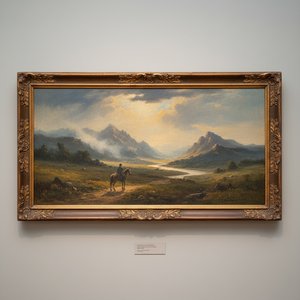
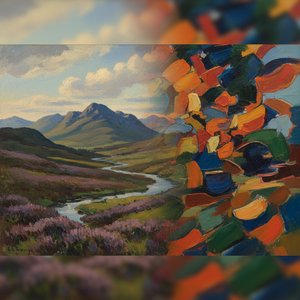
Aperçu en situation Aperçu en RA Acheter la peinture faite à la main Passer au format image numérique Partager
Détails Guide Ajouter aux favoris Télécharger Articles similaires Radiographie Voir le diaporama Statistiques

Landscape with Yellow Fields

Sir William George Gillies’ "Landscape with Yellow Fields" captures a serene Scottish scene—a charming house amidst golden fields, painted by a master of evocative landscapes.

Explore les paysages écossais et natures mortes de W.G. Gillies. Découvrez ses influences cubistes, ses liens avec le groupe 1922, son héritage à l'École d'art d'Édimbourg et son impact profond sur l'art du 20e siècle.

Giclées et impressions d'art

Impressions giclées ou sur toile de qualité musée, avec une production rapide et des finitions au choix. ( Acheter la peinture faite à la main Passer au format image numérique)

P118B $10
P118H $10
P118W $10
P438Z $10
P508JH $12
P508YH $12
P805H $10
P805Z $10
P919BZ $10
P919G $10
P919XJ $10
P959ZH $10
P968JZ $12
W106C $8
W218G $10
W218JH $8
W218Y $10
W307PJ $10
W316G $10
W316PJ $8
W316Y $10
W398PJ $8
W4111J $10
W500HY $15
W500JH $15
W692G $12
W849H $8
W940BG $15
W953PJ $8

Format standard
personnalisé
CM
INCH

Choisissez parmi nos formats prédéfinis qui respectent les proportions originales de l’œuvre.

largeur
hauteur

Vous pouvez saisir vos propres dimensions pour vous adapter à un cadre ou à un espace spécifique. Si la taille sélectionnée ne correspond pas aux proportions de l'image originale, nous recadrerons l'œuvre ou étendrons l'image avec une bordure en miroir ou une couleur unie. Une maquette numérique vous sera envoyée pour approbation avant le début de la production.
Veuillez noter que l'aperçu à l'écran ne reflète pas le recadrage ou l'extension réelle. Seule la maquette montrera avec précision la composition finale.
Bien que des tailles personnalisées soient disponibles, nous vous recommandons de choisir une dimension dans la liste prédéfinie afin de préserver les proportions originales.

Livraison dans le monde entier () en 2 semaines au lieu des 4/5 semaines habituelles. (25 septembre)

why_choose_icon
Livraison express gratuite dans le monde entier
why_choose_icon
Toile de lin de haute qualité
why_choose_icon
Assurance transport complète
why_choose_icon
Garantie de remboursement des droits de douane
why_choose_icon
Garantie de fidélité des couleurs
why_choose_icon
Garantie de retour de 100 jours (uniquement en cas de défaut)
why_choose_icon
Garantie de remboursement à 100%
why_choose_icon
Tarifs dégressifs sur quantité

Prix total

$ 68

reproduction

Landscape with Yellow Fields

Giclées et impressions d'art

Format de la reproduction

-

Prix total final

$ 68

L'essentiel de l'œuvre

  • Dimensions: 55 x 76 cm
  • Subject or theme: Rural landscape
  • Medium: Oil on Canvas
  • Artist: William Gillies
  • Artistic style: Scottish Colourist
  • Location: Royal Scottish Academy

Quiz d'art

Chaque question ne comporte qu'une seule bonne réponse.

Question 1:
What is the primary subject of ‘Landscape with Yellow Fields’?
Question 2:
Which artistic movement is most strongly associated with William George Gillies’ style, as evidenced by his early works like ‘Two Pots, Saucer and Fruit’?
Question 3:
What year was ‘Landscape with Yellow Fields’ painted, according to the provided information?
Question 4:
The red roof of the house in ‘Landscape with Yellow Fields’ is most likely intended to:
Question 5:
William George Gillies was primarily known for his work in which area?

A Frozen Reverie: Sir William George Gillies’ “Landscape with Yellow Fields”

Sir William George Gillies' "Landscape with Yellow Fields" isn’t merely a depiction of a rural scene; it’s a carefully constructed meditation on light, color, and the quiet dignity of the Scottish countryside. Painted around 1934, this work stands as a pivotal moment in Gillies’ artistic evolution, bridging his earlier explorations of Cubism with a deeply rooted appreciation for the evocative beauty of the British Isles. The painting captures a quintessential Highland vista – a rolling expanse of golden fields punctuated by a modest farmhouse and scattered trees, all bathed in the soft, diffused light characteristic of a late afternoon. It's a scene that feels both familiar and profoundly serene, inviting the viewer to step into a timeless moment of rural tranquility.

Gillies’ artistic journey had been shaped by encounters with European masters. His time in Paris with André Lhote exposed him to the principles of Cubism, leading to early works like “Two Pots, Saucer and Fruit,” where objects were fragmented and reassembled into geometric arrangements. However, a transformative encounter with Paul Klee in 1934 ignited a shift towards a more intuitive and emotionally resonant style. Klee’s use of vibrant color and childlike simplicity – his ability to imbue everyday subjects with a sense of wonder – profoundly influenced Gillies, prompting him to embrace bolder hues and a looser, more expressive brushstroke.

The Language of Color and Light

What immediately draws the eye is Gillies’ masterful manipulation of color. The dominant yellow of the fields isn't a flat, uniform hue; it’s layered with subtle variations – ochre, amber, and hints of gold – creating an illusion of depth and movement. This rich palette is expertly contrasted against the muted greens and browns of the trees and distant hills, further emphasizing the warmth and luminosity of the foreground. The red roof of the farmhouse acts as a striking focal point, anchoring the composition and adding a touch of domesticity to the vast landscape. Gillies’ use of light isn't photographic realism; it’s an artistic interpretation – a deliberate choice to capture the *feeling* of sunlight filtering through the air.

The technique employed is distinctly Impressionistic, yet infused with Gillies’ unique sensibility. He utilizes short, broken brushstrokes to build up texture and create a sense of atmosphere. These strokes aren't blended smoothly; instead, they retain their individual character, contributing to the painting’s vibrant energy. The layering of color and the visible brushwork invite the viewer to actively engage with the artwork, noticing the subtle shifts in tone and hue as they gaze upon it.

A Portrait of Rural Scotland

Beyond its aesthetic qualities, “Landscape with Yellow Fields” offers a glimpse into the heart of rural Scottish life. The farmhouse, modest yet sturdy, suggests a connection to the land and a sense of community. The scattered trees hint at the presence of wildlife and the rhythms of nature. Gillies’ paintings frequently depicted scenes from his native Scotland, capturing its distinctive landscapes and portraying the lives of its people with empathy and understanding.

The painting's historical context is also significant. Created during a period of economic hardship in Britain, it reflects a longing for simpler times and a connection to the land – values that resonated deeply with many at the time. Gillies’ work served as a powerful reminder of the beauty and resilience of the Scottish countryside.

Collecting the Essence: Reproduction & Beyond

Reproductions of “Landscape with Yellow Fields” offer an accessible way to experience the painting's captivating atmosphere. WahooArt meticulously recreates Gillies’ techniques, capturing the nuances of color, texture, and light that make this artwork so compelling. The 55 x 76 cm size is ideal for adding a touch of rustic charm to any interior space – whether it’s a living room, bedroom, or study.

More than just a decorative piece, “Landscape with Yellow Fields” evokes a sense of nostalgia and tranquility. It's an invitation to slow down, appreciate the beauty of nature, and connect with the timeless spirit of rural Scotland. Consider this reproduction not merely as a print, but as a portal – a window into a world of quiet contemplation and artistic brilliance.


Biographie de l'artiste

Sir William George Gillies : Une Vie d'Art en Écosse

Jeunesse et Formation

  • Né: Haddington, East Lothian, Royaume-Uni, 1898.
  • Gillies s'était initialement inscrit à l'École d'Art d'Édimbourg, mais ses études ont été interrompues par son service pendant la Première Guerre mondiale avec les Royal Engineers.
  • Après la guerre, il est retourné pour achever ses études à l'École d'Art d'Édimbourg, où il a finalement obtenu son diplôme et est devenu enseignant dévoué là-bas pendant plus de 40 ans.

Développement Artistique et Influences

  • Le parcours artistique de Gillies a commencé par une exploration du cubisme après avoir étudié auprès d’André Lhote à Paris (1923) et voyagé en Italie (1924).
  • Ses premières œuvres, comme “Two Pots, Saucer and Fruit” (1933), illustrent cette influence, présentant une composition inspirée de Cézanne avec les palettes de couleurs sobres de Braque et Picasso.
  • Un moment décisif est venu en 1934 lorsqu'il a rencontré le travail de Paul Klee, l’inspirant à adopter une utilisation plus imaginative des couleurs et des qualités enfantines dans ses compositions.
  • Il s'est progressivement éloigné du cubisme strict, développant un style distinctif enraciné dans les traditions écossaises de paysages et d'art populaire.

Le Groupe 1922 et Esprit Collaboratif

  • En 1922, Gillies a cofondé le “Groupe 1922” avec d'autres artistes tels que William Crozier, William Geissler et William MacTaggart.
  • Cette société d’exposition a fourni une plateforme aux jeunes artistes écossais pour présenter leur travail à la New Gallery à Édimbourg pendant une décennie.
  • Le groupe a favorisé un sentiment de communauté et d'innovation dans le milieu artistique écossais.

Thèmes et Sujets

  • Paysages: Gillies est connu pour ses représentations des régions du Lothian, du Fife et de la Border en Écosse. Il a capturé l'essence de ces paysages avec un œil sensible.
  • Art populaire: L’art populaire était une autre composante importante, présentant souvent des céramiques créées par sa sœur cadette, Emma Smith Gillies, dont la mort prématurée en 1936 l'a profondément affecté.
  • Portraits: Bien qu’il ait expérimenté avec les portraits au début de sa carrière, les paysages et l’art populaire sont devenus ses sujets principaux.

Réalisations Majeures et Reconnaissance

  • Gillies a été directeur de l'École d'Art d'Édimbourg de 1959 jusqu'à sa retraite en 1966.
  • Son abondante production et son dévouement à l'enseignement ont eu une influence profonde sur les générations de peintres écossais.
  • Il a été élu membre royal (RA), ce qui représente une reconnaissance significative dans le monde de l’art.

Signification Historique et Héritage

  • Sir William George Gillies est considéré comme l'un des peintres écossais les plus importants du 20e siècle.
  • Son œuvre comble le fossé entre le modernisme précoce et une identité artistique écossaise distincte.
  • Héritage: Son influence s'étend au-delà de ses peintures, façonnant la direction de l’art écossais grâce à son enseignement et à son mentorat.
  • Il est décédé en 1973, laissant derrière lui un riche ensemble d'œuvres qui sont célébrées aujourd'hui pour leur beauté, leur sensibilité et leur pertinence durable.
sir william george gillies

sir william george gillies

1898 - 1973 , United Kingdom

En bref

  • Artistic Movement Or Style: Scottish Colourists
  • Artists Or Movements Influenced By This Artist: ['Groupe 1922']
  • Artists Who Influenced This Artist:
    • André Lhote
    • Paul Cézanne
    • Pablo Picasso
  • Date Of Birth: 1898
  • Full Name: Sir William George Gillies
  • Nationality: Écossais
  • Notable Artworks:
    • Deux pots, une tasse et un fruit
    • Paysage méditerranéen avec ciel couvert
    • Nature morte – Vase jaune et tissu rayé
  • Place Of Birth: Haddington, Royaume-Uni
Explorez des œuvres d'art classées par thèmes, styles et caractéristiques.