Aperçu en situation Aperçu en RA Acheter la peinture faite à la main Passer au format image numérique Partager
Détails Guide imprimable Ajouter aux favoris Télécharger Articles similaires Radiographie Voir le diaporama Statistiques

Printemps -

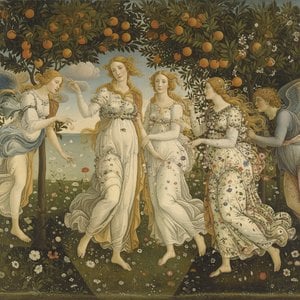
Le Printemps de Botticelli capture une beauté sereine entre arbres et oiseaux. Admirez ce chef-d'œuvre et sa grâce intemporelle chez vous.

Explorez l'art captivant de Sandro Botticelli (1445-1510), un maître de la peinture de la Renaissance primitive. Connu pour sa ligne élégante, ses œuvres emblématiques telles que 'La Naissance de Vénus' & 'Le Printemps', et pour avoir relié les styles gothique et renaissance. Découvrez son héritage !

Giclées et impressions d'art

Impressions giclées ou sur toile de qualité musée, avec une production rapide et des finitions au choix. ( Acheter la peinture faite à la main Passer au format image numérique)

Corner sample of the P118B picture frame: polystyrène moulé, 5 cm wide and 3 cm thick
P118B €10
Corner sample of the P118H picture frame: polystyrène moulé, 5 cm wide and 3 cm thick
P118H €10
Corner sample of the P118W picture frame: polystyrène moulé, 5 cm wide and 3 cm thick
P118W €10
Corner sample of the P438Z picture frame: polystyrène moulé, 5.5 cm wide and 3.5 cm thick
P438Z €10
Corner sample of the P508JH picture frame: polystyrène moulé, 7 cm wide and 3.5 cm thick
P508JH €12
Corner sample of the P508YH picture frame: polystyrène moulé, 7 cm wide and 3.5 cm thick
P508YH €12
Corner sample of the P805H picture frame: polystyrène moulé, 5 cm wide and 3.5 cm thick
P805H €10
Corner sample of the P805Z picture frame: polystyrène moulé, 5 cm wide and 3.5 cm thick
P805Z €10
Corner sample of the P919BZ picture frame: polystyrène moulé, 7 cm wide and 3.5 cm thick
P919BZ €10
Corner sample of the P919G picture frame: polystyrène moulé, 7 cm wide and 3.5 cm thick
P919G €10
Corner sample of the P919XJ picture frame: polystyrène moulé, 7 cm wide and 3.5 cm thick
P919XJ €10
Corner sample of the P959ZH picture frame: polystyrène moulé, 5 cm wide and 3 cm thick
P959ZH €10
Corner sample of the P968JZ picture frame: polystyrène moulé, 6 cm wide and 4 cm thick
P968JZ €12
Corner sample of the W106C picture frame: bois massif, 5 cm wide and 3 cm thick
W106C €8
Corner sample of the W218G picture frame: bois massif, 5 cm wide and 3 cm thick
W218G €10
Corner sample of the W218JH picture frame: bois massif, 5 cm wide and 3 cm thick
W218JH €8
Corner sample of the W218Y picture frame: bois massif, 5 cm wide and 3 cm thick
W218Y €10
Corner sample of the W307PJ picture frame: bois massif, 6 cm wide and 3 cm thick
W307PJ €10
Corner sample of the W316G picture frame: bois massif, 6 cm wide and 3 cm thick
W316G €10
Corner sample of the W316PJ picture frame: bois massif, 6 cm wide and 3 cm thick
W316PJ €8
Corner sample of the W316Y picture frame: bois massif, 6 cm wide and 3 cm thick
W316Y €10
Corner sample of the W398PJ picture frame: bois massif, 5 cm wide and 3 cm thick
W398PJ €8
Corner sample of the W4111J picture frame: bois massif, 6.5 cm wide and 3.5 cm thick
W4111J €10
Corner sample of the W500HY picture frame: bois massif, 7 cm wide and 5 cm thick
W500HY €15
Corner sample of the W500JH picture frame: bois massif, 7 cm wide and 5 cm thick
W500JH €15
Corner sample of the W692G picture frame: bois massif, 8 cm wide and 4 cm thick
W692G €12
Corner sample of the W849H picture frame: bois massif, 5 cm wide and 3 cm thick
W849H €8
Corner sample of the W940BG picture frame: bois massif, 7.5 cm wide and 4.5 cm thick
W940BG €15
Corner sample of the W953PJ picture frame: bois massif, 6 cm wide and 3.5 cm thick
W953PJ €8

Format standard
personnalisé
CM
INCH

Choisissez parmi nos formats prédéfinis qui respectent les proportions originales de l’œuvre.

largeur
hauteur

Saisissez la largeur et la hauteur souhaitées pour qu'elles s'adaptent à votre cadre ou à votre mur. Une impression ne peut être que découpée, elle ne peut jamais être agrandie au-delà de l'image originale ; ainsi, un format de forme différente entraînera la perte d'une partie de l'image. Nous vous envoyons une maquette numérique pour approbation avant toute impression. L'image présentée sur cette page ne montre pas le recadrage réel — seule la maquette le permet.

Livraison dans le monde entier () en 2 semaines au lieu des 4/5 semaines habituelles. (21 octobre)

Livraison express gratuite dans le monde entier
Toile de lin de haute qualité
Assurance transport complète
Garantie de remboursement des droits de douane
Garantie de fidélité des couleurs
Garantie de retour de 100 jours (uniquement en cas de défaut)
Garantie de remboursement à 100%
Tarifs dégressifs sur quantité

Prix total

€ 59

Printemps -

Giclées et impressions d'art

Format de la reproduction

-

Prix total final

€ 59

L'essentiel de l'œuvre

  • Medium: Tempéra sur panneau
  • Influences:
    • Antiquité classique
    • Humanisme
  • Movement: Première Renaissance
  • Artist: Sandro Botticelli
  • Notable elements: Oiseau, femmes, arbres

Sandro Botticelli’s *Primavera*: A Symphony of Myth and Renaissance Ideal

Sandro Botticelli's *Primavera*, painted circa 1482, stands as one of the most captivating and enigmatic works of the Early Renaissance. This exquisite depiction, seemingly a simple scene of three women – Venus, Flora, and possibly Zephyrus – accompanied by a magnificent array of mythical figures, is far more than just a pastoral idyll. It’s a complex tapestry woven with allegorical meaning, reflecting the intellectual currents of Florence at the height of Medici patronage and Botticelli's own masterful command of line and color.

  • Subject Matter: The painting portrays a gathering of mythological figures within a lush, idealized garden. While interpretations vary, it’s widely believed to be an allegory for the arrival of Spring, representing rebirth, fertility, and the triumph of love over death.
  • Style & Technique: Botticelli's signature style is immediately apparent – elongated figures with graceful poses, delicate lines defining every contour, and a luminous palette dominated by pale blues, greens, and pinks. He employs tempera on panel, a technique that lends the painting a remarkable clarity of detail and a subtle sheen. The meticulous rendering of drapery and foliage demonstrates his profound understanding of perspective and naturalism, though filtered through a distinctly Renaissance idealization.
  • Historical Context: *Primavera* was commissioned likely by Lorenzo di Pierfrancesco de' Medici, brother to the future Pope Leo X, for his wedding festivities. This commission reflects the growing importance of secular art within Florentine society and the patronage of wealthy families like the Medici who sought to associate themselves with classical mythology and humanist ideals.

Decoding the Symbolism: A Garden of Allegory

The symbolism embedded within *Primavera* is layered and open to interpretation, a hallmark of Renaissance art’s engagement with classical philosophy and Neoplatonic thought. Venus, the goddess of love, stands at the center, her gaze directed towards Zephyrus, the west wind, often interpreted as representing desire and passion. Flora, personifying springtime, scatters flowers – symbols of fertility and renewal – while the three maidens represent chastity, beauty, and virtue. The presence of Mercury, with his caduceus (a staff entwined with serpents), suggests intellectual or divine communication. The overall composition evokes a sense of harmonious balance and spiritual elevation, reflecting the Renaissance fascination with achieving perfect proportions and representing ideal forms.

  • Venus: Represents love, beauty, and desire.
  • Flora: Symbolizes fertility, growth, and the renewal of nature.
  • Zephyrus: Often associated with the west wind, signifying passion and movement.
  • Mercury: Represents intellect, communication, and divine influence.

Emotional Impact & Artistic Legacy

*Primavera* continues to resonate with viewers centuries after its creation. Its serene beauty, coupled with its profound symbolism, evokes a sense of wonder and contemplation. Botticelli’s ability to capture the ethereal quality of light and form, combined with his masterful use of color, creates an image that is both visually stunning and emotionally evocative. The painting's influence can be seen in countless subsequent works of art, solidifying Botticelli’s place as one of the most important figures in Renaissance art history. A hand-painted reproduction offers a unique opportunity to experience this iconic masterpiece firsthand, bringing its timeless beauty into your home or studio.

Reproductions Available

Questions et réponses

Quelle émotion les couleurs de «Printemps -» de Sandro Botticelli dégagent-elles ?

Dans « Printemps - », des couleurs Tons neutres accompagnent une sensation Romantique.

Où puis-je voir un aperçu de « Printemps - » ?

Un aperçu de «Printemps -» de Sandro Botticelli est disponible sur la page Aperçu de l'œuvre.

Existe-t-il une fiche informative sur «Printemps -» de Sandro Botticelli destinée aux étudiants ?

La page Guide de «Printemps -» de Sandro Botticelli propose une fiche pédagogique imprimable en deux volets : l'œuvre accompagnée de sa fiche d'identité, une frise chronologique la situant dans la vie de l'artiste, d'autres œuvres de l'artiste, la palette de couleurs mesurée, ainsi que des citations prêtes à être copiées en quatre styles différents.


Biographie de l'artiste

jeune vie et formation

Sandro Botticelli, né Alessandro di Mariano di Vanni Filipepi vers 1445, est une figure clé de la Renaissance italienne précoce. Initialement relégué à l'arrière-plan après sa mort, l'œuvre de Botticelli a été revitalisée au XIXe siècle par les préréfables, conduisant à une réévaluation de ses contributions artistiques. Botticelli est né à Florence, en Italie, et y a vécu toute sa vie dans le même quartier. Sa famille, dont son père Mariano di Vanni d'Amadeo Filipepi, était impliquée dans diverses professions, ce qui leur a permis de se rencontrer avec des artistes. Giorgio Vasari rapportait que Botticelli avait initialement été formé comme orfèvre.

style artistique et œuvres notables

L'œuvre de Botticelli est caractérisée par une élégante linéarité, reliant le gothique italien tardif à la Renaissance précoce. Ses œuvres les plus célèbres, La Naissance de Vénus et *Primavera*, sont exposées à la Galerie des Offices à Florence, qui abrite une importante collection de ses œuvres. * La Naissance de Vénus (voir sur WahooArt) * *Primavera* (explorer l'art de Sandro Botticelli sur WahooArt) * Nativité mystique (National Gallery, Londres), datée 1501, est la seule œuvre de Botticelli avec une date claire.

héritage et influence

Le style de Botticelli a évolué vers une approche plus personnelle dans les années 1490, s'écartant des contemporains comme Léonard de Vinci et du style de la Renaissance haute émergente. Son œuvre a été reconnue comme une contribution significative au mouvement artistique de la Renaissance italienne. * le mouvement artistique de la Renaissance italienne * Sandro Botticelli sur Wikipédia
  • Des artistes notables de la Renaissance italienne comprennent Sandro Botticelli, Léonard de Vinci, Michel-Ange et Titien.
  • La Galerie des Offices à Florence abrite une importante collection d'œuvres de Botticelli.
  • L'œuvre de Botticelli a été reconnue comme une figure clé de la Renaissance italienne précoce.
**Dates clés :** * 1445 : Sandro Botticelli est né à Florence, en Italie. * 1474 : a passé du temps à Pise. * 1481-1482 : a travaillé sur la Chapelle Sixtine à Rome. * 1501 : Nativité mystique (National Gallery, Londres) a été datée.
Sandro Botticelli

Sandro Botticelli

1445 - 1510 , Italie

En bref

  • Artistes Influents:
    • Fra Angelico
    • Paolo Uccello
  • Date De Décès: 1510
  • Date De Naissance: c. 1445
  • Lieu De Naissance: Florence, Italie
  • Mouvement Artistique: Renaissance italienne
  • Nationalité: Italienne
  • Nom Complet: Sandro Botticelli
  • Oeuvres Notables:
    • La Naissance de Vénus
    • Primavera
    • Nativité mystique
Explorez des œuvres d'art classées par thèmes, styles et caractéristiques.