A Renaissance Vision of Maternal Guidance: Sandro Botticelli’s Untitled Madonna and Child
Sandro Botticelli (1445-1510), born Alessandro di Mariano di Vanni Filipepi in Florence, Italy, stands as a cornerstone of the Early Renaissance—a period characterized by an unprecedented revival of classical ideals and artistic innovation. His life unfolded within the vibrant cultural landscape of Florence, where he honed his craft under the tutelage of Fra Filippo Lippi, establishing connections with influential patrons like the Medici family that would propel him to international acclaim.
Botticelli’s artistic journey began modestly; initially apprenticed as a goldsmith, he swiftly transitioned to painting, embracing the stylistic currents shaping Florentine art. This formative period instilled in him a meticulous attention to detail and an appreciation for elegant linearity—qualities that would permeate his oeuvre and define his distinctive visual language.
Subject & Composition
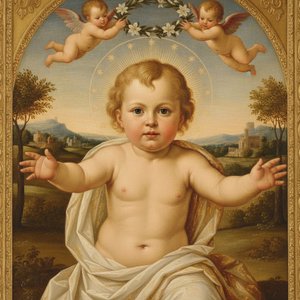
The centerpiece of Botticelli’s “Untitled Madonna and Child” is undoubtedly Mary, depicted with serene dignity as she cradles the infant Jesus. This iconic portrayal embodies the humanist spirit of the Renaissance, reflecting a renewed interest in human anatomy and emotion. Notably, Botticelli eschewed strict realism—opting instead for a stylized representation that prioritized clarity of form and symbolic significance.
Surrounding Mary and Jesus are several angelic figures, their poses dynamic and expressive. Some gaze downwards with reverence, conveying the profound spiritual devotion prevalent during the era; others extend their arms in gestures of adoration and support, reinforcing the painting’s overarching theme of divine protection. The circular format itself—a deliberate choice—mirrors the halo commonly adorning holy saints, symbolizing Mary's sanctity and elevating the scene to a realm of celestial beauty.
Style & Technique
Botticelli’s style represents a harmonious blend between Late Gothic traditions and the burgeoning Early Renaissance. His masterful technique is immediately apparent: smooth brushstrokes create surfaces that appear effortless, capturing subtle gradations of light and shadow—a hallmark of Renaissance painting. The artist skillfully employed oil paint, allowing for rich color saturation and nuanced tonal variations.
Furthermore, Botticelli’s characteristic *elegant linearity*—flowing contours defining the figures and drapery—contributes to the painting's refined aesthetic appeal. He meticulously rendered details with precision, reflecting the humanist emphasis on observation and anatomical accuracy. Despite eschewing strict perspective, Botticelli prioritized conveying emotion and spiritual contemplation through expressive gestures and idealized forms.
Historical Context & Influences
Botticelli flourished during Florence’s golden age—a time of intellectual ferment fueled by rediscovered classical texts and humanist scholarship. He moved within a circle of artists and thinkers who championed human reason and artistic excellence, absorbing influences from masters like Fra Filippo Lippi and Leonardo da Vinci.
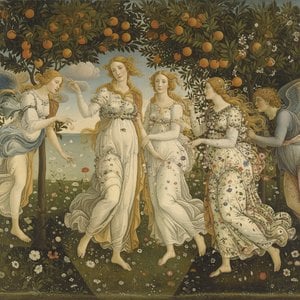
The Medici family—particularly Lorenzo de' Medici—served as Botticelli’s principal patron, providing him with financial support and fostering an environment conducive to creative experimentation. This patronage enabled Botticelli to produce monumental works such as “Primavera” and “The Birth of Venus,” cementing his legacy as one of the most celebrated artists of the Renaissance.
Symbolism & Meaning
"Untitled (5768)" overflows with symbolic resonance—a testament to Botticelli’s profound understanding of humanist ideals. Mary's crown signifies her divine status and regal authority, reflecting Christian theology’s reverence for the Virgin Mother. The open book held by Jesus symbolizes knowledge, wisdom, and the scriptures—foreshadowing Christ’s role as the ultimate teacher.
The angelic figures embody heavenly messengers, connecting the earthly realm to the divine realm. Their gestures of adoration express unwavering faith and devotion—capturing the spiritual essence of Renaissance piety. Even the hazy landscape in the background contributes to the painting's contemplative atmosphere, symbolizing Paradise and reinforcing its overarching message of hope and transcendence.
Emotional Impact & Aesthetic Appeal
Botticelli’s “Untitled Madonna and Child” evokes a palpable sense of peace, reverence, and maternal love—qualities that continue to resonate with audiences today. The tender interaction between Mary and Jesus—expressed through serene expressions and graceful postures—captures the sublime beauty of human compassion.
The painting's vibrant palette—dominated by rich blues, reds, and golds—enhances its visual splendor and conveys a feeling of opulent grandeur. Its circular format lends itself beautifully to interior design settings, creating focal points that inspire contemplation and evoke memories of Renaissance elegance. For discerning collectors seeking exceptional reproductions, Botticelli’s masterpiece remains an enduring symbol of artistic achievement.



 Aperçu en situation
 Acheter la peinture faite à la main
 Partager
 Partager
 Détails

 Télécharger
 Articles similaires
 Radiographie
 Voir le diaporama
 Statistiques

 Afficher la suite






































 L'option verre n'est disponible que pour les dimensions inférieures à 110 cm.