Aperçu en situation Aperçu en RA Passer au format impression Passer au format image numérique Partager
Détails Ajouter aux favoris Télécharger Articles similaires Radiographie Voir le diaporama Statistiques

La Lamentation du Christ

Magnifique tableau de Botticelli représentant la douleur et la compassion suscitées par la mort du Christ. Découvrez sa beauté raffinée et son symbolisme profond dans cette œuvre emblématique de la Renaissance italienne.

Explorez l'art captivant de Sandro Botticelli (1445-1510), un maître de la peinture de la Renaissance primitive. Connu pour sa ligne élégante, ses œuvres emblématiques telles que 'La Naissance de Vénus' & 'Le Printemps', et pour avoir relié les styles gothique et renaissance. Découvrez son héritage !

Reproduction à l'huile faite à la main

Huile sur toile peinte à la main, avec cadre et dimensions personnalisés, réalisée sur commande par nos artistes. ( Passer au format impression Passer au format image numérique)

P118B $10
P118H $10
P118W $10
P438Z $10
P508JH $12
P508YH $12
P805H $10
P805Z $10
P919BZ $10
P919G $10
P919XJ $10
P959ZH $10
P968JZ $12
W106C $8
W218G $10
W218JH $8
W218Y $10
W307PJ $10
W316G $10
W316PJ $8
W316Y $10
W398PJ $8
W4111J $10
W500HY $15
W500JH $15
W692G $12
W849H $8
W940BG $15
W953PJ $8

Format standard
personnalisé
CM
INCH

Choisissez parmi nos formats prédéfinis qui respectent les proportions originales de l’œuvre.

largeur
hauteur

Vous pouvez saisir vos propres dimensions pour l'adapter à un cadre ou à un espace spécifique. Si la taille sélectionnée ne correspond pas aux proportions de l'image d'origine, nous recadrerons l'œuvre ou prolongerons la peinture avec des éléments peints à la main supplémentaires. Une maquette numérique vous sera envoyée pour approbation avant le début de la production.
Veuillez noter que l'aperçu à l'écran ne reflète pas le recadrage ou l'extension réels. Seule la maquette montrera fidèlement la composition finale.
Bien que des tailles personnalisées soient disponibles, nous vous recommandons de sélectionner une dimension dans la liste prédéfinie afin de préserver les proportions d'origine.

Exemples de personnalisation possibles : remplacer un visage par la photo du client ; ajouter un animal de compagnie (par exemple, remplacer un chat par un chien) ; inclure un message caché en arrière-plan ; modifier le paysage ou les éléments de l'arrière-plan.
Après la commande, l’équipe WahooArt.com contactera le client par e-mail pour recueillir ses instructions et lui fournira une maquette d’aperçu

Livraison dans le monde entier () en 3 à 4 semaines au lieu des 5 semaines habituelles. (15 septembre). Aucun compromis sur la qualité.

why_choose_icon
Livraison express gratuite dans le monde entier
why_choose_icon
Toile de lin de haute qualité
why_choose_icon
Assurance transport complète
why_choose_icon
Garantie de remboursement des droits de douane
why_choose_icon
Garantie de fidélité des couleurs
why_choose_icon
Garantie de retour de 100 jours (uniquement en cas de défaut)
why_choose_icon
Garantie de remboursement à 100%
why_choose_icon
Tarifs dégressifs sur quantité

Prix total

$ 272

reproduction

La Lamentation du Christ

Technique de reproduction

Format de la reproduction

-

Prix total final

$ 272

L'essentiel de l'œuvre

  • Artistic style: Elegant; Mannerist
  • Artist: Sandro Botticelli
  • Location: Galleria Sabauda, Turin
  • Influences: Renaissance
  • Movement: Early Renaissance
  • Subject or theme: Religious devotion; Sorrow; Marian art

Quiz d'art

Chaque question ne comporte qu'une seule bonne réponse.

Question 1:
What is the primary subject matter of Sandro Botticelli’s "The Lamentation of Christ"?
Question 2:
Where is "The Lamentation of Christ" currently housed?
Question 3:
Botticelli employed what artistic technique to convey emotion in "The Lamentation of Christ", resulting in rich colors and layering?
Question 4:
What architectural element is prominently featured in the background of "The Lamentation of Christ" and symbolizes the passage of time?
Question 5:
Botticelli's work is considered part of a larger tradition in Western art focused on expressing religious devotion. What theme does this tradition commonly explore?

The Lamentation Of Christ - A Symphony of Sorrow

Sandro Botticelli’s *Lamentation of Christ*, housed in the Galleria Sabauda of Turin, Italy, transcends mere depiction; it embodies a profound meditation on grief and faith. Completed around 1495, this painting stands as a cornerstone of Florentine Renaissance art—a testament to Botticelli's mastery of color, composition, and emotional expression.

  • Composition & Structure: The artwork employs a pyramidal structure, meticulously crafted to draw the viewer’s eye upwards towards Christ’s lifeless body. This deliberate arrangement reinforces the central theme of mourning while simultaneously establishing unity amongst the figures surrounding Mary—a visual embodiment of compassion and sorrow.
  • Symbolism – Layers of Meaning: Beyond its formal beauty lies a rich tapestry of symbolism. The donkey serves as a poignant reminder of Jesus’s humble origins, contrasting sharply with his divine status. The clock hanging above symbolizes the inescapable passage of time—a solemn acknowledgement of mortality and loss. Each gesture and expression conveys deep emotion, inviting contemplation on themes of suffering and redemption.
  • Technique – Oil Paint & Glazing: Botticelli’s skillful use of oil paint allows for luminous colors and subtle glazing effects that imbue the painting with an ethereal quality. This technique—characteristic of Renaissance artists—captures the delicate nuances of human emotion and enhances the overall visual impact.
  • Historical Context – Savonarola's Influence: The painting’s creation coincided with the fervent religious fervor championed by Girolamo Savonarola, who exerted considerable sway over Florentine society. Botticelli’s artistic choices reflect this spiritual climate—a deliberate departure from idealized beauty towards a more introspective exploration of human experience.
  • Botticelli's Legacy – Beyond Florence: While *Lamentation of Christ* remains firmly rooted in Florentine tradition, it resonates across centuries due to its universal themes. Botticelli’s influence extends far beyond his immediate surroundings—inspiring artists and shaping artistic sensibilities for generations to come.

This masterpiece continues to captivate audiences today with its poignant portrayal of grief and its exquisite execution. Its enduring beauty speaks volumes about Botticelli's genius as an artist and his profound understanding of the human condition.

Exploring Botticelli’s Artistic Vision

Botticelli’s artistic style distinguishes itself from other Renaissance painters through a deliberate embrace of elegance and grace—a stylistic hallmark that aligns with humanist ideals. He eschewed the rigid conventions of Byzantine art, favoring instead a more fluid and expressive approach.

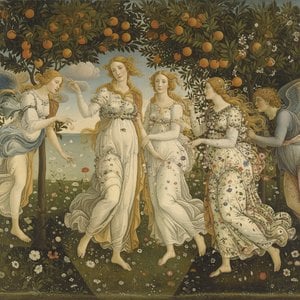
  • The Primavera & Venus: Botticelli’s fame rests largely on his mythological paintings, notably *Primavera* and *Venus*. These works exemplify his mastery of color and line—creating dreamlike landscapes populated by idealized figures that celebrate beauty and fertility.
  • Madonna Portraits – Intimacy & Emotion: Botticelli's portraits of Mary are particularly noteworthy for their sensitivity and psychological depth. He captures the maternal tenderness and spiritual contemplation characteristic of Marian art.

Botticelli’s artistic legacy extends beyond his individual paintings—influencing subsequent generations of artists who sought to emulate his distinctive style. His work remains a beacon of Renaissance beauty—a timeless reminder of the power of art to convey profound emotion and spiritual insight.

Marian Art – A Tradition Enduring Through Time

The study of Mary via Mariology is intertwined with Marian art, which has been a significant subject in Western art for centuries. These depictions explore themes of her perpetual virginity, motherhood of God, immaculate conception, and assumption into heaven—concepts central to Catholic theology.

  • Iconography & Symbolism: Marian iconography employs specific symbols—such as lilies representing purity and doves symbolizing the Holy Spirit—to convey spiritual truths. These images serve as vehicles for prayer and devotion—connecting worshippers with the divine.
  • Medieval Roots – Renaissance Echoes: The tradition of portraying Mary dates back to Byzantine art—where depictions of the Virgin Mother were revered as sacred icons. Botticelli’s work reflects this enduring heritage—demonstrating the continuity between medieval spirituality and Renaissance artistic expression.

Botticelli's *Lamentation of Christ* stands as a testament to the enduring power of art to communicate profound spiritual themes—a timeless masterpiece that continues to inspire admiration and contemplation.

Resources for Further Exploration

To delve deeper into Botticelli’s artistic achievements and Marian art traditions, consider visiting /art/list/?Filter=9DJ97Q-Sandro-Botticelli-Primavera and https://en.wikipedia.org/wiki/Marian_art_in_the_Catholic_Church.


Biographie de l'artiste

jeune vie et formation

Sandro Botticelli, né Alessandro di Mariano di Vanni Filipepi vers 1445, est une figure clé de la Renaissance italienne précoce. Initialement relégué à l'arrière-plan après sa mort, l'œuvre de Botticelli a été revitalisée au XIXe siècle par les préréfables, conduisant à une réévaluation de ses contributions artistiques. Botticelli est né à Florence, en Italie, et y a vécu toute sa vie dans le même quartier. Sa famille, dont son père Mariano di Vanni d'Amadeo Filipepi, était impliquée dans diverses professions, ce qui leur a permis de se rencontrer avec des artistes. Giorgio Vasari rapportait que Botticelli avait initialement été formé comme orfèvre.

style artistique et œuvres notables

L'œuvre de Botticelli est caractérisée par une élégante linéarité, reliant le gothique italien tardif à la Renaissance précoce. Ses œuvres les plus célèbres, La Naissance de Vénus et *Primavera*, sont exposées à la Galerie des Offices à Florence, qui abrite une importante collection de ses œuvres. * La Naissance de Vénus (voir sur WahooArt) * *Primavera* (explorer l'art de Sandro Botticelli sur WahooArt) * Nativité mystique (National Gallery, Londres), datée 1501, est la seule œuvre de Botticelli avec une date claire.

héritage et influence

Le style de Botticelli a évolué vers une approche plus personnelle dans les années 1490, s'écartant des contemporains comme Léonard de Vinci et du style de la Renaissance haute émergente. Son œuvre a été reconnue comme une contribution significative au mouvement artistique de la Renaissance italienne. * le mouvement artistique de la Renaissance italienne * Sandro Botticelli sur Wikipédia
  • Des artistes notables de la Renaissance italienne comprennent Sandro Botticelli, Léonard de Vinci, Michel-Ange et Titien.
  • La Galerie des Offices à Florence abrite une importante collection d'œuvres de Botticelli.
  • L'œuvre de Botticelli a été reconnue comme une figure clé de la Renaissance italienne précoce.
**Dates clés :** * 1445 : Sandro Botticelli est né à Florence, en Italie. * 1474 : a passé du temps à Pise. * 1481-1482 : a travaillé sur la Chapelle Sixtine à Rome. * 1501 : Nativité mystique (National Gallery, Londres) a été datée.
Sandro Botticelli

Sandro Botticelli

1445 - 1510 , Italie

En bref

  • Artistes Influents:
    • Fra Angelico
    • Paolo Uccello
  • Date De Décès: 1510
  • Date De Naissance: c. 1445
  • Lieu De Naissance: Florence, Italie
  • Mouvement Artistique: Renaissance italienne
  • Nationalité: Italienne
  • Nom Complet: Sandro Botticelli
  • Oeuvres Notables:
    • La Naissance de Vénus
    • Primavera
    • Nativité mystique
Explorez des œuvres d'art classées par thèmes, styles et caractéristiques.