Aperçu en situation Aperçu en RA Passer au format impression Passer au format image numérique Partager
Détails Guide Ajouter aux favoris Télécharger Articles similaires Radiographie Voir le diaporama Statistiques

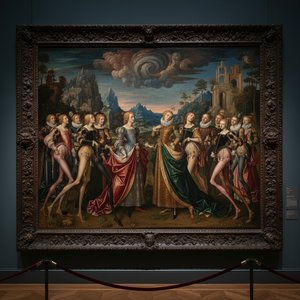
Who comes?

Experience the luminous intimacy of Rupert Bunny's Who comes?, a masterpiece of Edwardian elegance featuring shimmering drapery and sunlit grace that invites you to bring this serene moment into your private collection.

Explorez les œuvres lumineuses de Rupert Charles Wulsten Bunny (1864-1947), peintre australien célébré à Paris. Découvrez son style coloriste somptueux, ses scènes idylliques et son symbolisme. Voir 'Endormies' sur

Reproduction à l'huile faite à la main

Huile sur toile peinte à la main, avec cadre et dimensions personnalisés, réalisée sur commande par nos artistes. ( Passer au format impression Passer au format image numérique)

P118B $10
P118H $10
P118W $10
P438Z $10
P508JH $12
P508YH $12
P805H $10
P805Z $10
P919BZ $10
P919G $10
P919XJ $10
P959ZH $10
P968JZ $12
W106C $8
W218G $10
W218JH $8
W218Y $10
W307PJ $10
W316G $10
W316PJ $8
W316Y $10
W398PJ $8
W4111J $10
W500HY $15
W500JH $15
W692G $12
W849H $8
W940BG $15
W953PJ $8

Format standard
personnalisé
CM
INCH

Choisissez parmi nos formats prédéfinis qui respectent les proportions originales de l’œuvre.

largeur
hauteur

Vous pouvez saisir vos propres dimensions pour l'adapter à un cadre ou à un espace spécifique. Si la taille sélectionnée ne correspond pas aux proportions de l'image d'origine, nous recadrerons l'œuvre ou prolongerons la peinture avec des éléments peints à la main supplémentaires. Une maquette numérique vous sera envoyée pour approbation avant le début de la production.
Veuillez noter que l'aperçu à l'écran ne reflète pas le recadrage ou l'extension réels. Seule la maquette montrera fidèlement la composition finale.
Bien que des tailles personnalisées soient disponibles, nous vous recommandons de sélectionner une dimension dans la liste prédéfinie afin de préserver les proportions d'origine.

Exemples de personnalisation possibles : remplacer un visage par la photo du client ; ajouter un animal de compagnie (par exemple, remplacer un chat par un chien) ; inclure un message caché en arrière-plan ; modifier le paysage ou les éléments de l'arrière-plan.
Après la commande, l’équipe WahooArt.com contactera le client par e-mail pour recueillir ses instructions et lui fournira une maquette d’aperçu

Livraison dans le monde entier () en 3 à 4 semaines au lieu des 5 semaines habituelles. (23 septembre). Aucun compromis sur la qualité.

why_choose_icon
Livraison express gratuite dans le monde entier
why_choose_icon
Toile de lin de haute qualité
why_choose_icon
Assurance transport complète
why_choose_icon
Garantie de remboursement des droits de douane
why_choose_icon
Garantie de fidélité des couleurs
why_choose_icon
Garantie de retour de 100 jours (uniquement en cas de défaut)
why_choose_icon
Garantie de remboursement à 100%
why_choose_icon
Tarifs dégressifs sur quantité

Prix total

$ 272

reproduction

Who comes?

Technique de reproduction

Format de la reproduction

-

Prix total final

$ 272

Who comes? is one of a series of works called ‘Days and Nights in August’, painted by Rupert Bunny between 1907 and 1911, which evoke a mood of intimacy and luxurious leisure; of perfume, poetry and distant music. The colours in Who comes? are few – white, black, brown, red, yellow – and they have been orchestrated so that small colour accents are played off against a basic theme. Warm sunlight, filtering through a boldly striped blind, colours the upper part of the picture, whereas in the half-light below the blind the flounced skirts shimmer translucently.Bunny’s chief model, posing for both figures in this painting, was his wife Jeanne. She was ‘a beautiful French woman and her husband delighted to paint her in the long, flounced and flowing dresses of the period. Once he said, with faint distaste: “When short skirts came in I no longer wanted to paint women”’.1The drapery has been painted in a way that has little relation to the bodies beneath. One reviewer in 1911 explained Bunny’s preference for loose drapery as a way of capturing or complementing the indefiniteness of nature, ‘leaving forms and outlines in a state of indecision and flux’.2 In contrast to the geometry of the striped blind, Bunny’s rendering of filmy cloth breaks the shapes so that the attention goes not to outlines and large areas but to surfaces and small accents. The effect is sensuous. Bunny was portraying a luxurious domesticity which, in the fashion terms of the day, was well represented by the tea-gown: ‘It gives a man a sort of luxurious feel of being an Oriental Pasha, as he lies in his chair, smoking the ever-present cigarette, to see himself surrounded by graceful houris clad in gauze and gorgeous draperies shimmering’.3Marcel Proust wrote at length on the same theme in A la recherche du temps perdu (1913–27) and, like Bunny, he lamented the passing of this excessively feminine style with the coming of the First World War.Mary Eagle41 Lucy Swanton, ‘Memoir of Rupert Bunny’, typescript, [Sydney]: Newcastle Region Art Gallery, 1968.2 Melbourne Argus, 24 July 1911, p.7.3 ‘Lamia’ in London Country Life, 28 September 1907.4 Mary Eagle, The Art of Rupert Bunny, Canberra: Australian National Gallery, 1991, p.64.Text © National Gallery of Australia, Canberra 2010From: Anne Gray (ed), Australian art in the National Gallery of Australia, National Gallery of Australia, Canberra, 2002

Biographie de l'artiste

Early Life and Training

Rupert Charles Wolston Bunny (1864 – 1947) was born in Inkerman Street, St Kilda, Victoria, third son of Brice Frederick Bunny, barrister, and his wife Marie Hedwig Dorothea, née Wulsten. Educated at the Alma Road Grammar School, St Kilda, The Hutchins School, Hobart, and at other places, including, for a time, Melbourne University. An early ambition to become an actor was not encouraged by his father. Eventually he joined the National Gallery schools under O. R. Campbell and G. F. Folingsby; his fellow students included Frederick McCubbin, E. Phillips Fox and Louis Abrahams. In 1884 Bunny went to London and enrolled at P. H. Calderon's art school in St John’s Wood. Two years later he left for Paris to study under Jean-Paul Laurens. Bunny exhibited at the Salon de la Société des Artistes Français* (Old Salon) from 1888, becoming the first Australian painter to receive a mention honorable for his painting ‘The Tritons’. He also began exhibiting with British societies and galleries including the Royal Academy, the Royal Society of British Artists, the Institute of Painters in Oil-Colours, the Fine Art Society, and the New Gallery, Grosvenor, and Grafton galleries. His participation in the Carnegie Institute's 'Pittsburgh Internationals' was to continue for almost thirty years; he was awarded a bronze medal at the Paris Exhibition of 1900, and was represented in the Bendigo Victorian Gold Jubilee Exhibition of 1901-02. In 1901 he left the Paris Old Salon for the New (Société Nationale des Beaux-Arts). This coincided with a change in his work from large, idealized subject compositions drawn from the Bible and especially classical mythology, painted in a neo-classical style touched with Pre-Raphaelitism, to paintings of women, landscapes, and portraiture. His interest in music is reflected in his portraits of musicians, especially of fellow Australians Nellie Melba, Percy Grainger and Ada Crossley.

Achievements and Accolades

Bunny's artistic prowess was recognized early, with an honourable mention at the Paris Salon of 1890 for his painting tritons. He further solidified his reputation by winning a bronze medal at the Paris Exposition Universelle in 1900 for Burial of St Catherine of Alexandria. The French state acquired 13 of his works for the Musée du Luxembourg and regional collections. He was a “sumptuous colourist and splendidly erudite painter of ideal themes,” as described by art critics.

Artistic Style and Themes

Bunny’s artistic style was characterized by his masterful use of color—a hallmark of the Symbolist movement—and his profound understanding of classical mythology and humanist ideals. His canvases often depicted serene female figures immersed in tranquil waters, conveying a sense of dreamy contemplation and spiritual reflection. These images were imbued with symbolic meaning, exploring themes of beauty, innocence, and transcendence.

Notable Works

Bunny’s oeuvre includes masterpieces such as ‘Endormies,’ which resides at the National Gallery of Victoria in Melbourne, Australia; ‘Sea Idyll,’ also housed in the National Gallery of Victoria; and ‘Pastoral,’ showcased at the National Gallery of Australia in Canberra. These paintings exemplify his distinctive aesthetic vision and continue to captivate audiences with their luminous colors and evocative compositions.

Legacy and Online Presence

Rupert Bunny’s contribution to Australian art history is undeniable, establishing him as a pivotal figure in the Symbolist movement and securing his place among the most celebrated painters of his era. His works are now disseminated across prominent museums worldwide, ensuring that his artistic legacy persists for generations to come. For those eager to delve deeper into Bunny's oeuvre, [https://WahooArt.com/@/rupert-charles-wulsten-bunny](https://WahooArt.com/@/rupert-charles-wulsten-bunny) offers a comprehensive collection of his paintings—including ‘Endormies,’ ‘Sea Idyll,’ and ‘Pastoral’—available for purchase as museum-quality reproductions through /fr/art/show/art-8xyffg-fr/

Rupert Charles Wulsten Bunny

Rupert Charles Wulsten Bunny

1864 - 1947 , Australie

En bref

  • Artistic Movement Or Style: Symbolisme
  • Artists Who Influenced This Artist:
    • Calderon
    • Laurens
  • Date Of Birth: 29 septembre 1864
  • Date Of Death: 25 mai 1947
  • Full Name: Rupert Charles Wolston Bunny
  • Nationality: Australien
  • Notable Artworks:
    • Endormies
    • Idylle marine
    • Pastorale
  • Place Of Birth: St Kilda, Australie
Explorez des œuvres d'art classées par thèmes, styles et caractéristiques.