L’œuvre d'art présentée sur cette page est protégée par le droit d'auteur, ce qui signifie que nous ne pouvons légalement créer ou vendre de reproduction identique. Cette protection est appliquée en vertu d'accords internationaux tels que la Convention de Berne et par les lois nationales, notamment celles énoncées par le Loi américaine sur le droit d'auteur - Titre 17.
Cette méthode est pleinement conforme aux réglementations sur le droit d'auteur car elle ne repose pas sur la copie ou la duplication de l'œuvre protégée. Il s'agit plutôt d'une réinterprétation créative — une nouvelle peinture qui s'inspire de l'original sans pour autant lui être identique.
Impressions giclées ou sur toile de qualité musée, avec une production rapide et des finitions au choix. ( Acheter la peinture faite à la main
Passer au format image numérique)
Choisissez parmi nos formats prédéfinis qui respectent les proportions originales de l’œuvre.
Vous pouvez saisir vos propres dimensions pour vous adapter à un cadre ou à un espace spécifique. Si la taille sélectionnée ne correspond pas aux proportions de l'image originale, nous recadrerons l'œuvre ou étendrons l'image avec une bordure en miroir ou une couleur unie. Une maquette numérique vous sera envoyée pour approbation avant le début de la production.
Veuillez noter que l'aperçu à l'écran ne reflète pas le recadrage ou l'extension réelle. Seule la maquette montrera avec précision la composition finale.
Bien que des tailles personnalisées soient disponibles, nous vous recommandons de choisir une dimension dans la liste prédéfinie afin de préserver les proportions originales.
Livraison dans le monde entier () en 2 semaines au lieu des 4/5 semaines habituelles. (10 octobre)
Yellow and withe drip
Format de la reproduction
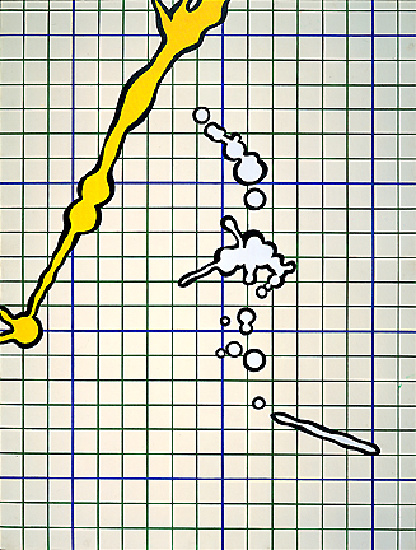
In the mid-1960s, the art world stood at a precipice, caught between the heavy, emotional shadows of Abstract Expressionism and the bright, neon-soaked reality of a burgeoning consumer culture. It was within this electric tension that Roy Lichtenstein unveiled "Yellow and White Drip," a work that would become a cornerstone of the Pop Art movement. Created in 1966, this painting is far more than a mere visual experiment; it is a deliberate, masterful rejection of academic conventions. Where previous generations sought depth through meticulous brushwork and soulful realism, Lichtenstein looked toward the mechanical, the commercial, and the everyday. He invited the viewer to find beauty not in the sublime, but in the graphic precision of the printing press and the ubiquitous language of mass media.
The composition itself serves as a striking dialogue between order and spontaneity. At first glance, the eye is drawn to the vibrant, energetic splash of yellow that cuts across the pristine white expanse. This "drip" suggests a moment of sudden movement, yet it is rendered with a calculated, almost clinical stillness. Interspersed within this landscape are geometric elements—green squares that ground the composition, providing a rhythmic structure that prevents the eye from wandering too far from the central motif. For the collector or interior designer, this piece offers a sophisticated balance; it possesses the raw energy of an action painting while maintaining the clean, structured aesthetic essential for modern, high-end decor.
To truly appreciate "Yellow and White Drip," one must look closer at the skin of the painting. Lichtenstein’s genius lay in his ability to mimic the industrial processes of advertising and comic strips, elevating "low" culture to the status of fine art. He utilized the halftone print technique—a method of using tiny, varying densities of dots to simulate shading and texture. This choice was a revolutionary act of deconstruction. By replacing the artist's unique hand with a simulated mechanical dot, he challenged the very notion of the "original" masterpiece. The resulting effect is remarkably flat and stylized, creating a surface that feels both incredibly modern and timelessly iconic.
This technical precision creates a fascinating emotional paradox. While the subject matter—a simple drip and geometric shapes—appears minimalist, the execution is dense with cultural meaning. The stark contrast between the saturated yellow and the clinical white background amplifies the visual impact, making the work an ideal focal point for any curated space. It demands attention through its clarity and brightness, yet it does not overwhelm; rather, it provides a crisp, intellectual energy that can transform a room from a mere living space into a gallery of contemporary thought.
Beyond the pigments and dots, "Yellow and White Drip" embodies the anxieties and aspirations of the mid-century landscape. It reflects a world becoming increasingly interconnected through mass production and shared visual symbols. Lichtenstein’s work acts as a mirror to our own era of digital saturation, where the boundaries between reality and mediated imagery continue to blur. The painting symbolizes a liberation from elitist hierarchies, suggesting that art can be found in the most commonplace fragments of our visual landscape.
For those seeking to bring a piece of art history into their homes or professional design projects, a high-quality reproduction of this masterpiece offers an unparalleled opportunity. It is a work that speaks to the bold, the brave, and the aesthetically discerning. Whether placed in a minimalist loft or a vibrant contemporary office, "Yellow and White Drip" serves as a constant reminder of the moment when art stopped looking inward at the soul and started looking outward at the electric, pulsating reality of modern life.
Les couleurs de «Yellow and withe drip» de Roy Lichtenstein présentent une saturation Muted avec une intensité Balanced.
Vous pouvez prévisualiser «Yellow and withe drip» de Roy Lichtenstein sur votre propre mur grâce à la page Aperçu RA de l'œuvre, en utilisant la réalité augmentée sur un appareil compatible.
«Yellow and withe drip» de Roy Lichtenstein est recommandé pour Accent, idéalement dans une Living Room. L'usage et l'espace permettent de déterminer où placer une reproduction.
L'œuvre «Yellow and withe drip» de Roy Lichtenstein date de 1966.
« Yellow and withe drip » a été créé par Roy Lichtenstein. Les informations présentes sur cette page décrivent l'œuvre originale de Roy Lichtenstein.
Lorsque « Yellow and withe drip » a été créé en 1966, Roy Lichtenstein — né(e) en 1923 — était âgé(e) de 43 ans.
«Yellow and withe drip» de Roy Lichtenstein est recommandé pour une Living Room. Cette suggestion s'appuie sur le sujet, les couleurs et l'atmosphère de l'œuvre.
1923 - 1997 , États-Unis d'Amérique