Impressions giclées ou sur toile de qualité musée, avec une production rapide et des finitions au choix. ( Commander la reproduction peinte à la main Acheter l'image haute résolution)





























Choisissez parmi nos formats prédéfinis qui respectent les proportions originales de l’œuvre.

Vous pouvez saisir vos propres dimensions pour vous adapter à un cadre ou à un espace spécifique. Si la taille sélectionnée ne correspond pas aux proportions de l'image originale, nous recadrerons l'œuvre ou étendrons l'image avec une bordure en miroir ou une couleur unie. Une maquette numérique vous sera envoyée pour approbation avant le début de la production.
Veuillez noter que l'aperçu à l'écran ne reflète pas le recadrage ou l'extension réelle. Seule la maquette montrera avec précision la composition finale.
Bien que des tailles personnalisées soient disponibles, nous vous recommandons de choisir une dimension dans la liste prédéfinie afin de préserver les proportions originales.
Livraison dans le monde entier () en 2 semaines au lieu des 4/5 semaines habituelles. (6 septembre)


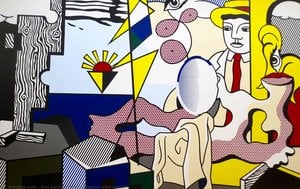
Mirror -6
Format de la reproduction
In the vast landscape of twentieth-century art, few images possess the immediate, arresting power of Roy Lichtenstein’s "Mirror -6." Created in 1972, this work serves as a breathtaking testament to the Pop Art movement's ability to transform the mundane into the monumental. At first glance, the viewer is met with a striking, primary-colored composition: a bold red circle, rhythmically interrupted by stark black and white stripes. Yet, beneath this deceptively simple surface lies a profound exploration of identity and perception. The painting functions as more than just an abstract arrangement; it acts as a conceptual window, where the circular form mimics a reflective surface, inviting us to look not just at the canvas, but into the very heart of the artist's vision.
The brilliance of "Mirror -6" lies in its masterful manipulation of Ben-Day dots, a signature technique that Lichtenstein famously adapted from the mechanical printing processes of comic books and mass media. By meticulously recreating the illusion of halftone shading through these tiny, patterned dots, he bridges the gap between high art and popular culture. This method lends the painting a unique, textured immediacy, as if the artwork itself were a vibrant fragment of a printed page brought to life on canvas. The interplay between the saturated red, the deep blacks, and the crisp whites creates a dynamic visual tension that keeps the eye moving, ensuring that the composition feels alive with energy and movement.
Beyond its aesthetic brilliance, "Mirror -6" is steeped in symbolic depth. The title itself suggests a duality—a reflection that goes beyond the physical. In this piece, the mirror becomes a metaphor for introspection and self-awareness. By utilizing a motif that reflects the artist's own presence within the work, Lichtenstein challenges the traditional boundaries between the creator and the subject. He moves away from the grand, sweeping narratives of previous eras to focus on the intimate, psychological experience of looking inward. This shift mirrors the broader cultural transition of the 1970s, where the focus turned toward questioning identity and the role of the individual within a media-saturated society.
For the discerning collector or interior designer, this painting offers an unparalleled opportunity to introduce a sense of historical significance and modern sophistication into a space. The bold geometry and high-contrast palette make it a versatile centerpiece, capable of anchoring a contemporary gallery wall or providing a striking focal point in a minimalist room. Owning a high-quality reproduction of such a masterpiece is not merely about decoration; it is about possessing a piece of the cultural revolution that redefined what art could be. "Mirror -6" remains an enduring icon of boldness, inviting every viewer to pause, reflect, and rediscover the beauty in the most fundamental shapes of our visual world.


1923 - 1997 , États-Unis d'Amérique

Explore the profound impact of the Pop Art Revolution on modern aesthetics. From Lichtenstein’s dots to Warhol’s icons, gain expert insights into how this vibrant movement redefined culture through consumerism and mass media. A definitive guide for art lovers and collectors.

Explore the profound psychological depth of Roy Lichtenstein's color theory. An expert analysis for art collectors on how bold palettes and Ben-Day dots redefine modern aesthetics and luxury interior curation.

Explore the profound impact of Pop Art on modern aesthetics. From Warhol’s icons to Lichtenstein's bold dots, discover how mass media redefined the masterpiece and continues to inspire sophisticated art collectors and contemporary interior design.

 Aperçu en situation
 Envoyer
 Partager
 Détails de l'œuvre

 Télécharger
 Articles similaires
 Radiographie
 Diaporama

 Lire la suite







 L'option verre n'est disponible que pour les dimensions inférieures à 110 cm.