A Disorienting Tableau: Unpacking the “Green St Mural”
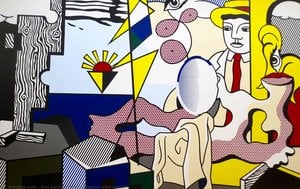
Roy Lichtenstein’s “Green St Mural,” completed in 1983, isn't merely a painting; it’s an experience. Emerging from a period of intense artistic exploration for the American Pop artist, this work represents a deliberate fracturing of reality, a visual embodiment of anxiety and alienation that continues to resonate today. The mural, originally commissioned for Castelli Gallery in New York City, was a bold statement against traditional notions of representation – a chaotic yet meticulously constructed landscape designed to unsettle and provoke thought. It’s a piece that demands attention, inviting the viewer into its fragmented world and challenging them to decipher its complex emotional core.
- Compositional Chaos: The mural's strength lies in its dynamic asymmetry. Rectangular forms – toilets, architectural fragments, distorted figures – collide and overlap, creating a sense of perpetual movement and instability. Lines are sharp and angular, contributing to the overall feeling of unease.
- Cubist & Surrealist Echoes: Lichtenstein masterfully blends influences from Cubism’s deconstruction of form with the dreamlike logic of Surrealism. Objects are presented in fractured planes, their familiar shapes distorted and rearranged, mirroring the disorientation experienced within the scene.
The Language of Abstraction: Technique and Materials
Lichtenstein’s technique is both precise and deliberately raw. The work employs oil on canvas, utilizing bold brushstrokes that suggest a frenetic energy despite the overall sense of chaos. He masterfully utilizes Ben-Day dots – a printing technique borrowed from comic books – to create texture and depth, adding another layer of visual complexity. These dots aren’t simply decorative; they represent a conscious engagement with mass media and its impact on our perception of reality. The flat application of color, particularly the stark contrasts between light and shadow, further emphasizes the fragmented nature of the composition.
Note the deliberate lack of blending or smooth transitions – this reinforces the feeling of abruptness and disruption inherent in the mural’s design.
A Symbolist Landscape: Decoding the Imagery
The imagery within “Green St Mural” is rich with symbolic potential. The prominent toilet, a recurring motif in Lichtenstein's work, can be interpreted as a commentary on consumerism and the banality of modern life – a symbol of routine and perhaps even decay. The eye, rendered in a strikingly realistic detail amidst the abstraction, suggests surveillance, perception, or the relentless gaze of society. The draped figure evokes vulnerability, isolation, and a sense of being trapped within this unsettling environment. Architectural fragments hint at lost structures and forgotten histories, adding to the mural’s overall atmosphere of disorientation.
- The Eye: Often interpreted as a symbol of observation or control, it adds a layer of psychological complexity.
- Toilet: Represents the mundane, the everyday, and perhaps a critique of societal values.
Historical Context & Roy Lichtenstein’s Vision
Created in 1983, “Green St Mural” reflects a pivotal moment in Lichtenstein's career. Following his earlier explorations with comic book imagery and advertising motifs, he moved towards a more abstract and emotionally charged style. This work demonstrates his continued interrogation of American culture, pushing the boundaries of Pop Art while simultaneously exploring themes of alienation and anxiety. The mural’s creation coincided with a period of social and political unrest, mirroring the anxieties of the time. Roy Lichtenstein's legacy as a provocative and influential artist is firmly cemented by this powerful and enduring piece.
Further Research: Explore Roy Lichtenstein’s “Green st mural” at MoMA



 Aperçu en situation
 Commander la reproduction peinte à la main
 Envoyer
 Partager
 Détails de l'œuvre

 Télécharger
 Articles similaires
 Radiographie
 Diaporama
 Statistiques

 Lire la suite






































 L'option verre n'est disponible que pour les dimensions inférieures à 110 cm.