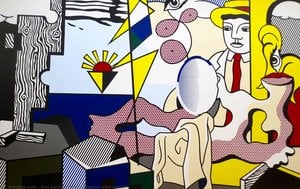
A Frozen Moment in Pop: Roy Lichtenstein’s “Entablature”
Roy Lichtenstein's "Entablature," painted in 1974, isn’t merely a depiction of an architectural element; it’s a carefully constructed meditation on form, repetition, and the very nature of visual language. This work, rendered in acrylic, sand, graphite pencil, and Magna medium on canvas, embodies the core tenets of Lichtenstein's Pop Art style – a deliberate dismantling and reimagining of familiar imagery to expose its underlying structure and provoke contemplation. The piece feels both monumental and strangely intimate, inviting the viewer into a world where classical architecture collides with the vibrant energy of mass media.
The composition itself is strikingly divided. A top band, thin and luminous in yellow-orange, establishes a delicate horizon line. Below this, a broader expanse explodes with repeating dotted patterns – a masterful application of Ben-Day dots, instantly recognizable as a nod to comic book printing techniques. These dots aren’t simply decorative; they are the building blocks of Lichtenstein's visual vocabulary, suggesting a process of reproduction and simplification. The central grey area, punctuated by parallel lines, anchors the composition with a sense of solidity, while the flanking bands, mirroring the top, create a rhythmic, almost hypnotic effect. It’s a deliberate orchestration of elements that simultaneously references ancient design and contemporary mass production.
Decoding the Pop Art Language
Lichtenstein's genius lay in his ability to strip away the illusion of depth and realism, embracing flatness as an aesthetic choice. “Entablature” exemplifies this perfectly. There’s no attempt to create a three-dimensional space; instead, the artist utilizes lines – sharp, precise, and strategically placed – to define boundaries and suggest form. The use of contrasting colors—the vibrant yellow-orange against the stark black and white—further emphasizes this flattened perspective, creating a dynamic tension within the composition. The choice of materials – acrylic paint, sand for texture, and Magna medium – speaks to Lichtenstein’s desire to mimic the techniques of commercial printing, blurring the lines between fine art and advertising.
Interestingly, “Entablature” can be viewed as a commentary on architectural history itself. The entablature, a decorative element found above columns in classical architecture, represents a transition from the heavy, imposing forms of Greek temples to the more restrained styles of Roman design. Lichtenstein’s reimagining subtly critiques this evolution, suggesting that even seemingly timeless structures are ultimately products of specific cultural and technological contexts. The piece isn't simply about replicating an architectural form; it’s about interrogating its meaning within a broader historical narrative.
Symbolism and Emotional Resonance
Beyond its formal qualities, “Entablature” carries a subtle emotional weight. The repetition of patterns evokes a sense of order and control, yet the flatness and lack of depth create an underlying feeling of detachment. It’s a work that invites us to consider the relationship between representation and reality – how we perceive the world through visual symbols and how those symbols shape our understanding. The deliberate use of Ben-Day dots, often associated with childhood and simplified imagery, adds a layer of nostalgia and perhaps even a touch of melancholy.
Furthermore, the work’s creation in 1974 – a period marked by increasing consumerism and cultural upheaval – provides valuable context. Lichtenstein was acutely aware of the changing landscape of American society, and “Entablature” can be interpreted as a reflection on these shifts. The piece serves as a powerful reminder that even seemingly objective forms of representation are inherently subjective and shaped by the prevailing cultural forces of their time. It’s a frozen moment in Pop Art's exploration of visual culture, offering a compelling glimpse into Lichtenstein’s artistic vision.



 Aperçu en situation
 Commander la reproduction peinte à la main
 Envoyer
 Partager
 Détails de l'œuvre

 Télécharger
 Articles similaires
 Radiographie
 Diaporama
 Stats
Stats


 Lire la suite






































 L'option verre n'est disponible que pour les dimensions inférieures à 110 cm.