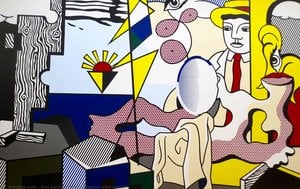
Entablature: A Bold Statement of Geometric Form
Roy Lichtenstein’s “Entablature,” completed in 1976, stands as a cornerstone of Pop Art—a movement that irrevocably challenged the conventions of fine art and embraced imagery derived from popular culture. More than just aesthetically striking, this canvas embodies Lichtenstein's meticulous exploration of architectural principles combined with his signature technique of Ben-Day dots, resulting in an artwork brimming with intellectual depth.
- Subject Matter: The painting depicts a simplified representation of a classical entablature—the horizontal structural element of buildings—stripped down to its essential geometric forms. Lichtenstein eschewed narrative storytelling, opting instead for abstraction that prioritizes visual impact and formal considerations.
- Style & Technique: Lichtenstein’s method was revolutionary. He meticulously recreated comic strip printing techniques onto canvas, employing halftone dots – tiny colored circles – to simulate the shading achieved through screen printing. This process created a textured surface reminiscent of newspaper print, instantly associating the artwork with familiar visual language.
- Color Palette: Dominated by a muted yellow hue, “Entablature” utilizes black stripes strategically positioned across the canvas to delineate shapes and add textural contrast. The simplicity of the color scheme underscores Lichtenstein’s focus on pure form and avoids distracting embellishments.
Historical Context & Pop Art's Rebellion
Created during the mid-1970s, “Entablature” emerged from a broader artistic landscape grappling with anxieties surrounding consumerism and mass media. The Pop Art movement arose in response to Abstract Expressionism’s emotional intensity, rejecting subjective experience for objective representation. Artists like Lichtenstein deliberately appropriated imagery from advertising, comics, and everyday life—sources previously deemed unsuitable for serious art—to critique societal values and provoke contemplation.
As highlighted by the MoMA database (MoMA), Lichtenstein’s intention wasn't merely to reproduce visual stimuli but to transform them into artworks that interrogated their underlying assumptions. The reference to Sergei Chepik and social realism at Roy Miles Gallery (Roy Miles Gallery) underscores the movement’s broader ambition—to engage with pressing social issues through innovative artistic strategies.
Symbolism & Emotional Resonance
Despite its apparent simplicity, “Entablature” carries significant symbolic weight. The entablature itself represents stability and permanence – concepts deliberately contrasted with the fleeting nature of modern life. Lichtenstein’s use of Ben-Day dots isn't merely a stylistic choice; it symbolizes the fragmentation and artificiality inherent in mass media culture.
Furthermore, exploring “Beyond the Ben-Day Dots” (Beyond the Ben-Day Dots) reveals Lichtenstein’s profound engagement with artistic heritage and his desire to elevate commonplace imagery into powerful statements. The meticulous reproduction available at WahooArt (Entablature) allows viewers to experience the artwork's brilliance firsthand.
- Emotional Impact: “Entablature” evokes a sense of calm contemplation despite its bold geometric forms. The repetition and precision of the Ben-Day dots create an almost hypnotic effect, inviting viewers to consider the relationship between form and content—a central preoccupation of Lichtenstein’s oeuvre.



 Aperçu en situation
 Commander la reproduction peinte à la main
 Envoyer
 Partager
 Détails de l'œuvre

 Télécharger
 Articles similaires
 Radiographie
 Diaporama
 Statistiques

 Lire la suite






































 L'option verre n'est disponible que pour les dimensions inférieures à 110 cm.