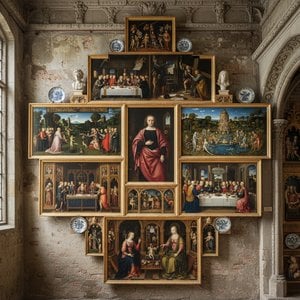
Saint Columba Altarpiece (central panel) : A Masterpiece of Northern Renaissance Devotion
The Saint Columba Altarpiece, created by Rogier van der Weyden around 1455, stands as a cornerstone of Early Netherlandish painting and embodies the profound spiritual convictions that characterized the artistic landscape of fifteenth-century Flanders. Housed within the Alte Pinakothek in Munich—a testament to its enduring significance—this monumental panel transcends mere visual representation; it’s an immersive experience into a meticulously crafted tableau of faith and human emotion.
- Artist: Rogier van der Weyden (1400 – 1464)
- Date: Approximately 1455
- Location: Alte Pinakothek, Munich
- Medium: Oil on oak panel
- Dimensions: 138 x 153 cm
Van der Weyden’s genius lies in his ability to fuse realism with symbolic depth—a hallmark of the Northern Renaissance aesthetic. The central panel depicts a serene Virgin Mary cradling the infant Jesus, surrounded by figures representing Saint Peter, Saint John the Evangelist, and Saint Benedict—all venerated saints whose patronage was particularly prominent during this period.
Composition & Technique: The painting’s pyramidal structure lends stability to its visual harmony. Van der Weyden employs a masterful use of chiaroscuro—the dramatic interplay between light and shadow—to sculpt the figures, conveying their physicality and emotional intensity. Delicate brushstrokes render textures with remarkable precision, from the velvety folds of Mary’s robe to the smooth skin of Jesus’ face. The artist's meticulous attention to detail reflects the humanist ideals prevalent at the time, prioritizing observation and accurate depiction.
Symbolism & Context: Beyond its visual splendor, the Saint Columba Altarpiece is laden with symbolic references rooted in Christian theology. Mary’s posture exudes maternal tenderness—a deliberate invocation of the Virgin Mary's role as protector of Christendom. The saints’ gestures convey piety and devotion, reinforcing the spiritual message conveyed by the artwork. Produced during Philip the Good’s reign—a period marked by political instability and religious fervor—the altarpiece served as a powerful emblem of royal patronage and artistic excellence.
Influence & Legacy: Rogier van der Weyden's influence extended far beyond his own lifetime, shaping the stylistic trajectory of subsequent generations of painters. Artists like Stefan Lochner embraced Van der Weyden’s innovative approach to color and composition—resulting in vibrant palettes and dynamic spatial arrangements. The Saint Columba Altarpiece remains an inspiration for contemporary artists seeking to capture the essence of human experience within a framework of spiritual contemplation.
Further Exploration: To delve deeper into Van der Weyden’s artistic vision, consider examining his other celebrated works—particularly “The Descent from the Cross” and “Portrait of Saint Cecilia”—which showcase his unparalleled mastery of technique and expressive power. For detailed reproductions and scholarly analyses, visit WGA or explore the Alte Pinakothek’s online catalog at Pinakothek Webseite.



 Aperçu en situation
 Passer au format impression
 Envoyer
 Partager
 Détails de l'œuvre

 Télécharger
 Articles similaires
 Radiographie
 Diaporama
 Statistiques


 Lire la suite






































 L'option verre n'est disponible que pour les dimensions inférieures à 110 cm.