vie et carrière
rogier van der weyden, également connu sous le nom de roger de la pasture, était un peintre néerlandais influent du début du XVe siècle. Né en Belgique vers 1400, il est devenu l'un des artistes les plus influents de son temps, ses œuvres obtenant une reconnaissance importante aux Pays-Bas, en Italie et en Espagne.
style artistique et technique
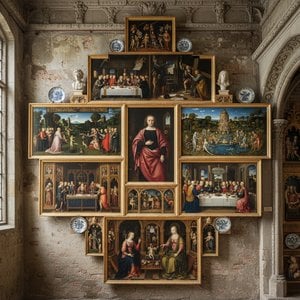
Le style artistique de Van der Weyden se caractérisait par des couleurs riches, des expressions sympathiques et une approche unique du pathos et du naturalisme. Ses figures apparaissaient souvent statuesques, notamment dans ses triptyques, qui présentaient des détails complexes et des traits faciaux idéalisés. Il employait une palette de couleurs variée, veillant à ce qu'aucune teinte ne soit répétée, ajoutant ainsi profondeur et complexité à ses compositions.
œuvres notables
*
saint luc rhabillant la madone (Musée des Beaux-Arts de Boston) : ce tableau présente la maîtrise de Van der Weyden dans l'huile sur panneau, offrant une représentation époustouflante de saint Luc. * Lamentation (Musée des Beaux-Arts de Tournai, Belgique) : ce petit mais puissant tableau démontre la capacité de Van der Weyden à transmettre une intensité émotionnelle par le clair-obscur.
musées et collections
* Musée des Beaux-Arts de Tournai, Belgique : abrite une impressionnante collection d'œuvres de Van der Weyden, notamment
le portrait diptyche de Jean de Gros. * Musées Royaux des Beaux-Arts (Bruxelles, Belgique) : abrite une collection importante de peintures néerlandaises du début, comprenant des œuvres de Van der Weyden et d'autres artistes notables.
héritage
L'influence de Van der Weyden sur le Renouveau flamand est indéniable. Il se tenait aux côtés de Robert Campin et Jan van Eyck en tant que l'un des trois grands artistes flemish primitifs, réputé pour son style et sa technique innovants. Malgré le déclin de sa renommée au XVIIe siècle, les œuvres de Van der Weyden ont été redécouvertes au XIXe siècle et il se dresse aujourd'hui comme une figure importante dans l'histoire de la peinture néerlandaise du début.
Découvrez les chefs-d'œuvre de Rogier van der Weyden et d'autres artistes néerlandais primitifs sur WahooArt.com.



 Aperçu en situation
 Acheter la peinture faite à la main
 Partager
 Partager
 Détails
 Guide
Guide

 Télécharger
 Articles similaires
 Radiographie
 Voir le diaporama
 Statistiques


 Afficher la suite






































 L'option verre n'est disponible que pour les dimensions inférieures à 110 cm.