


Impressions giclées ou sur toile de qualité musée, avec une production rapide et des finitions au choix. ( Commander la reproduction peinte à la main Acheter l'image haute résolution)
Choisissez parmi nos formats prédéfinis qui respectent les proportions originales de l’œuvre.

Vous pouvez saisir vos propres dimensions pour vous adapter à un cadre ou à un espace spécifique. Si la taille sélectionnée ne correspond pas aux proportions de l'image originale, nous recadrerons l'œuvre ou étendrons l'image avec une bordure en miroir ou une couleur unie. Une maquette numérique vous sera envoyée pour approbation avant le début de la production.
Veuillez noter que l'aperçu à l'écran ne reflète pas le recadrage ou l'extension réelle. Seule la maquette montrera avec précision la composition finale.
Bien que des tailles personnalisées soient disponibles, nous vous recommandons de choisir une dimension dans la liste prédéfinie afin de préserver les proportions originales.
Livraison dans le monde entier () en 2 semaines au lieu des 4/5 semaines habituelles. (7 septembre)


Gallery Low
Format de la reproduction

To gaze upon the work of Robert Polidori is to enter a realm where time itself seems to have paused, caught in the delicate, crumbling embrace of architectural ruin. Born on February 10, 1951, in Montreal, Quebec, Polidori’s life and artistic trajectory reflect a profound connection between geography and memory. Raised in the United States amidst the landscapes of Seattle, Southern California, and New Orleans, his early exposure to diverse environments laid the groundwork for a career dedicated to documenting the physical traces of history. As a Canadian-American photographer, he possesses a unique perspective that bridges the gap between the personal and the monumental, finding deep emotional resonance in the spaces left behind by human civilization.
Polidori’s artistic sensibilities were profoundly shaped by his academic pursuits and early cinematic encounters. His journey through the study of photography and film—influenced by the structural explorations of Michael Snow’s Wavelength—instilled in him a fascination with how light, space, and duration interact within a frame. He drew significant inspiration from Surrealist masters such as René Magritte and Giorgio Morandi, whose works taught him that the most profound truths often lie beneath a surface of quiet contemplation or subtle illusion. This influence is evident in his ability to transform a mere photograph of an abandoned room into a psychological landscape, where the textures of peeling wallpaper and sun-bleached floors evoke unspoken anxieties and the haunting beauty of what has been lost.
The hallmark of Polidori’s oeuvre is his mastery of large-scale color photography, a technique that allows him to present architectural decay with an almost tactile intensity. He does not merely document destruction; he celebrates the melancholic grandeur of it. His lens has traveled to the most evocative corners of the globe, capturing the aftermath of catastrophe and the slow erosion of time. From the shell-shocked structures of Beirut and the nuclear silence of Chernobyl to the post-Hurricane Katrina devastation in New and Orleans, Polidori’s work serves as a vital historical record. He captures the way light interacts with debris, turning dust and wreckage into elements of a sublime, dreamlike composition.
His explorations are not limited to disaster zones; they extend into the quiet, dignified decay of colonial legacies and cultural landmarks. His studies of Havana, Cuba, and the interiors of Mumbai or Amman reveal a fascination with how urban environments evolve and dissolve. Through his meticulous attention to textural detail and a muted, sophisticated color palette, he achieves a level of photographic realism that feels both hyper-present and otherworldly. In these images, the architecture becomes a protagonist, telling stories of vanished inhabitants, forgotten rituals, and the inexorable march of entropy.
The significance of Robert Polidori’s contribution to contemporary photography cannot be overstated. He has been recognized as one of the most esteemed practitioners of large-scale photography, with his work commanding presence in the world's most prestigious institutions. His career is marked by a series of monumental achievements that have solidified his place in the canon of modern art:
Ultimately, Polidori’s work invites us to share in a collective memory. As curator Paulette Gagnon once noted, his photographic accounts invite viewers to inhabit historical moments, making them part of our shared human experience. By finding the "utopia" within decay, Polidori reminds us that even in the process of falling apart, there is a profound, enduring grace that demands to be seen.

1951 -

Explore the profound elegance of Neoclassical art. Discover the principles of order, symmetry, and virtue through the works of masters like David and Mengs. Immerse yourself in a journey of classical grace and timeless aesthetic perfection.
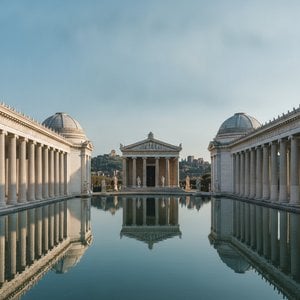
Discover the profound elegance of Neoclassicism. Explore how the pursuit of order, symmetry, and Greco-Roman ideals created a timeless aesthetic for collectors seeking grandeur and intellectual depth in fine art and architecture.

Explore the refined world of Neoclassical portraiture. Discover the mastery of line, light, and order through an expert exploration of academic art history, from Jacques-Louis David to Jean-Antoine Houdon. Immerse yourself in the timeless elegance of classical realism.

Discover the profound beauty of Academic Classicism. Explore the principles of order, anatomical precision, and the enduring legacy of Neoclassical masters through this expert guide to timeless elegance and technical perfection in fine art.

Explore the profound beauty of Academic Painting and Realism. Discover how master artists capture truth through meticulous technique, offering discerning collectors unparalleled excellence in hand-painted oil reproductions and bespoke fine art commissions.

 Aperçu en situation
 Envoyer
 Partager
 Détails de l'œuvre

 Télécharger
 Articles similaires
 Radiographie
 Diaporama


 Lire la suite




































 L'option verre n'est disponible que pour les dimensions inférieures à 110 cm.


