


Impressions giclées ou sur toile de qualité musée, avec une production rapide et des finitions au choix. ( Commander la reproduction peinte à la main Acheter l'image haute résolution)





























Choisissez parmi nos formats prédéfinis qui respectent les proportions originales de l’œuvre.

Vous pouvez saisir vos propres dimensions pour vous adapter à un cadre ou à un espace spécifique. Si la taille sélectionnée ne correspond pas aux proportions de l'image originale, nous recadrerons l'œuvre ou étendrons l'image avec une bordure en miroir ou une couleur unie. Une maquette numérique vous sera envoyée pour approbation avant le début de la production.
Veuillez noter que l'aperçu à l'écran ne reflète pas le recadrage ou l'extension réelle. Seule la maquette montrera avec précision la composition finale.
Bien que des tailles personnalisées soient disponibles, nous vous recommandons de choisir une dimension dans la liste prédéfinie afin de préserver les proportions originales.
Livraison dans le monde entier () en 2 semaines au lieu des 4/5 semaines habituelles. (7 septembre)


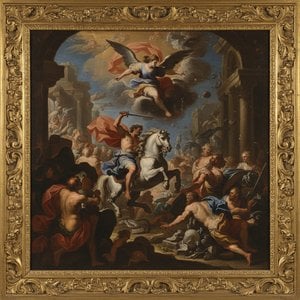
HERCULE SUR LE BUCHER
Format de la reproduction
In the grand theater of the Baroque era, few images capture the raw intersection of human agony and divine destiny as poignantly as Guido Reni’s Hercules Sur Le Bucher. Painted during the height of the seventeenth century, this monumental work serves as a breathtaking window into a moment of profound mythological crisis. As the legendary hero Hercules prepares for his pyre, the canvas vibrates with an almost palpable tension. Reni does not merely depict a scene from antiquity; he orchestrates a cosmic drama where the muscular weight of the mortal form meets the swirling, ethereal uncertainty of the heavens. For the discerning collector or lover of classical beauty, this piece offers more than just visual splendor—it provides a window into the very soul of Baroque classicism.
The composition is a masterclass in directed movement, utilizing a sweeping diagonal trajectory that pulls the viewer’s gaze from the lower left toward the upper right. This upward surge mimics the hero's own struggle, creating a sense of breathless ascension amidst a turbulent sky. Reni employs chiaroscuro with unparalleled skill, casting deep, oppressive shadows that contrast sharply against the radiant light illuminating Hercules’ torso and face. This interplay of light and dark does more than create depth; it mirrors the internal conflict of a man caught between his earthly labors and his impending apotheosis. The flesh tones are rendered with an anatomical precision that celebrates the strength of the human spirit, while the surrounding clouds appear as restless, painterly strokes of grey and azure, suggesting a world in flux.
Beyond its striking visual impact, Hercules Sur Le Bucher is steeped in layers of symbolic meaning that resonate with anyone moved by themes of resilience and transformation. The figure of Hercules, stripped of his armor and vulnerable yet powerful, represents the eternal struggle against adversity. The swirling clouds and stormy atmosphere serve as metaphors for the chaotic forces of fate and divine intervention that govern the lives of even the greatest legends. In the context of interior design, such a piece acts as a profound focal point, bringing an air of intellectual depth and dramatic gravitas to any curated space. It is a work that demands attention, inviting contemplation on the nature of suffering and the eventual triumph of the heroic will.
The palette chosen by Reni—a sophisticated blend of earthy ochres, deep browns, and sudden flashes of ivory—grounds the mythological subject in a tangible, visceral reality. This careful balance of warmth and coolness ensures that the painting remains both emotionally accessible and aesthetically timeless. For those seeking to adorn a home or gallery with a high-quality reproduction, this artwork offers an unparalleled opportunity to embrace the elegance of the Italian Baroque. It is an invitation to live surrounded by art that does not merely decorate a wall, but tells a story of enduring strength, capturing a moment where the mortal and the divine collide in a spectacular display of artistic mastery.

Guido Reni, également connu sous le nom de Le Guide, est né à Bologne, en Italie, en 1575. Il était l'unique enfant de Daniele Reni, musicien, et Ginevra Pozzi, elle aussi issue d'une famille musicale. Cette éducation lui a inculqué une appréciation pour l'harmonie et la forme qui ont influencé son style artistique plus tard. À l'âge de neuf ans, Guido a commencé son apprentissage auprès de Denis Calvaert, peintre flamand travaillant à Bologne. Il étudia aux côtés d'autres jeunes artistes aspirants, Albani et Domenichino, acquérant ainsi une base solide en principes classiques.
La carrière artistique de Reni s'est étendue sur plusieurs villes italiennes, notamment Rome, Naples et sa ville natale, Bologne. Ses premières œuvres reflétaient l'influence de Calvaert et des frères Carracci, mettant l'accent sur la précision anatomique et la composition dramatique. Cependant, Reni a rapidement développé un style distinctif caractérisé par son classicisme élégant, sa technique raffinée et son intensité émotionnelle. Il est devenu une figure dominante de la École Bolognesa, connue pour son accent mis sur la formation académique et les formes idéalisées.
L'œuvre de Reni englobe une grande variété de sujets, notamment des scènes religieuses, des récits mythologiques et des représentations allégoriques. Certaines de ses œuvres les plus célèbres comprennent :
Le style de Reni est souvent décrit comme un classicisme éclectique. Il a combiné la précision de l'art classique avec le dynamisme et l’émotion du baroque. Ses figures sont typiquement idéalisées, possédant une beauté sereine et un mouvement gracieux.
Guido Reni a joué un rôle crucial dans la formation du style baroque de la Haute Italie. Il a influencé des générations d'artistes avec sa technique raffinée, ses compositions élégantes et sa profondeur émotionnelle. Son œuvre est conservée dans des musées importants du monde entier, notamment le Palais des Capodimonte à Naples. L’héritage de Reni s'étend au-delà de la peinture ; il était également un poète et une figure intellectuelle respectée de son temps.
Son art continue d'inspirer les artistes et les amateurs d'art aujourd'hui, consolidant ainsi sa place en tant que l'un des peintres les plus importants du 17e siècle. Son influence peut être vue dans les artistes baroques ultérieurs qui ont cherché à imiter son élégance et son pouvoir émotionnel.
Guido Reni est décédé à Bologne en 1642, laissant derrière lui un riche héritage artistique qui captive encore les publics des siècles plus tard.

1575 - 1642 , Italie
Explore the breathtaking power of Baroque art. Delve into the dramatic interplay of light, shadow, and motion through the works of masters like Caravaggio. Discover how the era's intense emotional realism continues to inspire collectors and connoisseurs of classical grandeur.

Embark on a sophisticated journey through Italian Baroque art. Discover the dramatic interplay of light and emotion in Caravaggio’s masterpieces and explore how to bring this timeless grandeur into your collection with expert art insights.

 Aperçu en situation
 Envoyer
 Partager
 Détails de l'œuvre

 Télécharger
 Articles similaires
 Radiographie
 Diaporama


 Lire la suite







 L'option verre n'est disponible que pour les dimensions inférieures à 110 cm.


