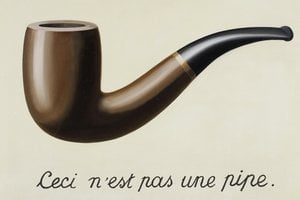
A Surreal Encounter with Reality
René Magritte's "Good Faith," painted in 1965, is far more than a mere depiction of a man enjoying a quiet moment; it is a profound invitation to contemplate the very nature of perception and representation. As one of the most influential figures of the Surrealist movement, Magritte masterfully crafts a scene that feels simultaneously familiar and deeply unsettling. The painting captures a solitary gentleman, dressed with impeccable precision in a black suit and tie, perched atop a hat adorned with a striking crimson ribbon. As he engages in the seemingly mundane activity of puffing on his pipe, the viewer is drawn into a complex tapestry of symbolic meaning where the boundaries between the ordinary and the extraordinary begin to dissolve.
The technical execution of the piece reflects Magritte’s unique approach to Surrealist principles. Eschewing the chaotic energy of pure automatism, he instead utilized oil on canvas with a deliberate, smooth precision. His brushstrokes are applied with such care that they enhance the illusionistic quality of the scene, creating a surface so polished it almost feels like a window into another dimension. This meticulous technique serves a higher purpose: by rendering the impossible with such startling realism, Magritte forces the viewer to question the reliability of their own eyes. The juxtaposition of familiar objects—a hat, a pipe, a suit—placed within an incongruous and dreamlike environment creates a visual tension that is both captivating and intellectually stimulating.
Symbolism and the Subconscious Mind
To understand "Good Faith," one must delve into the historical and psychological currents that shaped Magritte’s vision. Emerging from the aftermath of World War I, Surrealism sought to liberate the human psyche from the rigid constraints of rationalism and bourgeois values. Magritte’s work serves as a gateway to this liberated subconscious, exploring fantasies and irrational impulses as legitimate sources of truth. The pipe itself acts as a potent symbol, representing contemplation, habituation, and perhaps even a quiet acceptance of fate. When placed within the monumental context of the hat, these small, everyday rituals are elevated to a status of profound significance, suggesting that meaning is often hidden within the most inconspicuous details of life.
There is an undeniable emotional resonance in this work that speaks to collectors and decorators alike. The painting evokes a sense of quiet mystery and intellectual curiosity, making it a centerpiece capable of sparking conversation in any sophisticated interior. For the art lover, it offers a puzzle to be solved; for the interior designer, it provides a bold, conceptual anchor that adds depth and narrative weight to a room. Whether viewed as an exploration of the artist's own fascination with hidden realities or as a philosophical inquiry into the nature of existence, "Good Faith" remains a timeless masterpiece that continues to challenge, haunt, and inspire all who encounter its enigmatic gaze.



 Aperçu en situation
 Commander la reproduction peinte à la main
 Envoyer
 Partager
 Détails de l'œuvre

 Télécharger
 Articles similaires
 Radiographie
 Diaporama
 Statistiques

 Lire la suite






































 L'option verre n'est disponible que pour les dimensions inférieures à 110 cm.