Aperçu en situation Aperçu en RA Passer au format impression Passer au format image numérique Partager
Détails Guide imprimable Ajouter aux favoris Télécharger Articles similaires Radiographie Voir le diaporama Statistiques

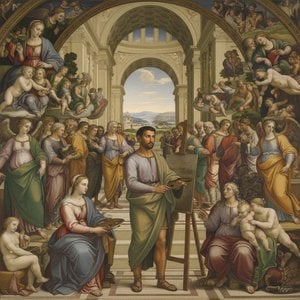
Le Triomphe de Galate

Magnifique fresque de Raphaël ! "Le Triomphe de Galate" illustre une mythologie grecque captivante, pleine d'anges et de beauté divine. Admirez cet chef-d’œuvre de la Renaissance.

Découvrez Raphaël (1483-1520), le maître de la Renaissance italienne réputé pour son élégance, sa clarté et ses compositions harmonieuses. Explorez les œuvres emblématiques telles que 'La Scuola di Atene', les Madones et les fresques qui définissent la beauté classique. #ArtRenaissance #Italie

Reproduction à l'huile faite à la main

Huile sur toile peinte à la main, avec cadre et dimensions personnalisés, réalisée sur commande par nos artistes. ( Passer au format impression Passer au format image numérique)

Corner sample of the P118B picture frame: polystyrène moulé, 5 cm wide and 3 cm thick
P118B 10
Corner sample of the P118H picture frame: polystyrène moulé, 5 cm wide and 3 cm thick
P118H 10
Corner sample of the P118W picture frame: polystyrène moulé, 5 cm wide and 3 cm thick
P118W 10
Corner sample of the P438Z picture frame: polystyrène moulé, 5.5 cm wide and 3.5 cm thick
P438Z 10
Corner sample of the P508JH picture frame: polystyrène moulé, 7 cm wide and 3.5 cm thick
P508JH 12
Corner sample of the P508YH picture frame: polystyrène moulé, 7 cm wide and 3.5 cm thick
P508YH 12
Corner sample of the P805H picture frame: polystyrène moulé, 5 cm wide and 3.5 cm thick
P805H 10
Corner sample of the P805Z picture frame: polystyrène moulé, 5 cm wide and 3.5 cm thick
P805Z 10
Corner sample of the P919BZ picture frame: polystyrène moulé, 7 cm wide and 3.5 cm thick
P919BZ 10
Corner sample of the P919G picture frame: polystyrène moulé, 7 cm wide and 3.5 cm thick
P919G 10
Corner sample of the P919XJ picture frame: polystyrène moulé, 7 cm wide and 3.5 cm thick
P919XJ 10
Corner sample of the P959ZH picture frame: polystyrène moulé, 5 cm wide and 3 cm thick
P959ZH 10
Corner sample of the P968JZ picture frame: polystyrène moulé, 6 cm wide and 4 cm thick
P968JZ 12
Corner sample of the W106C picture frame: bois massif, 5 cm wide and 3 cm thick
W106C 8
Corner sample of the W218G picture frame: bois massif, 5 cm wide and 3 cm thick
W218G 10
Corner sample of the W218JH picture frame: bois massif, 5 cm wide and 3 cm thick
W218JH 8
Corner sample of the W218Y picture frame: bois massif, 5 cm wide and 3 cm thick
W218Y 10
Corner sample of the W307PJ picture frame: bois massif, 6 cm wide and 3 cm thick
W307PJ 10
Corner sample of the W316G picture frame: bois massif, 6 cm wide and 3 cm thick
W316G 10
Corner sample of the W316PJ picture frame: bois massif, 6 cm wide and 3 cm thick
W316PJ 8
Corner sample of the W316Y picture frame: bois massif, 6 cm wide and 3 cm thick
W316Y 10
Corner sample of the W398PJ picture frame: bois massif, 5 cm wide and 3 cm thick
W398PJ 8
Corner sample of the W4111J picture frame: bois massif, 6.5 cm wide and 3.5 cm thick
W4111J 10
Corner sample of the W500HY picture frame: bois massif, 7 cm wide and 5 cm thick
W500HY 15
Corner sample of the W500JH picture frame: bois massif, 7 cm wide and 5 cm thick
W500JH 15
Corner sample of the W692G picture frame: bois massif, 8 cm wide and 4 cm thick
W692G 12
Corner sample of the W849H picture frame: bois massif, 5 cm wide and 3 cm thick
W849H 8
Corner sample of the W940BG picture frame: bois massif, 7.5 cm wide and 4.5 cm thick
W940BG 15
Corner sample of the W953PJ picture frame: bois massif, 6 cm wide and 3.5 cm thick
W953PJ 8

Format standard
personnalisé
CM
INCH

Choisissez parmi nos formats prédéfinis qui respectent les proportions originales de l’œuvre.

largeur
hauteur

Saisissez la largeur et la hauteur souhaitées, pour s'adapter à votre cadre ou à votre mur. Cette œuvre est peinte à la main ; ainsi, pour un format de forme différente, l'artiste peut peindre un peu plus autour du tableau ou réduire légèrement les bords — c'est vous qui choisissez. Nous vous envoyons une maquette numérique pour approbation avant que la peinture ne commence. L'image présentée sur cette page ne reflète pas le résultat réel — seule la maquette le fait.

Exemples de personnalisation possibles : remplacer un visage par la photo du client ; ajouter un animal de compagnie (par exemple, remplacer un chat par un chien) ; inclure un message caché en arrière-plan ; modifier le paysage ou les éléments de l'arrière-plan.
Après la commande, l’équipe WahooArt.com contactera le client par e-mail pour recueillir ses instructions et lui fournira une maquette d’aperçu

Livraison dans le monde entier () en 3 à 4 semaines au lieu des 5 semaines habituelles. (20 octobre). Aucun compromis sur la qualité.

Livraison express gratuite dans le monde entier
Toile de lin de haute qualité
Assurance transport complète
Garantie de remboursement des droits de douane
Garantie de fidélité des couleurs
Garantie de retour de 100 jours (uniquement en cas de défaut)
Garantie de remboursement à 100%
Tarifs dégressifs sur quantité

Prix total

€ 237

Le Triomphe de Galate

Technique de reproduction

Format de la reproduction

-

Prix total final

€ 237

L'essentiel de l'œuvre

  • Title: Le Triomphe de Galatée
  • Artist: Raphaël Sanzio
  • Movement: Renaissance
  • Subject or theme: Galatée et les Nymphes
  • Medium: Fresque

Quiz d'art

Chaque question ne comporte qu'une seule bonne réponse.

Question 1:
Quel est le sujet principal du tableau "Le Triomphe de Galathée" ?
Question 2:
Dans la mythologie grecque, qui est le principal antagoniste de Galathée dans cette œuvre ?
Question 3:
Dans quel bâtiment du Vatican Raphaël a-t-il peint "Le Triomphe de Galathée" ?
Question 4:
Quel style artistique le tableau "Le Triomphe de Galathée" anticipe-t-il ?
Question 5:
Quel matériau Raphaël a-t-il utilisé pour créer les couleurs vives du ciel et de la mer dans le tableau ?

The Triumph of Galatea: A Renaissance Myth Made Radiant

Raphael’s “Triumph of Galatea,” completed in 1512 for the Villa Farnesina in Rome, isn't merely a fresco; it’s an immersive experience. Commissioned by Agostino Chigi, one of the wealthiest men of his age, this work transcends its initial purpose as decoration to become a profound meditation on beauty, mythology, and the very nature of artistic creation. The scene unfolds within the open gallery of the villa, bathed in a luminous quality that immediately draws the viewer into a world of ethereal grace and dramatic narrative. It’s a pivotal piece, often cited as a bridge between the Mannerism of the late 15th century and the burgeoning Baroque style that would dominate the following decades – a testament to Raphael's ability to synthesize tradition with innovation.

At its heart lies Galatea, the Nereid nymph, depicted in a moment of glorious apotheosis. She’s not simply rescued; she *ascends*, lifted by a chorus of angelic figures, their forms rendered with an exquisite delicacy that contrasts sharply with the raw power of Polyphemus, the one-eyed giant looming menacingly in the background. This deliberate juxtaposition is key to understanding Raphael's artistic choices. He deliberately avoids depicting the violent act of Acis’s death – a common element in earlier versions of the myth – instead focusing on Galatea’s elevation, suggesting a triumph over adversity and a celebration of divine beauty. The composition itself is meticulously balanced, utilizing diagonal lines created by the dolphins carrying her chariot to draw the eye across the scene, while the carefully arranged figures create a sense of dynamic movement and layered depth.

The Mythic Narrative: The story originates in Ovid’s *Metamorphoses*, where Galatea falls in love with the mortal shepherd Acis. Jealousy leads Polyphemus to kill Acis, transforming his blood into a river – the River Acis. Raphael cleverly sidesteps this tragic element, presenting instead Galatea’s ascension to a higher realm, symbolizing her victory over mortality and suffering.

Symbolism of Light: The fresco is renowned for its masterful use of *chiaroscuro*—the dramatic contrast between light and shadow—to sculpt the figures and create an atmosphere of both serenity and drama. This technique not only enhances the beauty of Galatea but also emphasizes her divine nature, casting a radiant glow upon her form.

The Angels: The angelic figures are rendered with a remarkable degree of realism and humanity, their expressions conveying a sense of awe and reverence. They’re not idealized representations of divinity; instead, they possess a palpable warmth and empathy, further emphasizing the painting’s focus on human beauty and emotion.

  • Villa Farnesina Setting: Context and Patronage
  • Technique and Artistic Innovation

Villa Farnesina Setting: Context and Patronage

To fully appreciate “Triumph of Galatea,” it’s essential to understand its historical context. The Villa Farnesina itself was a significant project, commissioned by the Sienese banker Agostino Chigi as a lavish retreat in Rome. The villa’s architecture reflects the grandeur and sophistication of Renaissance Italy, and its decoration—including Raphael’s frescoes—was intended to impress guests and showcase the family’s wealth and influence. The fresco cycle within the Villa Farnesina was inspired by Angelo Poliziano’s “Stanze per la giostra,” a series of poems celebrating Florentine festivities. Raphael skillfully adapted these poetic themes into visual form, creating a harmonious blend of literature and art.

Furthermore, the choice of subject matter—a mythological tale of love and transformation—was particularly fitting for a wealthy banker’s villa. Mythological narratives were often used to explore themes of virtue, beauty, and morality – values that were highly valued by Renaissance humanists. The fresco served as both decoration and a subtle commentary on the ideals of the era.

Technique and Artistic Innovation

Raphael's mastery is evident in every detail of “Triumph of Galatea.” He employed *sfumato*, a technique developed by Leonardo da Vinci, to create soft, hazy outlines that blur the boundaries between figures and background. This creates an atmospheric effect that enhances the painting’s sense of depth and realism. The use of color is equally remarkable – vibrant blues and greens evoke the depths of the sea, while delicate pinks and golds highlight Galatea’s ethereal beauty. The artist’s attention to anatomical detail is also noteworthy, particularly in the rendering of the angels’ wings and the musculature of the figures.

Interestingly, recent research has revealed that Raphael utilized Egyptian blue pigment—a rare and expensive material—in the painting’s sky and sea. This suggests a conscious effort on his part to evoke the grandeur and timelessness of classical antiquity, aligning with the Renaissance revival of interest in ancient Greek and Roman art and culture.

To explore our range of reproductions and commission your own, please visit /art/list/?Filter=7YKFWM-Raphael-(Raffaello-Sanzio-Da-Urbinoo)-The-Triumph-of-Galatea and discover the magic of Raphael’s “Triumph of Galatea.” For further research, you may also find valuable insights at https://en.wikipedia.org/wiki/The_Loves_of_the_Gods.

Questions et réponses

Est-ce que Raphaël, créateur de « Le Triomphe de Galate », est connu sous d'autres noms ?

Raphaël est également connu sous le nom de Raffaello Sanzio da Urbino.

De quel type d'œuvre s'agit-il pour "Le Triomphe de Galate" ?

« Le Triomphe de Galate » est une œuvre de type Art mural.

Quelle émotion l'œuvre Baroque «Le Triomphe de Galate» dégage-t-elle ?

L'émotion Mystérieux de « Le Triomphe de Galate » accompagne son style Baroque.


Biographie de l'artiste

**Jeunesse et formation**

Raphaël (Raffaello Sanzio da Urbino), un peintre et architecte italien renommé, est né entre le 28 mars et le 6 avril 1483, dans la petite mais culturellement significative ville d'Urbino. Son père, Giovanni Santi, était peintre de cour du duc, lui offrant une exposition précoce au monde artistique. Après le décès de son père à l’âge de onze ans, Raphaël a vraisemblablement géré l’atelier familial, consolidant ainsi sa base artistique.

**Carrière artistique et influences**

Le parcours artistique de Raphaël peut être divisé en trois phases distinctes, chacune marquée par un style unique :
  • Premières années à Umbrie : caractérisée par l'influence de son père et l'ambiance culturelle d’Urbino.
  • Période florentine (1504-1508) : absorbant les traditions artistiques de Florence, qui a considérablement façonné son style.
  • Période romaine (1508-1520) : travaillant pour deux papes et leurs associés, produisant certaines de ses œuvres les plus célèbres, notamment l’école des Athènes dans la stanza della segnatura du Vatican.

**Œuvres notables et héritage**

Certaines des œuvres notables de Raphaël comprennent :

**Influence et héritage**

L'influence de Raphaël sur l'art est profonde, avec son œuvre constituant un pilier du grand Siècle. Son style serein et harmonieux a servi de modèle à la peinture néoclassique, comme le note l’historien d’art Johann Joachim Winckelmann. Malgré l'influence ultérieure du style de Michel-Ange, Raphaël reste l'un des artistes les plus vénérés de l'histoire. Voir le profil de Raphaël sur WahooArt
Raphaël

Raphaël

1483 - 1520 , Italie

En bref

  • Artistes Influents:
    • Giovanni Santi
    • Pietro Perugino
  • Date De Décès: 6 avril 1520
  • Date De Naissance: 28 mars 1483
  • Influences Artistiques: Peinture néoclassique
  • Lieu De Naissance: Urbino, Italie
  • Mouvement Artistique: Haute Renaissance
  • Nationalité: Italienne
  • Nom Complet: Raphaël (Raffaello Sanzio)
  • Œuvres Notables:
    • L'École d'Athènes
    • Madone Esterházy
    • La Transfiguration
    • Les Stanze Vaticanes
Explorez des œuvres d'art classées par thèmes, styles et caractéristiques.