


L’œuvre d'art présentée sur cette page est protégée par le droit d'auteur, ce qui signifie que nous ne pouvons légalement créer ou vendre de reproduction identique. Cette protection est appliquée en vertu d'accords internationaux tels que la Convention de Berne et par les lois nationales, notamment celles énoncées par le Loi américaine sur le droit d'auteur - Titre 17.
Cette méthode est pleinement conforme aux réglementations sur le droit d'auteur car elle ne repose pas sur la copie ou la duplication de l'œuvre protégée. Il s'agit plutôt d'une réinterprétation créative — une nouvelle peinture qui s'inspire de l'original sans pour autant lui être identique.
Impressions giclées ou sur toile de qualité musée, avec une production rapide et des finitions au choix. ( Commander la reproduction peinte à la main Passer au format numérique)





























Choisissez parmi nos formats prédéfinis qui respectent les proportions originales de l’œuvre.

Saisissez la largeur et la hauteur souhaitées pour qu'elles s'adaptent à votre cadre ou à votre mur. Une impression peut être recadrée, mais jamais agrandie au-delà de l'image originale ; ainsi, un format de forme différente entraînera la perte d'une partie de l'image. Nous vous envoyons une maquette numérique pour approbation avant toute impression. L'image présentée sur cette page ne montre pas le recadrage réel — seule la maquette le permet.
Livraison dans le monde entier () en 2 semaines au lieu des 4/5 semaines habituelles. (10 novembre)
Self-portrait
Format de la reproduction
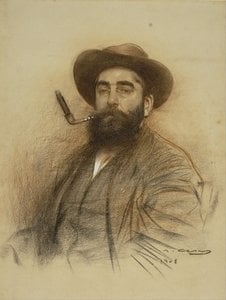
In this evocative 1908 drawing, we are invited into the intimate, smoke-filled atmosphere of a bygone era. The piece serves as a profound window into the life of Ramon Casas Carbó, an artist who did not merely paint the world around him but acted as its visual chronicler. Through the delicate yet commanding use of line and shadow, the work captures a moment of quiet introspection. A man, seated with a poised, crossed-legged stance, anchors the composition; his presence is defined by the rugged texture of his beard and the thoughtful weight of his gaze. As he holds a pipe, a thin trail of implied smoke suggests a pause in time, inviting the viewer to share in this contemplative stillness. The monochromatic palette strips away the distractions of color, forcing an encounter with the raw, structural essence of the subject's character.
The technique employed here speaks to the mastery of draftsmanship that defined the Catalan Modernisme movement. Every stroke of the pencil or charcoal serves a purpose, building volume and depth through meticulous hatching and tonal gradations. The artist’s ability to render the heavy fabric of the clothing against the soft, organic textures of facial hair creates a tactile experience for the eye. While the central figure commands our attention, the subtle presence of others in the background adds a layer of social complexity, suggesting that this private moment is occurring within the vibrant, bustling pulse of Barcelona’s intellectual circles. This interplay between the individual and the collective is a hallmark of Casas's ability to capture both personal identity and societal transformation.
For the discerning collector or interior designer, this work offers more than mere decoration; it provides a sense of historical gravity and intellectual depth. The stark, black-and-white aesthetic makes it a versatile masterpiece, capable of anchoring a contemporary minimalist space with its classic elegance or adding a layer of sophisticated nostalgia to a traditional study. It is a piece that demands conversation, acting as a bridge between the late nineteenth-century's artistic revolution and the modern aesthetic. To possess a reproduction of this self-portrait is to hold a fragment of Catalonia's golden age, bringing an atmosphere of timeless wisdom and artistic prestige into any curated environment.
L'original « Self-portrait » se trouve au Musée National d'Art de Catalogne, et l'œuvre est toujours protégé par le droit d'auteur.
«Self-portrait» de Ramon Casas est dans le toujours protégé par le droit d'auteur. Ce statut régit les modalités de reproduction de l'image de l'œuvre.
« Self-portrait » est attribué à Ramon Casas.

Espagne

Maîtrisez l'art du clair-obscur et du contraste en noir et blanc grâce à notre analyse technique. Explorez la puissance de l'ombre ici.

Sublimez votre intérieur avec l'élégance du noir et blanc. WahooArt transforme vos souvenirs en chefs-d'œuvre à l'huile peints à la main par nos maîtres. Découvrez l'art du clair-obscur et créez un héritage intemporel grâce à notre savoir-faire d'exception et notre expertise unique.

Explore the profound artistry of graphite drawing. Discover professional techniques for mastering depth, texture, and detail through a lens of art history, from classical sketches to modern masterpieces. Elevate your understanding of the pencil medium with our expert guide.

Explorez la maîtrise du clair-obscur de Ugo da Carpi au Caravage. Plongez dans l'histoire technique du relief et de la lumière.
 Aperçu en situation
 Envoyer
 Partager
 Détails de l'œuvre
 Guide
Guide

 Télécharger l'image
 Articles similaires
 Radiographie
 Diaporama
 Questions et réponses
 Statistiques


 Lire la suite









 L'option verre n'est disponible que pour les dimensions inférieures à 110 cm.


