Premières années et formation
Pieter de Hooch, figure marquante du Siècle d'or néerlandais, est né le 20 décembre 1629 à Rotterdam, aux Pays-Bas. Il était l’aîné de cinq enfants de Hendrick Hendricksz de Hooch, maçon, et Annetge Pieters, sage-femme. On sait peu de choses sur sa vie précoce, mais il est supposé qu'il a travaillé à Rotterdam, Delft et Amsterdam. La formation artistique de De Hooch s’est déroulée à Haarlem sous la direction du peintre paysagiste Nicolaes Berchem, aux côtés de Jacob Ochtervelt. Cette période a jeté les bases de son succès ultérieur en tant que peintre de scènes domestiques paisibles avec une porte ouverte.
Style artistique et thèmes
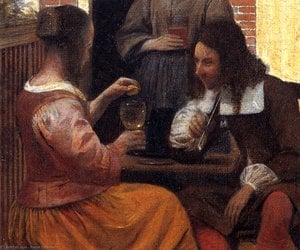
Le travail de De Hooch se caractérise par son souci du détail, son naturalisme et son utilisation de la lumière. Ses peintures représentent souvent la vie quotidienne, reflétant les valeurs et les aspirations de la classe moyenne émergente. Un exemple notable de ce style est « Le Cour de maison à Delft » (1658), qui met en valeur sa capacité à capturer les détails banals de la vie quotidienne. Le travail de De Hooch partage également des thèmes et des compositions avec Emanuel de Witte, mais son intérêt pour les personnes et leurs relations le distingue. Cela se manifeste dans « Femme allaitant » (1658) et « Femme avec un bébé sur ses genoux » (1658), qui témoignent de son intérêt pour les scènes domestiques.
Évolution artistique et influences
Au début de sa carrière, De Hooch a été influencé par le style des peintres de genre tels que Hendrick Sorgh, comme en témoigne l'utilisation de couleurs sombres et d'ambiances intérieures dans ses premières œuvres. Cependant, il a rapidement développé son propre style distinctif, caractérisé par une attention particulière à la lumière et à la perspective. Son travail montre également une influence du courant artistique italien, notamment dans sa représentation des architectures et de la décoration intérieure. De Hooch s’est distingué par sa capacité à créer une atmosphère calme et sereine dans ses peintures, capturant l'intimité de la vie domestique avec une grande sensibilité.
Œuvres notables et héritage
Parmi les œuvres les plus remarquables de De Hooch, on peut citer :
- « Le Buveur Joyeux » (vers 1650)
- « Joueurs de cartes dans une pièce ensoleillée » (1658)
- « Une femme préparant du pain et du beurre pour un garçon » (1661)
- « Femme lisant une lettre » (1664)
L'héritage de De Hooch se manifeste par son influence sur les générations d’artistes suivantes, en particulier dans les mouvements impressionnistes et réalistes. Son attention à la lumière et à l’ombre a jeté les bases de la peinture baroque.
Collections et reconnaissance
Les œuvres de De Hooch peuvent être admirées dans divers musées prestigieux, notamment :
- Le Musée royal des beaux-arts d'Anvers, en Belgique, qui possède une vaste collection d'art européen du XVe au XXe siècle.
- La National Gallery de Londres.
- Le Rijksmuseum à Amsterdam.
Son travail est aujourd’hui reconnu comme un témoignage précieux de la vie quotidienne et des valeurs de la société néerlandaise au XVIIe siècle, contribuant significativement à l'histoire de l'art européen. Il est considéré comme l'un des maîtres du genre intérieur hollandais, aux côtés de Johannes Vermeer.



 Aperçu en situation
 Passer au format impression
 Partager
 Partager
 Détails

 Télécharger
 Articles similaires
 Radiographie
 Voir le diaporama
 Statistiques


 Afficher la suite






































 L'option verre n'est disponible que pour les dimensions inférieures à 110 cm.