


Huile sur toile peinte à la main, avec cadre et dimensions personnalisés, réalisée sur commande par nos artistes. ( Commander l'impression Acheter l'image haute résolution)





























Choisissez parmi nos formats prédéfinis qui respectent les proportions originales de l’œuvre.

Vous pouvez saisir vos propres dimensions pour l'adapter à un cadre ou à un espace spécifique. Si la taille sélectionnée ne correspond pas aux proportions de l'image d'origine, nous recadrerons l'œuvre ou prolongerons la peinture avec des éléments peints à la main supplémentaires. Une maquette numérique vous sera envoyée pour approbation avant le début de la production.
Veuillez noter que l'aperçu à l'écran ne reflète pas le recadrage ou l'extension réels. Seule la maquette montrera fidèlement la composition finale.
Bien que des tailles personnalisées soient disponibles, nous vous recommandons de sélectionner une dimension dans la liste prédéfinie afin de préserver les proportions d'origine.
Livraison dans le monde entier () en 3 à 4 semaines au lieu des 5 semaines habituelles. (7 septembre). Aucun compromis sur la qualité.


Tableau no. 2 Composition no. V
Format de la reproduction
Piet Mondrian’s *Tableau no. 2 Composition no. V*, a monumental work born from the heart of early 20th-century abstraction, transcends mere representation to become a profound exploration of universal order and spiritual essence. This painting, a cornerstone of Neoplasticism – Mondrian's own revolutionary artistic doctrine – invites us into a world stripped bare of superfluous detail, revealing instead a meticulously constructed architecture of pure form and color. The canvas pulsates with an understated dynamism, a testament to the artist’s relentless pursuit of harmony through geometric reduction.
At first glance, the composition appears deceptively simple: a vast expanse of warm yellow serves as the backdrop for a brick wall rendered in varying shades of pink and ochre. However, this apparent stillness belies an intricate network of lines and squares – bold red, vibrant blue, assertive green, and resolute black – that interlock with precise geometry. These aren’t merely decorative elements; they are the building blocks of Mondrian's universe, each color carefully chosen to evoke specific emotional and spiritual resonances. The strategic placement of these primary hues creates a visual tension, a delicate balance between stability and movement, reflecting the artist’s belief in the inherent order of the cosmos.
Mondrian's artistic journey was far from instantaneous. His early works, steeped in the traditions of Dutch landscape painting – particularly reminiscent of the Hague School – demonstrate a diligent study of nature and technique. However, even within these representational pieces, a subtle yearning for simplification began to emerge. This nascent desire culminated in his embrace of Pointillism and Fauvism, movements that offered him new tools for exploring color and form. Crucially, Mondrian’s artistic vision was deeply influenced by Post-Impressionist painters like Paul Cézanne, whose emphasis on geometric structure and the underlying forms of objects paved the way for abstraction. As he himself stated, “Art is higher than reality and has no direct relation to reality.”
The influence of Cézanne is particularly evident in *Tableau no. 2 Composition no. V*. Just as Cézanne sought to capture the essence of nature through simplified geometric forms, Mondrian aimed to distill the fundamental elements of existence into a purely abstract language. This pursuit wasn’t merely aesthetic; it was driven by a profound belief that art could serve as a vehicle for expressing universal values and achieving spiritual enlightenment – a concept central to his Neoplasticist philosophy.
Each element within *Tableau no. 2 Composition no. V* carries significant symbolic weight. The yellow background represents the infinite, while the red, blue, green, and black squares embody the fundamental forces of nature – earth, sky, vegetation, and darkness. The horizontal and vertical lines, meticulously drawn, symbolize stability and dynamism respectively, creating a visual dialogue that anchors the composition. Mondrian believed that by reducing his subject matter to these essential elements, he could create a work of art that transcended individual experience and resonated with humanity as a whole.
The inclusion of a brick wall – a seemingly mundane element – adds an intriguing layer of complexity. It represents the tangible world, the realm of earthly existence, which Mondrian sought to transcend through his abstract forms. The varying shades of pink and yellow within the wall suggest a subtle tension between these two realms, hinting at the ongoing struggle between the material and the spiritual.
Piet Mondrian’s *Tableau no. 2 Composition no. V* remains an enduring testament to the power of abstraction. Its bold colors, precise lines, and profound symbolism continue to captivate viewers today. WahooArt offers meticulously crafted, hand-painted reproductions that faithfully capture the essence of this iconic masterpiece. Owning a reproduction allows you to bring this extraordinary work into your home or office, transforming any space into a sanctuary of geometric harmony and spiritual contemplation. Explore the full depth of Mondrian’s vision – and elevate your surroundings – with a stunning replica of *Tableau no. 2 Composition no. V*.


1872 - 1944 , Pays-Bas
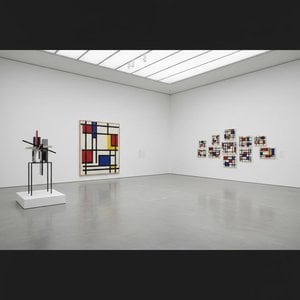
Explore the profound essence of Neoplasticism. Discover how Piet Mondrian and De Stijl masters used pure color and geometric form to redefine modern art. An essential guide for collectors seeking to understand the enduring power of abstract harmony and universal order.

Explore the profound elegance of De Stijl. Discover how Piet Mondrian and the masters of Neoplasticism utilized geometric harmony and primary colors to redefine modern abstraction. An authoritative guide for the discerning collector seeking timeless, structured beauty.

Explore the profound spiritual depth of geometric abstraction. From Malevich's Suprematism to modern masters, our expert guide reveals how pure form and color command presence in fine art collections.

 Aperçu en situation
 Envoyer
 Partager
 Détails de l'œuvre

 Télécharger
 Articles similaires
 Radiographie
 Diaporama
 Lire la suite







 L'option verre n'est disponible que pour les dimensions inférieures à 110 cm.


