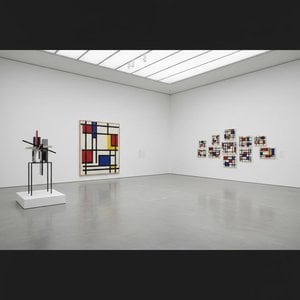
Lozenge Composition 3 Lines Blue Gray Yellow - Piet Mondrian
Piet Mondrian’s “Lozenge Composition 3 Lines Blue Gray Yellow” isn't merely pigment on canvas; it’s a declaration of artistic intent, a distillation of Neoplasticism—a philosophy Mondrian championed as the path to aesthetic purity and spiritual liberation. Emerging from the vibrant crucible of early 20th-century abstraction, this work embodies the core tenets of his movement, rejecting representational illusion for a radical simplification of form.
A Genesis in Landscape Painting
Before embracing geometric abstraction, Mondrian honed his skills as a landscape painter, influenced by the Hague School and Impressionism. Paintings like “The Red Mill” demonstrate meticulous observation of nature—the subtle gradations of color, the interplay of light and shadow—a technique he would later abandon in favor of pure visual language. Yet, even within these naturalistic depictions, hints of Mondrian’s future vision peek through: a deliberate restraint of color palettes, an awareness of compositional balance.
The Birth of Neoplasticism
Paris in 1912 proved transformative for Mondrian. Exposure to Cubism challenged his preconceptions about depicting reality, prompting experimentation with fragmentation and multiple perspectives. However, he swiftly moved beyond these influences, recognizing that true artistic expression demanded a more fundamental approach. This realization led to the genesis of Neoplasticism—a stylistic doctrine rooted in the belief that art should reflect the underlying order of the universe. Mondrian articulated this conviction powerfully: “Art is higher than reality and has no direct relation to reality.”
Decoding the Visual Vocabulary
“Lozenge Composition 3 Lines Blue Gray Yellow” exemplifies Neoplasticism’s austere aesthetic. Thick black lines delineate a network of rectangles and triangles on a predominantly white ground—a deliberate rejection of traditional perspective and ornamentation. The central lozenge shape, filled with subtle shades of gray and white, intersects these lines, creating dynamic diagonals that convey movement and balance. Mondrian meticulously reduced his artistic vocabulary to its most essential components: primary colors (red, blue, yellow), non-colors (black, white, gray), and horizontal and vertical lines—each element imbued with symbolic significance.
A Legacy of Harmony
More than just a visually striking arrangement, “Lozenge Composition” represents Mondrian’s unwavering commitment to universal harmony. It continues to inspire artists and designers today, demonstrating the enduring relevance of his vision—a testament to the transformative power of abstraction and its ability to transcend subjective emotion.



 Aperçu en situation
 Acheter la peinture faite à la main
 Partager
 Partager
 Détails
 Guide
Guide

 Télécharger
 Articles similaires
 Radiographie
 Voir le diaporama
 Statistiques

 Afficher la suite






































 L'option verre n'est disponible que pour les dimensions inférieures à 110 cm.